



Key Takeaways
What is honor roll in high school? Learn GPA requirements, tier definitions, how it's calculated, and how schools recognize students with modern display solutions.
Honor roll is one of the most recognized academic milestones a high school student can achieve, yet many students — and even school administrators — aren’t entirely clear on what it means, how it works, or what it takes to earn it. So what is honor roll in high school, exactly? At its core, honor roll is a formal recognition program that identifies students who have achieved a set grade point average threshold during a specific grading period. It’s the school’s way of saying: this student showed up, worked hard, and earned grades that place them among their school’s academic leaders.
This guide covers everything schools and students need to know — from GPA requirements and tier definitions to how honor roll is calculated and how forward-thinking schools are rethinking the way they display and celebrate these achievements.
What Is Honor Roll in High School?
Honor roll in high school is a periodic academic honor awarded to students who meet or exceed a specified GPA cutoff during a grading period, most commonly a quarter or semester. It is one of the oldest and most universally applied forms of school-based academic recognition in the United States.
The term “honor roll” itself comes from the tradition of posting a physical “roll” — a list — of honored names in a prominent school location. Though the format of recognition has evolved dramatically, the core idea remains: students who meet an academic standard deserve to be named and celebrated.
Most high school honor roll programs are re-earned each grading period. A student who makes the honor roll in the fall semester must meet the same standard again in the spring to maintain that distinction. This periodic structure means honor roll recognition reflects current, consistent achievement rather than a single strong performance.

How Honor Roll GPA Requirements Work
The specific GPA threshold for honor roll varies from school to school, but a widely used framework across American high schools looks like this:
| Recognition Tier | Typical GPA Range |
|---|---|
| Honor Roll | 3.0 – 3.49 |
| High Honor Roll | 3.5 – 3.74 |
| Highest Honor Roll / Principal’s List | 3.75 and above |
Some schools simplify this to just two tiers, while others add a Perfect 4.0 List for students who earned all A grades during the period. A few schools use a single honor roll cutoff at 3.5 or even 3.7, setting a higher bar for recognition.
Weighted vs. Unweighted GPA
Schools that offer Advanced Placement (AP), honors, or dual-enrollment courses often use a weighted GPA scale, which awards additional points for these more challenging courses (e.g., an A in an AP class might count as 5.0 rather than 4.0). Schools handle honor roll calculations differently:
- Some calculate honor roll based on unweighted GPA to maintain consistent standards regardless of course selection
- Others use weighted GPA, which can mean a student taking many AP courses reaches the honor roll threshold more easily
- A few schools require that students meet the cutoff on both weighted and unweighted scales
Understanding which calculation method your school uses is essential for knowing exactly where a student stands relative to the honor roll threshold. For a deeper look at how GPA thresholds apply beyond high school, Latin honors GPA requirements at the college level follow a similar tiered logic.
What Courses Count Toward Honor Roll?
In most high schools, every course in which a student is enrolled counts toward the GPA used for honor roll calculations — core academics (English, math, science, social studies), electives, physical education, and fine arts classes alike. This is an important detail: a strong grade in a challenging AP course and a poor grade in an elective can pull a student’s average in opposite directions.
Some schools exclude certain pass/fail courses or courses taken outside the regular GPA framework from honor roll calculations. Students who are borderline honor roll candidates should understand exactly which courses are included in the calculation so they can prioritize accordingly.
Are There Any Other Requirements?
While GPA is the defining criterion, some schools add secondary requirements for honor roll eligibility:
- No failing grades: A student cannot make honor roll with an F in any course, even if the overall GPA clears the threshold
- No Ds: Some schools require that no individual course grade fall below a C
- Attendance minimums: A small number of schools require students to meet minimum attendance standards as a condition of recognition
- Behavior standards: Certain schools factor disciplinary standing into eligibility
These additional criteria are less common but worth checking, particularly in private and charter high schools that take a more holistic view of academic standing.

Why Honor Roll Matters
Honor roll isn’t just a feel-good acknowledgment. It carries concrete benefits for students and meaningful cultural signals for schools.
For Students
College Applications: Honor roll status — particularly multiple semesters of High Honor Roll or Highest Honor Roll — demonstrates consistent academic achievement to college admissions officers. While GPA is the primary metric colleges review, a formal honor roll designation confirms that the student met a recognized standard, not just a self-reported claim.
Scholarships: Some scholarships require or give preference to students with documented honor roll achievement. Many local scholarships offered through community organizations, businesses, and foundations specifically mention honor roll standing as a criteria or tiebreaker.
Transcript Documentation: In schools where honor roll is noted on official transcripts, the recognition becomes a permanent part of a student’s academic record, verifiable by any institution that reviews it.
Personal Motivation: The periodic nature of honor roll creates natural goal-setting cycles. Students who are one semester away from earning high honor roll have a concrete target — not a vague aspiration to “do better” but a specific GPA threshold with a defined timeline.
For Schools
Academic Culture Signal: When a school celebrates honor roll consistently and visibly, it reinforces the message that academic achievement matters. Students who see their peers recognized for academic accomplishment internalize that scholarship is something their community values and celebrates — not something to downplay to fit in socially.
Data and Accountability: Honor roll participation rates over time give administrators useful data about academic trends, grade distribution, course rigor, and whether academic programs are producing the outcomes they’re designed to achieve.
Community Pride: Families, alumni, and community members take pride in schools with visible academic achievement cultures. Prominent honor roll recognition contributes to a school’s reputation as an academically serious institution — which matters for enrollment and community support alike.
Honor Roll vs. Other Academic Honors
Honor roll sits within a broader ecosystem of high school academic recognition. Understanding where it fits helps schools build comprehensive programs that celebrate diverse forms of excellence. Among the special awards available for high school students, honor roll is among the most attainable — and therefore among the most motivationally powerful.
Honor Roll vs. National Honor Society (NHS): Honor roll is automatic — meet the GPA threshold and you’re on the list. NHS is selective, requiring minimum GPA plus documented service hours, leadership experience, and faculty recommendations affirming strong character. NHS carries more weight on college applications precisely because it signals excellence beyond grades alone.
Honor Roll vs. AP Scholar: Honor roll is based on GPA across all courses. AP Scholar award recognition from the College Board recognizes students who score 3 or higher on multiple AP exams — a performance-based distinction validated externally, independent of a school’s grading standards.
Honor Roll vs. Valedictorian/Salutatorian: Honor roll is periodic recognition earned each semester or quarter. Salutatorian recognition and valedictorian status are cumulative designations awarded at graduation based on a student’s rank among their entire graduating class — the culmination of four years of academic work rather than a single semester’s achievement.
Honor Roll vs. Mu Alpha Theta: Subject-specific honors like Mu Alpha Theta, the national mathematics honor society for high schools, recognize deep excellence in a specific discipline rather than overall GPA performance. Students can earn discipline-specific honors alongside or independently of honor roll standing.

How Schools Recognize Honor Roll Students
Knowing what honor roll is in high school is only half the picture. How schools actually recognize and display that achievement determines whether the recognition has meaningful motivational impact.
Traditional Recognition Methods
The most common traditional approaches include:
Printed Lists on Bulletin Boards: Inexpensive and easy to produce, printed honor roll lists give current-period recognition but are typically taken down when the next quarter’s list goes up — leaving no permanent record and minimal lasting visibility.
Assembly Announcements: Brief public acknowledgment of honor roll recipients during school assemblies provides a moment of recognition but fades quickly from collective memory.
Honor Roll Certificates: Certificates presented to students in homeroom or at academic ceremonies provide tangible acknowledgment, but they typically end up in a drawer rather than displayed where peers, families, and visitors can see them.
Physical Plaques: Some schools invest in engraved plaques recognizing cumulative honors or NHS members. These create permanent recognition but are expensive to update, impossible to expand without renovation, and cannot include photos or narrative context.
The core limitation of all traditional methods is the same: physical space and print constraints force schools to choose between comprehensiveness and quality. A school with 300 students earning honor roll each semester cannot display all 300 names with meaningful detail on a standard bulletin board.
Modern Digital Recognition Displays
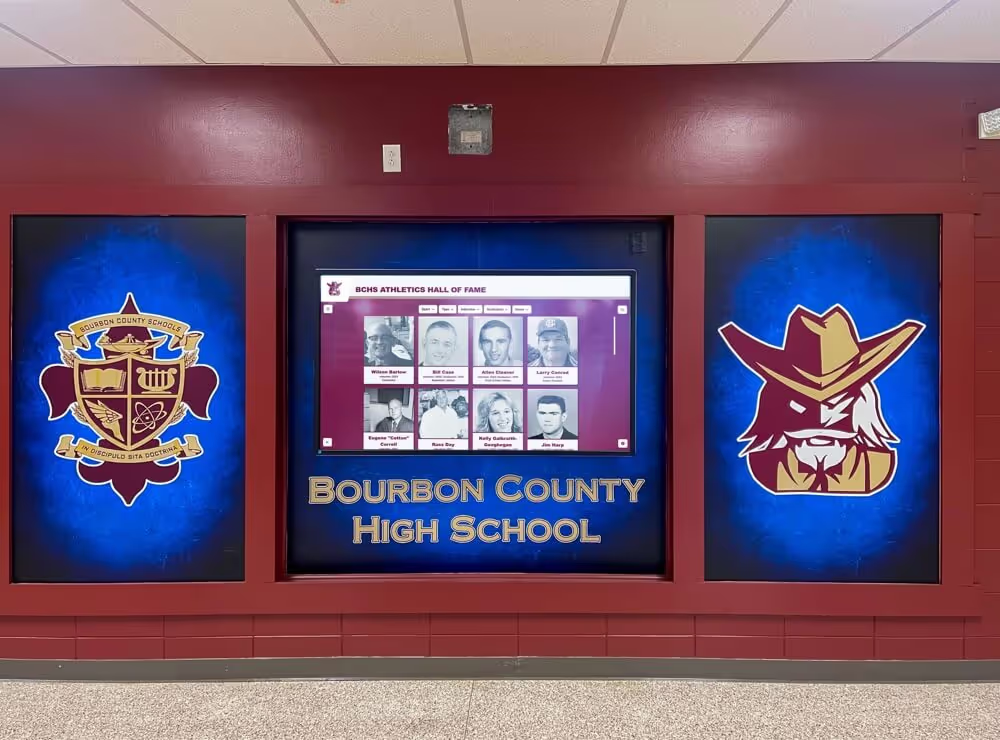
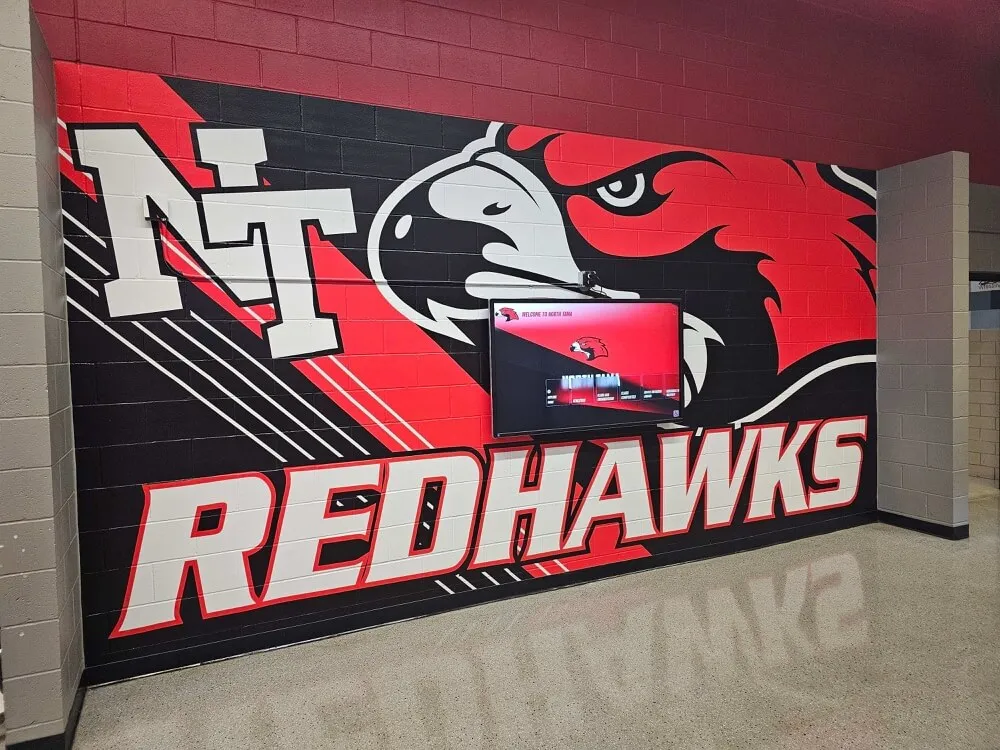
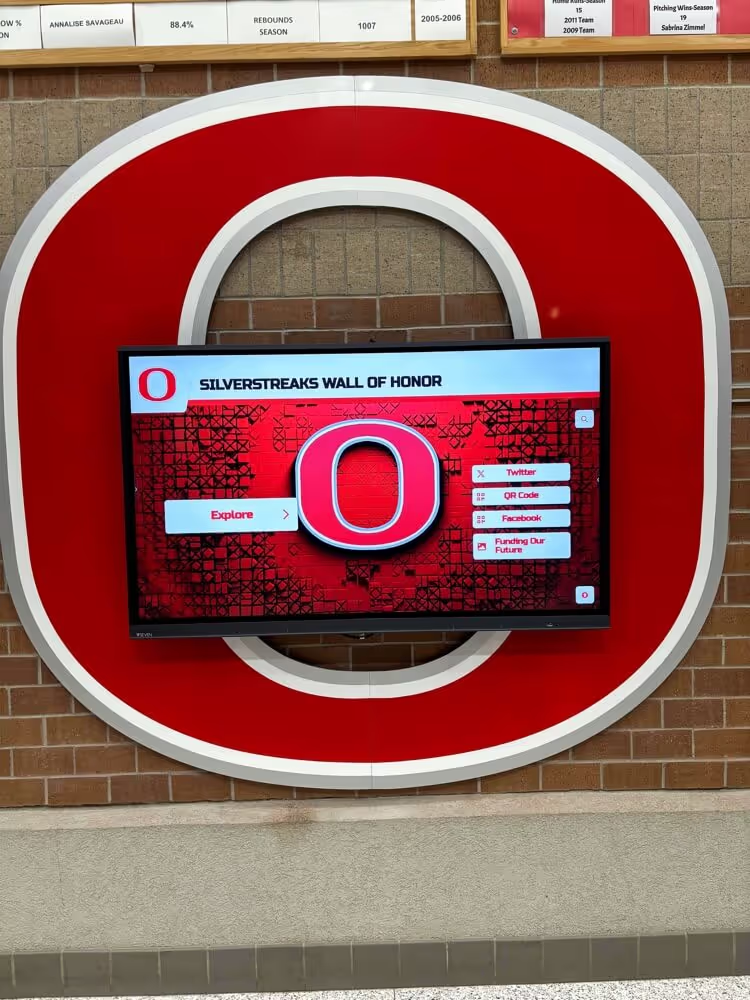
Digital recognition systems solve the fundamental constraints of traditional approaches. Schools that have invested in digital displays for academic recognition can recognize every student at every tier — not just the top performers — with rich, searchable profiles that stay current across multiple years.
Effective digital academic recognition includes:
- Student photos that make recognition personal and visible
- Achievement tier and GPA information providing specific context
- Multi-year recognition histories showing sustained achievement across a student’s career
- Searchable archives allowing students, families, and visitors to find any recipient quickly
- Seamless semester updates that refresh content when new honor roll lists are finalized
For schools building comprehensive semester recognition programs, digital platforms represent the most scalable and impactful solution — one that grows with the program rather than running out of wall space.
Where to Place Recognition Displays
Location determines how much daily cultural impact honor roll recognition actually achieves:
Main Lobby and Front Entrance: The first space students, families, and visitors encounter. Academic recognition here communicates institutional values immediately — that this school takes scholarship seriously enough to display it where everyone can see it.
Main Hallways: High-traffic routes where students pass multiple times daily provide repeated exposure to honor roll achievement. Students who see recognized peers every day internalize that academic excellence is normal and celebrated in their school.
Near Administrative Offices: Displays visible during family-school meetings create natural opportunities for counselors and administrators to reference students’ academic achievements in context.
Cafeteria and Common Areas: Social gathering spaces where students talk with peers about what they see on screens — recognition displays in these areas can spark genuine peer conversations about academic goals.

Building an Honor Roll Recognition Culture
Recognition technology is a tool. The culture around honor roll — how teachers talk about it, how administrators celebrate it, how students perceive it — determines whether the program actually drives the motivation it’s designed to create.
Integrate Academic and Athletic Recognition Together
Many schools have invested heavily in athletic trophy cases, championship banners, and wall-of-fame installations. Academic honor roll recognition deserves the same treatment. Schools that display academic honors with the same permanence and prominence as athletic achievements send a clear message: we celebrate excellence in all its forms.
Building school spirit and community depends on students seeing their school celebrate a wide range of achievements — not just sports. When honor roll students see their names displayed with the same care and visibility as athletic champions, the symbolic message is powerful: academic achievement belongs in the school’s public identity.
Connect Current Students to Academic Alumni
One underutilized dimension of honor roll recognition is the connection it can create between current students and alumni who earned similar distinctions. A touchscreen display that shows a prominent local professional or successful alum was also a multi-year honor roll recipient does something a paper list never can — it makes academic achievement feel consequential and career-connected rather than just a quarterly administrative milestone.
Alumni recognition programs that bridge current student achievement and alumni outcomes add an aspirational layer to academic recognition — proof that the habits and standards represented by honor roll designations carry forward well beyond high school.
Creating a Dedicated Academic Hall of Achievement
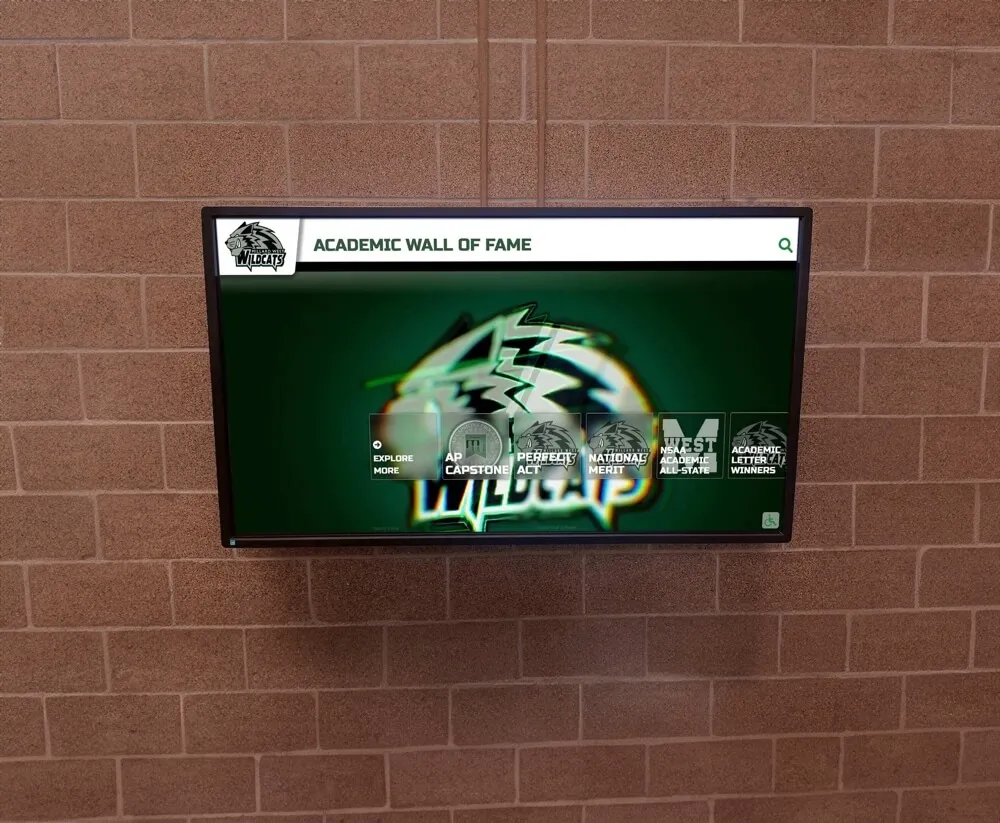
Some schools have taken academic recognition further by establishing a formal hall of achievement that permanently honors students who met the highest academic standards. This type of installation — a dedicated academic wall of fame — elevates honor roll from a periodic acknowledgment to a permanent institutional record, one that future students encounter and aspire to join.
Content for an academic hall of achievement might include:
- Students who earned honor roll every semester of their four-year career
- NHS inductees with service hours and leadership roles documented
- Valedictorians and salutatorians from each graduating class
- AP Scholar and AP Scholar with Distinction recipients
- Academic competition champions and nationally recognized scholars

Tips for Students Trying to Make Honor Roll
For students asking “what do I need to do to make honor roll in high school,” the answer comes down to a small number of consistent habits rather than last-minute cramming.
Know your school’s exact cutoff. Find out whether your school uses weighted or unweighted GPA, whether any grade floors apply (no Ds or Fs), and exactly what GPA threshold applies to each tier. Having a specific target makes it possible to calculate exactly where you stand throughout the semester.
Track your GPA before final exams. Most student information systems allow students to see their current grade in each class at any point during the semester. Calculate where your GPA will land based on current grades before finals, so you know which courses need the most attention in the final weeks.
Prioritize consistency over peaks. Honor roll requires meeting a threshold across all courses, not just excelling in one. A student with three A’s and two C’s may miss the honor roll while a student with all B’s earns it. Consistent, balanced performance across subjects is more effective than concentrating effort in a few classes.
Use available resources early. Tutoring, teacher office hours, and study groups are most effective when accessed throughout the semester rather than only in the final week. Students who identify struggles early and seek help immediately are far more likely to recover their grades in time to meet the honor roll threshold.
Set semester-by-semester goals. Because honor roll resets each grading period, every semester is a fresh opportunity. Students who missed honor roll in one semester can earn it in the next by approaching the new period with specific targets and a revised approach to their study habits.
Conclusion
What is honor roll in high school? It is one of the most meaningful and attainable academic distinctions available to high school students — a formal recognition of consistent effort and achievement that carries real consequences for transcripts, scholarships, and college applications. For schools, honor roll programs are among the most powerful tools available for building academic cultures where intellectual achievement is visible, celebrated, and aspired to.
The schools that get the most from their honor roll programs are those that treat recognition as seriously as the achievement itself: displaying student names permanently and prominently, updating recognition each semester, and giving academic honors the same visibility that athletic achievements have long enjoyed. When every student who earned a spot on the High Honor Roll sees their name in a prominent school display — not just on a bulletin board that gets replaced next quarter — the motivational signal is clear and lasting.
Ready to give your honor roll students recognition that matches their achievement? Explore Rocket Alumni Solutions to see how schools are building interactive academic recognition displays that celebrate honor roll students with the permanence and visibility they’ve earned.