



Key Takeaways
Learn what FBLA is, how Future Business Leaders of America works, what competitive events members participate in, and how schools recognize FBLA achievements with digital displays and permanent recognition installations.
Ask a high school student where the school’s biggest football wins are displayed, and they’ll point you to the trophy case or the championship banner in the gym. Ask where the student who placed second in the nation in FBLA Business Ethics is recognized, and most will struggle to answer. Future Business Leaders of America produces some of the most accomplished students in any school — students who can write a business plan, analyze a financial statement, or pitch a startup idea under competitive pressure — yet the recognition those students receive rarely matches the visibility given to athletic accomplishments. This guide explains what FBLA is, how it works, and how schools can build recognition programs that give business education the institutional standing it deserves.

What Is FBLA?
FBLA — Future Business Leaders of America — is a national nonprofit student organization that prepares high school and middle school students for careers in business and professional life. It is one of the largest student organizations in the United States, serving more than 230,000 members across thousands of chapters in all 50 states plus Washington D.C., Puerto Rico, and several international locations.
The organization was founded in 1942 with support from the U.S. Office of Education and operates today under the umbrella of FBLA-PBL, Inc. — a 501(c)(3) nonprofit. The full FBLA-PBL organization encompasses four divisions:
- FBLA-Middle Level — serving students in grades 5 through 9
- FBLA (High School Division) — the primary division for grades 9–12, encompassing competitive events, leadership programs, and chapter recognition tracks
- Phi Beta Lambda (PBL) — the collegiate counterpart for two- and four-year university students
- Professional Division — for business educators, alumni, and professionals who support the organization’s mission
When schools, parents, and students refer to “FBLA,” they almost universally mean the high school division. Chapters affiliate with their state FBLA association and with the national organization, which is headquartered in Reston, Virginia.
FBLA as a Co-Curricular Program
The characteristic that most distinguishes FBLA from a typical school club is its status as a co-curricular program. It functions as a direct extension of classroom learning in business, marketing, finance, and career and technical education (CTE) courses. A student competing in FBLA’s Accounting event is applying classroom knowledge under competitive conditions that mirror real professional environments. That distinction — applied learning, competitive testing, measurable outcomes — is why FBLA achievement deserves recognition equivalent to academic honor rolls and athletic championships.
How FBLA Chapters Are Organized
Starting and Maintaining a Chapter
FBLA chapters are established at individual schools with sponsorship from a faculty adviser, typically a business education or CTE teacher. Chapters affiliate with their state FBLA association and pay national membership dues. Once affiliated, the chapter becomes part of a structured network with access to competitive events, leadership conferences, training resources, and national program materials.
Maintaining an active chapter requires:
- A committed faculty adviser who integrates competitive event preparation into instruction and invests time outside of class in student development
- Annual re-affiliation with the state association and national organization
- Student officer leadership that manages chapter meetings, community service projects, and competitive event participation
- Minimum participation standards set by chapter bylaws, typically including attendance, academic standing, and involvement in at least one competitive event or service project each year
The quality of an FBLA chapter correlates directly with adviser engagement. Strong chapters reflect advisers who treat FBLA preparation as an extension of their teaching, not an afterthought.
Chapter Leadership Structure
Each chapter is led by a student officer team alongside the faculty adviser. Standard officer positions include:
- President — leads chapter meetings, coordinates with state and national organizations, serves as chapter spokesperson
- Vice President — supports the president and assumes leadership duties in their absence
- Secretary — manages meeting minutes, correspondence, and chapter records
- Treasurer — handles chapter finances, dues collection, and budget management
- Parliamentarian — ensures proper parliamentary procedure during meetings
- Reporter/Historian — documents chapter activities through social media, newsletters, and archives
Serving as a chapter officer is a documented leadership experience worth including in graduation recognition, college application materials, and school-wide recognition programs — comparable to serving as a student government officer or team captain.
FBLA Competitive Events: The Core of Membership
The competitive events program is the defining feature of FBLA membership and the primary source of achievements that merit formal school recognition. FBLA offers more than 70 competitive events spanning knowledge tests, performance assessments, team projects, and prejudged production submissions.
Event Categories
Individual Knowledge Events test mastery of business content areas through written examinations, covering disciplines such as:
- Accounting I and II
- Business Law
- Business Mathematics
- Computer Applications
- Economics
- Entrepreneurship
- Introduction to Business
- Introduction to Information Technology
- Marketing
- Personal Finance
- Health Care Administration
Individual Performance Events assess applied skills in live judged scenarios, including Client Service, Interview Skills, Job Interview, and Public Speaking. Students demonstrate real professional competencies in front of industry-experienced judges — not teachers grading a paper, but practitioners evaluating authentic performance.
Team Events require two or three members to collaborate under competitive conditions on projects including Business Ethics, Business Plan, E-business, Hospitality and Event Management, Marketing, Sales Presentation, and Social Media Strategies. Team events mirror actual workplace collaboration and present outcomes in front of judges who evaluate both the work product and the team’s ability to defend their decisions.
Prejudged and Production Events involve advance submission of completed projects for evaluation before the conference. These include Desktop Publishing, Digital Video Production, Graphic Design, Spreadsheet Applications, and Website Design. Production events reward technical skill alongside creativity — a student who builds a fully functional website for a local nonprofit is demonstrating capabilities that most adults in the workforce cannot replicate.
Chapter Events assess an entire chapter’s programmatic work, including the American Enterprise Project, Community Service Project, and Partnership with Business Project. These events recognize chapters — not just individual members — and celebrate collective achievement alongside individual performance.
The Four-Level Competition Ladder
FBLA competitive events follow a structured progression from local to national:
Chapter Level — Members select events, prepare with adviser guidance, and participate in preliminary internal competitions. This level builds foundational skills before external competition begins.
Regional or District Leadership Conference — The first external competition, held in fall or winter depending on the state. Top performers advance to state-level competition. Reaching the regional conference is the minimum bar for external competitive achievement.
State Leadership Conference (SLC) — Held each spring, the SLC determines state placement rankings and selects representatives for the national conference. Qualifying for the SLC is a meaningful competitive achievement — comparable to qualifying for a regional athletic tournament. Placing in the top ten is a distinction that belongs in any school’s academic recognition program.
National Leadership Conference (NLC) — Held each June, the NLC brings together top state competitors from across the country. National finalists and champions are determined here. A student who places at the national level has outperformed the best business students from every state in the country. That achievement deserves permanent, high-visibility recognition.
Understanding this ladder allows school administrators and recognition coordinators to calibrate acknowledgment appropriately. State qualifiers should receive formal recognition; national competitors warrant the highest level of permanent display visibility a school can provide.
FBLA Awards and Individual Honor Programs
Beyond competitive event placements, FBLA maintains formal award programs that carry genuine weight with college admissions offices and employers.
Who’s Who in FBLA is one of the most prestigious individual recognitions the organization awards. Recipients are outstanding seniors who demonstrate exceptional FBLA participation, academic achievement, leadership, and community service. Honorees are recognized at the National Leadership Conference and represent a small percentage of total membership.
Business Achievement Awards (BAA) recognize members who develop business competencies through a four-level program: Advocate, Achiever, Leader, and America’s Leader. Each level requires documented completion of progressively complex business activities — reading, writing, research, community engagement — outside of formal competitive events. Students who complete all four levels demonstrate sustained initiative and self-directed learning that employers value highly.
American Enterprise Award recognizes members who demonstrate strong understanding of the American economic system alongside FBLA engagement and academic performance. The award connects business education to civic and economic literacy in a way that resonates across academic disciplines.
Gold Seal Chapter of Merit is the highest chapter-level distinction in FBLA, awarded to chapters that meet comprehensive standards across membership growth, competitive participation, community service, and chapter management quality. A chapter that earns Gold Seal status over multiple consecutive years is building an institutional record worth celebrating alongside athletic dynasty records and academic department achievements.
The FBLA Recognition Gap — and Why It Costs Schools
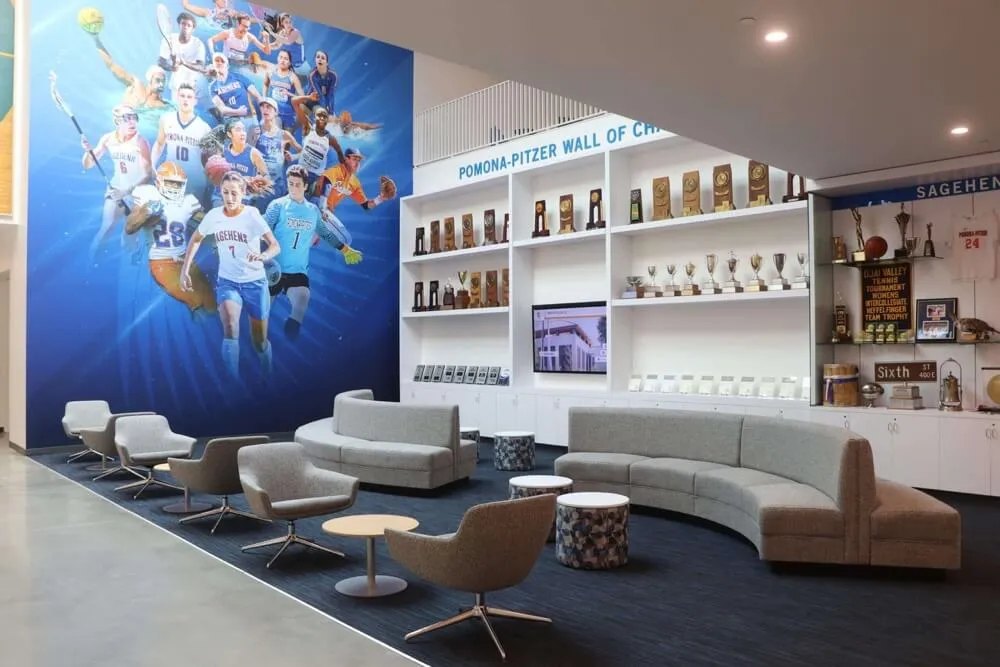
Walk through most high school lobbies and hallways, and the recognition infrastructure tells a clear story about institutional values. Athletic trophies occupy illuminated cases. Championship banners hang from gymnasium rafters. NHS induction ceremonies draw community audiences. These programs deserve their recognition — but their visibility stands in sharp contrast to what FBLA members typically receive.
A student who qualifies for the State Leadership Conference in Business Ethics — competing against hundreds of students from across their state — may receive a brief announcement and a congratulatory post on social media. A student who reaches the National Leadership Conference final round may receive a certificate and a mention in the next school newsletter. The recognition ends there, and next year the achievement has no permanent home in the school’s physical environment.
This gap has real consequences:
Enrollment impact: When students see which achievements earn public celebration, those achievements attract more participants. Schools with visible FBLA recognition consistently see stronger chapter participation and higher CTE enrollment. Recognition functions as programmatic infrastructure, not just ceremony.
Adviser recruitment and retention: Skilled business educators are attracted to programs that receive institutional support. Visible recognition signals that administration values the program, which helps attract and retain advisers who make chapters competitive.
College application support: When FBLA achievements have permanent visibility in a school’s recognition displays, they carry stronger institutional weight in letters of recommendation and college interviews. An adviser who can point to a display showing a student’s place in the school’s history tells a more compelling story than one who can only reference a certificate.
Community and alumni relationships: Business professionals who graduated from schools with strong FBLA programs — and can see those programs recognized alongside athletic traditions — are more likely to engage as mentors, judges, and sponsors. Visible recognition creates connection points for alumni involvement.
Academic achievement recognition programs work best when they encompass every form of distinction a school values — including career and technical education accomplishments that too often get treated as secondary to athletic and traditional academic honors.
How Schools Currently Recognize FBLA Members
Immediate Recognition Strategies That Work
Schools don’t need major budget investment to begin closing the FBLA recognition gap. Several low-cost strategies have immediate impact:
Named announcements after every conference. Specificity matters: “Fourteen FBLA members qualified for the State Leadership Conference, including three who placed in the top ten: Maya Chen in Entrepreneurship (4th), Jordan Williams in Website Design (7th), and Darius Thompson in Public Speaking (9th)” communicates genuine achievement. Generic congratulations do not.
Graduation program recognition sections. Adding a formal FBLA section to graduation programs — listing state qualifiers, national competitors, Who’s Who recipients, and chapter officers alongside NHS members and AP scholars — communicates that the school values FBLA accomplishment at the same institutional level as academic and leadership honors.
School social media with specifics. Posting individual recognition after State and National Leadership Conferences, with photos and specific achievement details, gives FBLA members the same social visibility that athletic teams receive after wins. Schools that post after every basketball game owe FBLA milestones the same treatment.
Morning announcements. Including FBLA achievements in regular school communications — not only during career and technical education awareness weeks — normalizes business education as a high-status school activity.
Year-end banquets. End-of-year recognition banquets that formally honor FBLA achievers alongside athletic and academic award recipients communicate equity across programs — a clear signal that administration values business education as a genuine school priority.
Physical Display Options
Schools building permanent FBLA recognition typically start with:
- Dedicated trophy case space for chapter awards, state plaques, and conference recognition hardware
- Framed photo galleries from State and National Leadership Conferences showing students in professional environments
- Wall-mounted achievement lists naming state qualifiers and national competitors by year and event
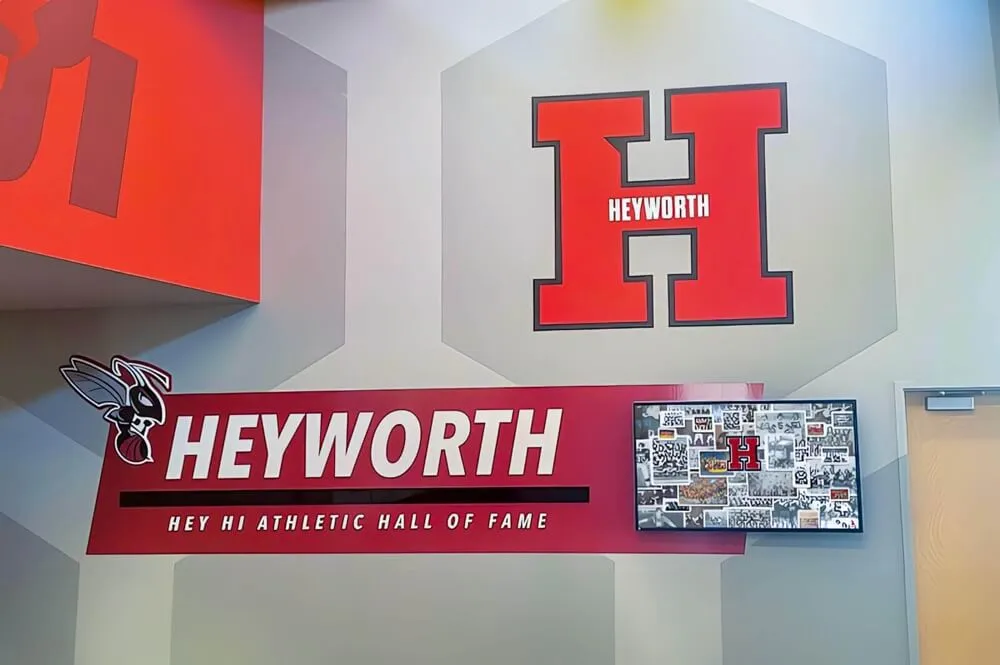
These physical displays have genuine value — they’re permanent, visible, and require no ongoing technology investment. But they come with constraints that compound over time. Physical displays fill up. Adding new sections requires fabrication and installation costs. Historical records from ten or fifteen years ago compete for space with current achievers. Schools with multiple active CTE programs competing for the same corridor wall space face difficult prioritization decisions that no one wins.
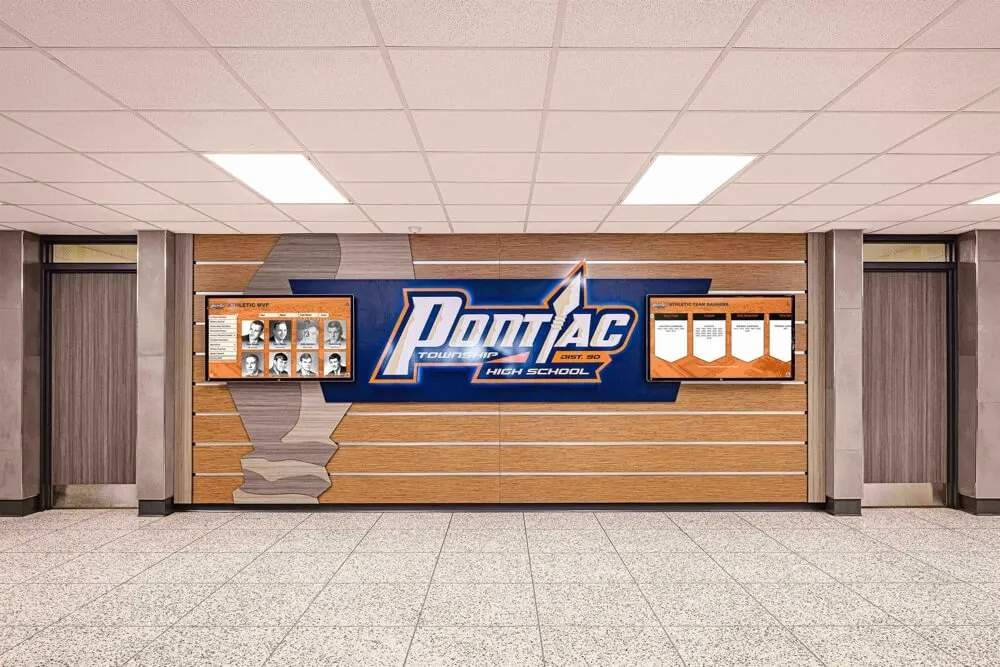
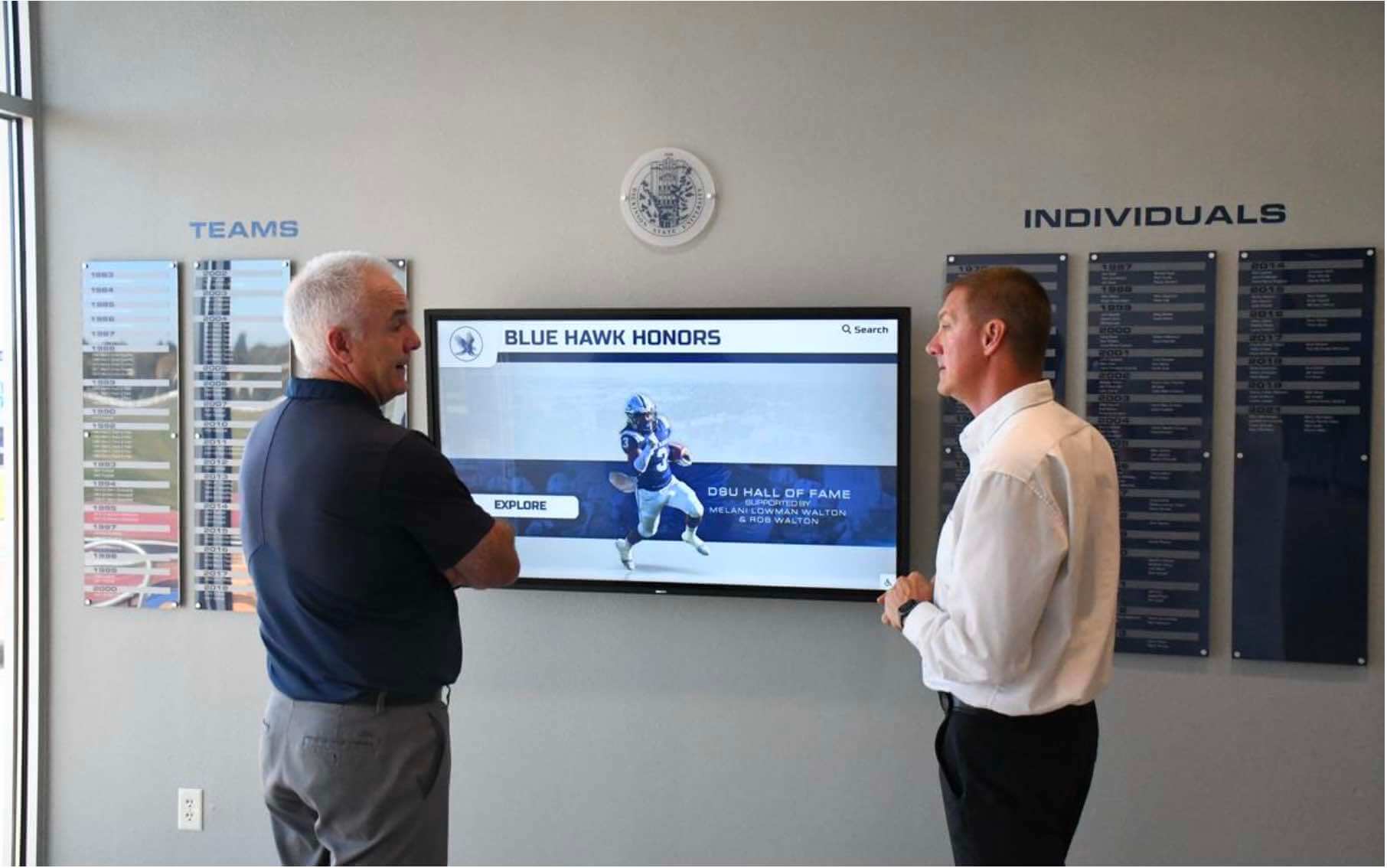
Digital wall of honor plaques offer a hybrid approach — combining the physical permanence of a mounted installation with the dynamic content capabilities of digital systems, allowing schools to update recognition content without replacing hardware.
Digital Displays for FBLA Chapter Recognition
How Interactive Touchscreen Systems Work
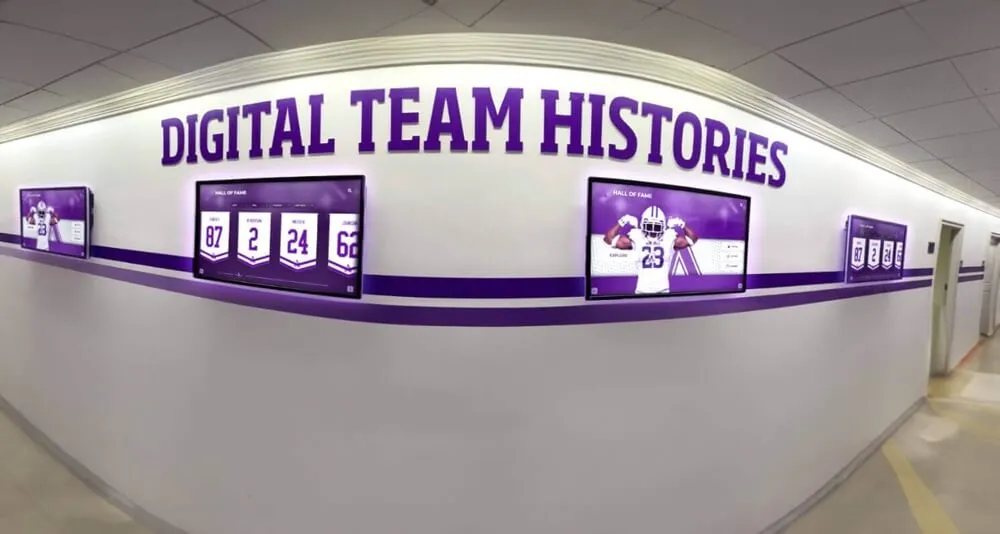
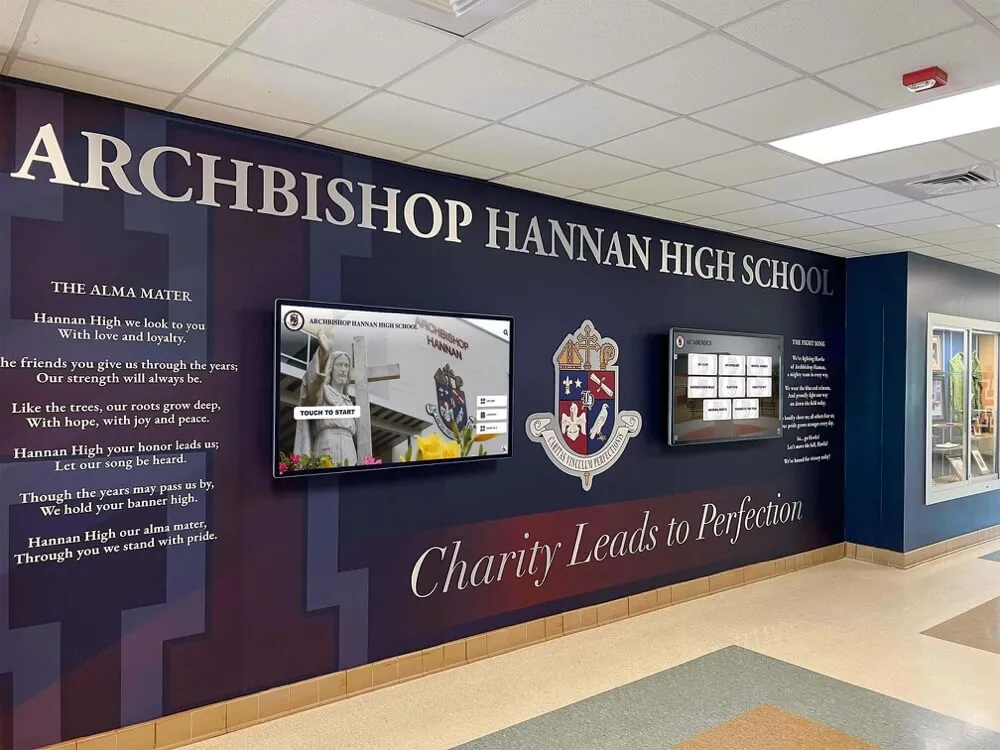
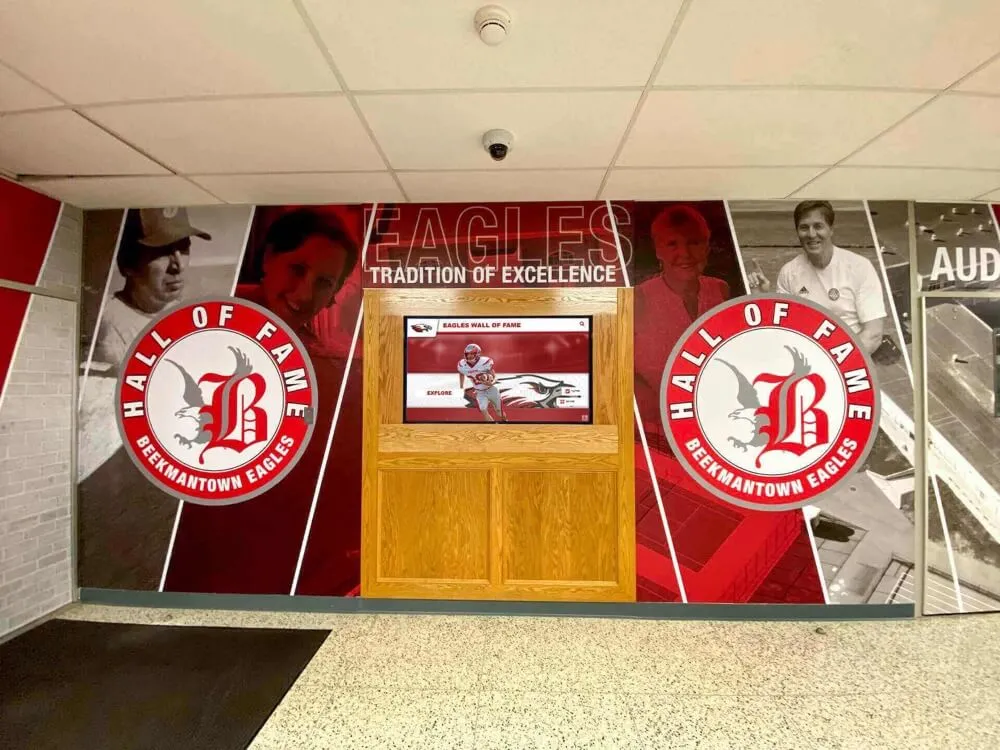
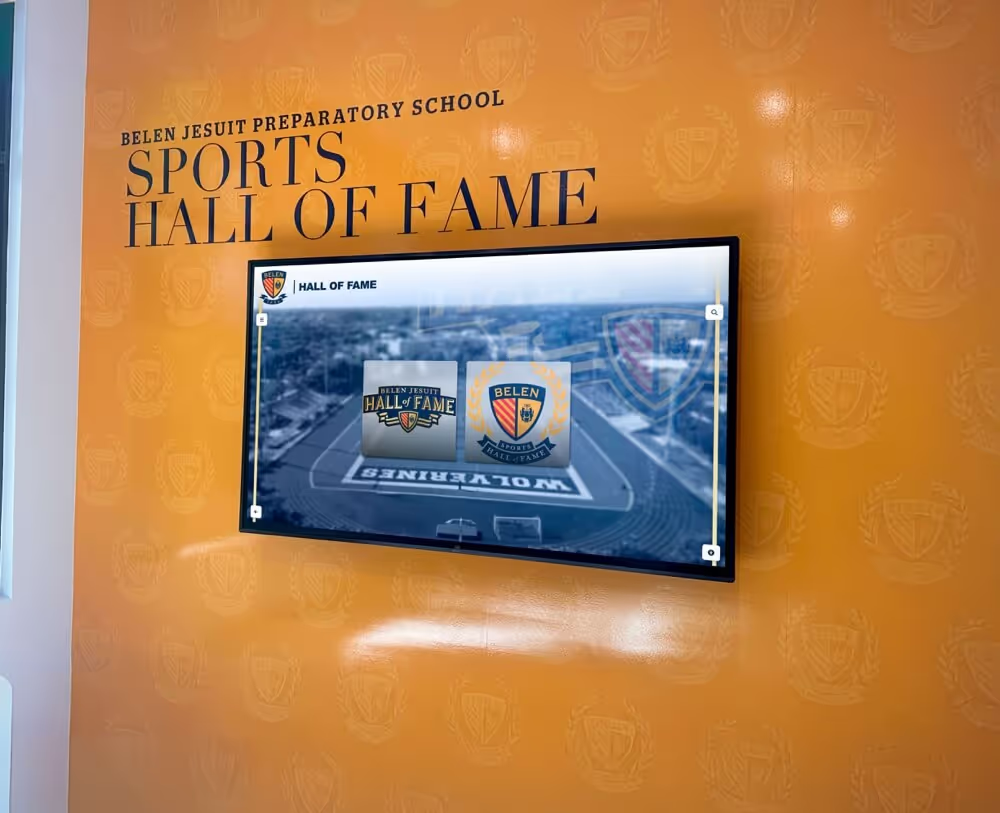
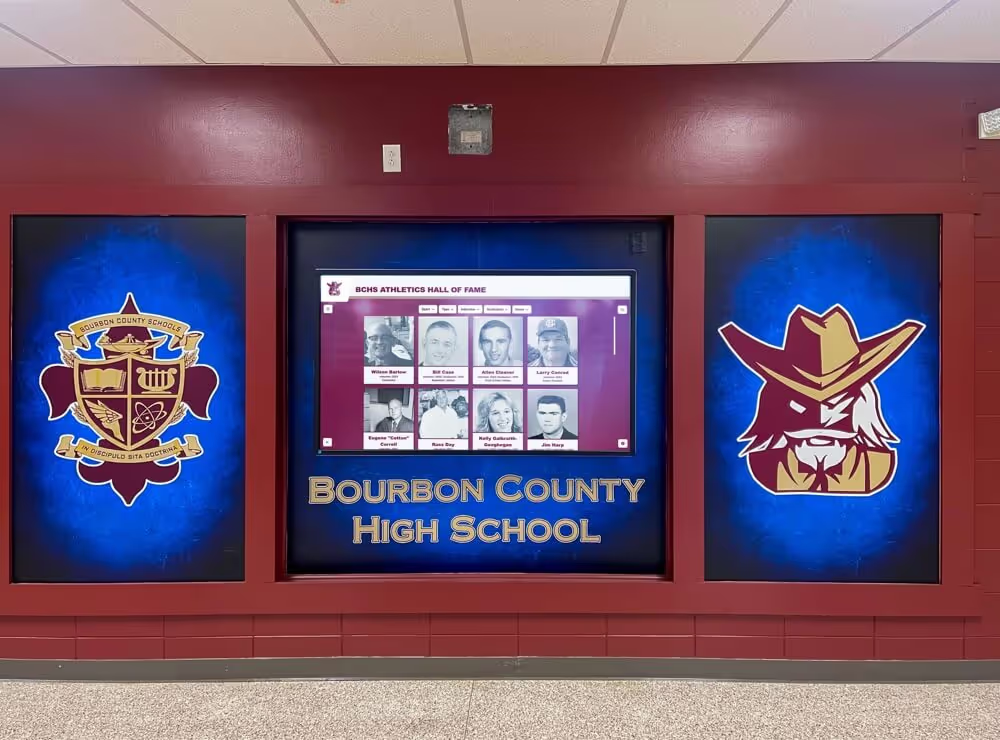
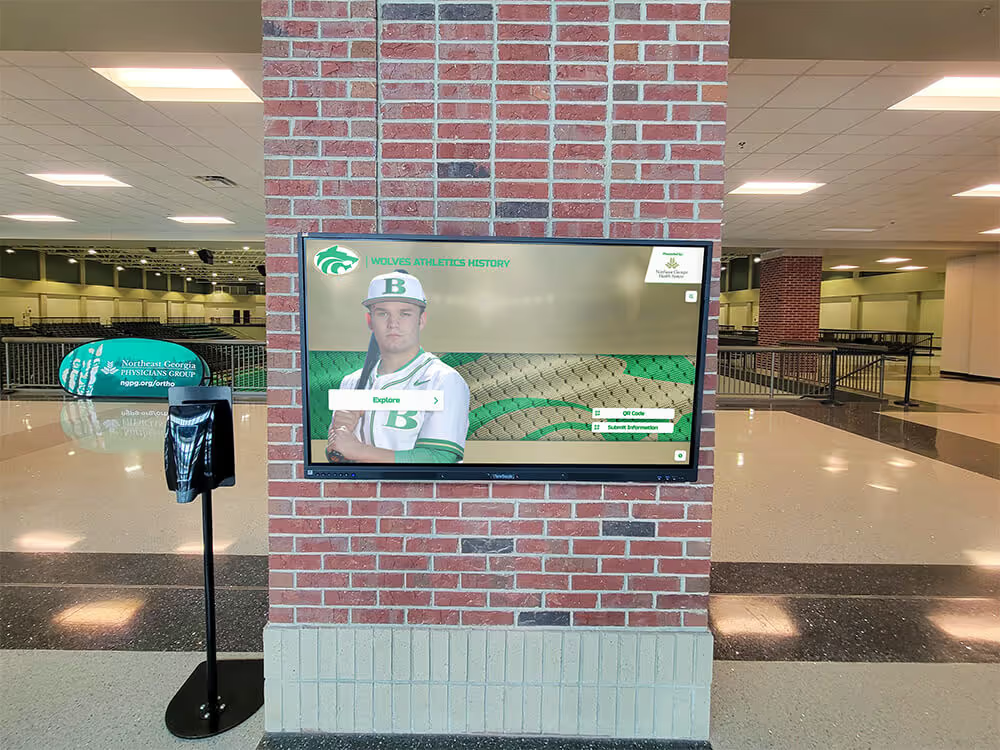
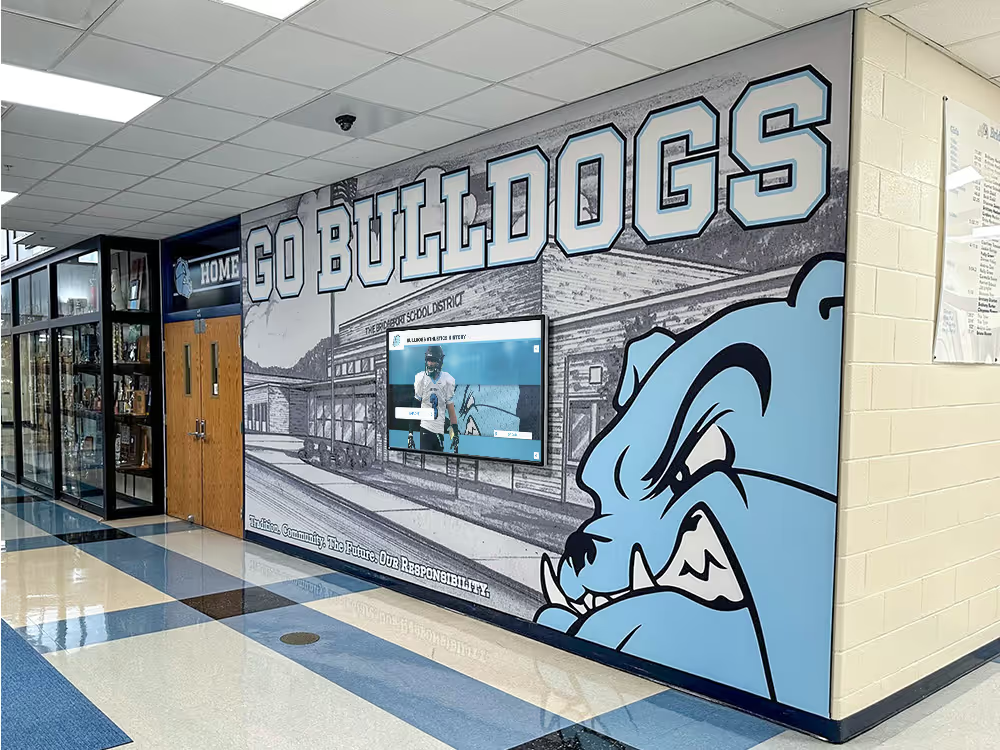
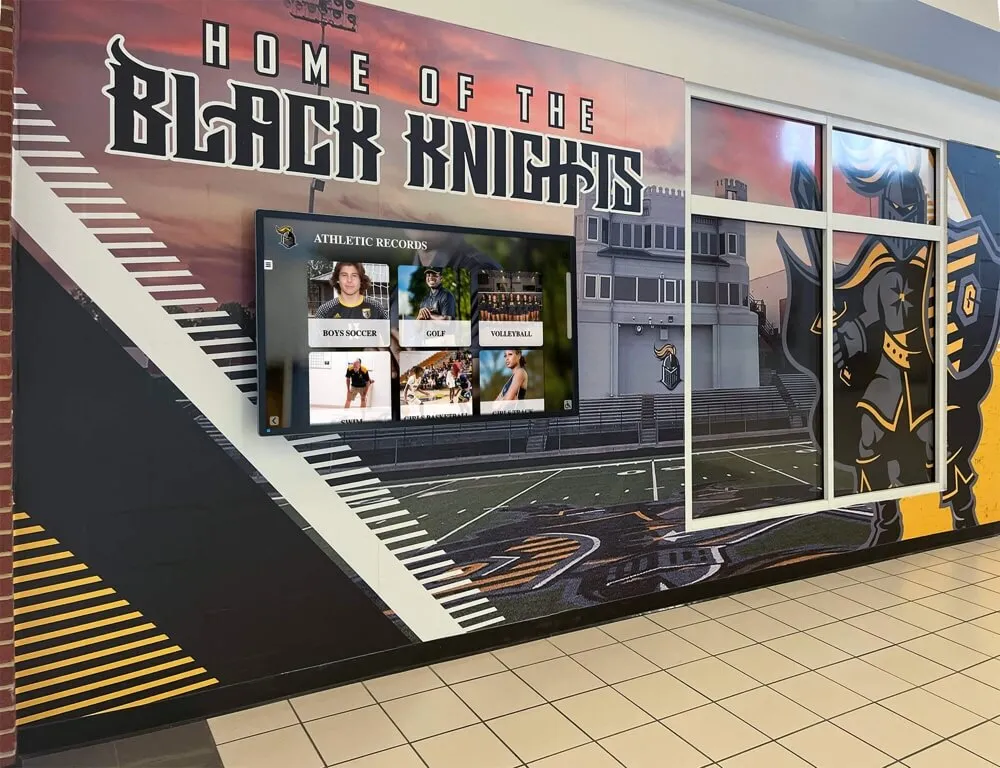
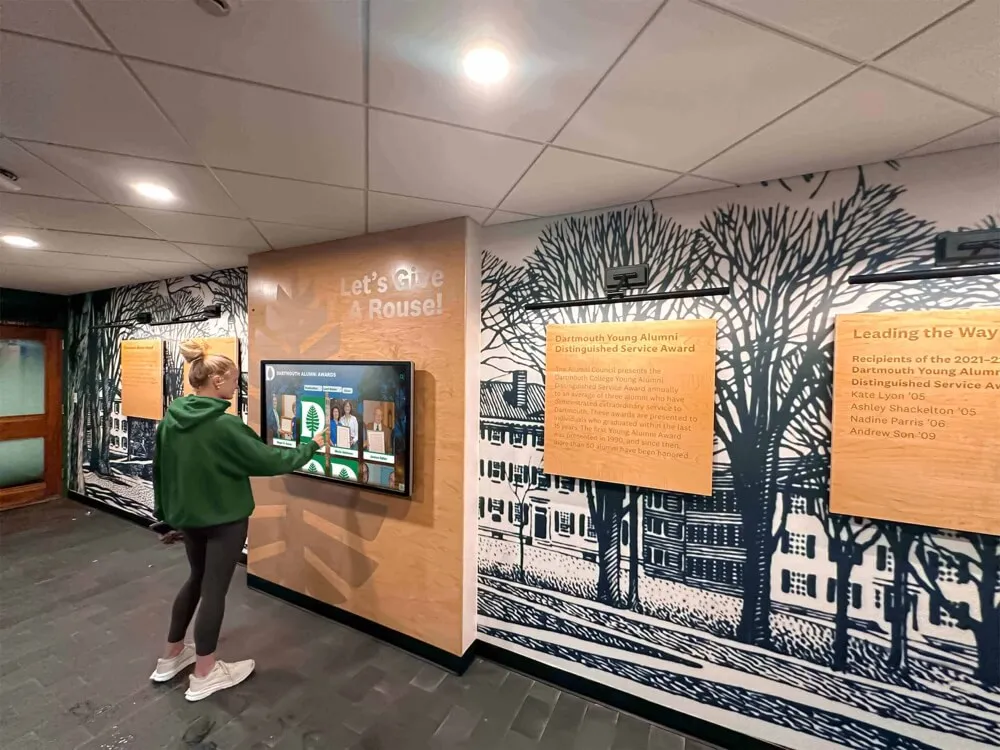
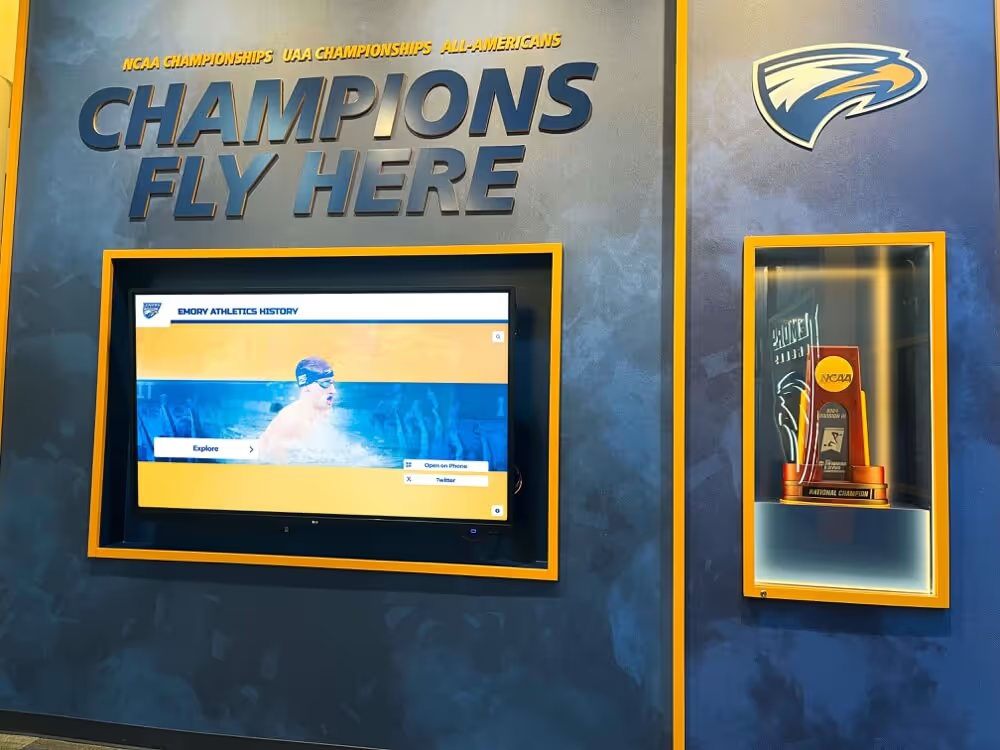
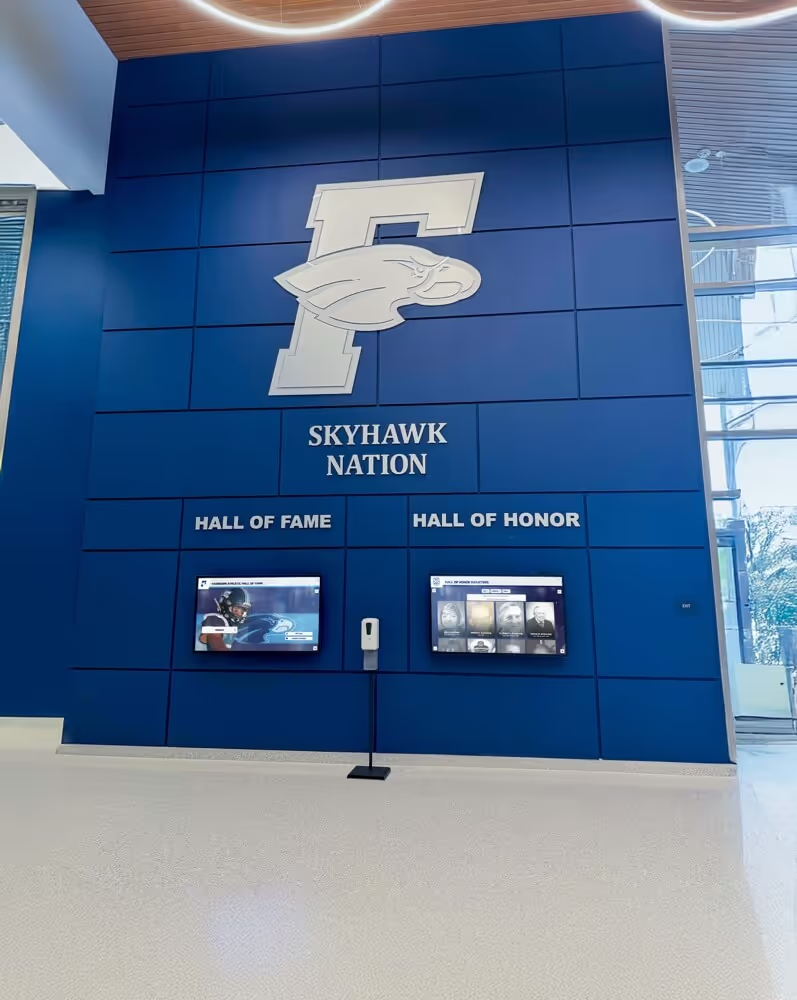
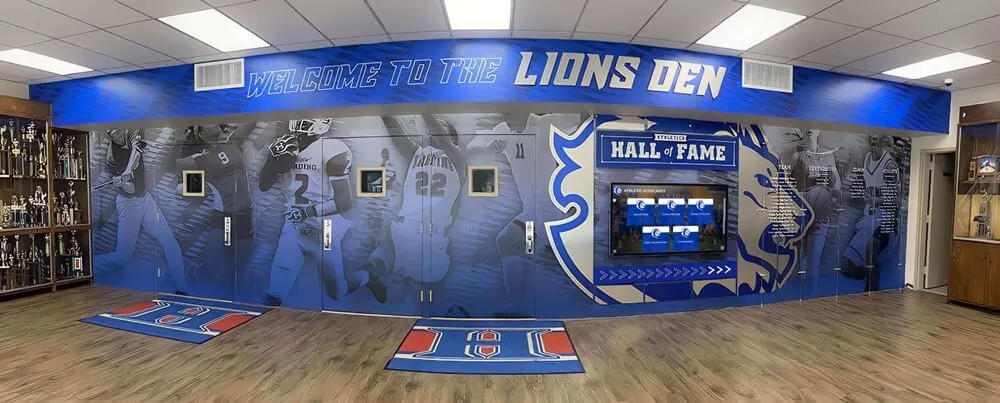
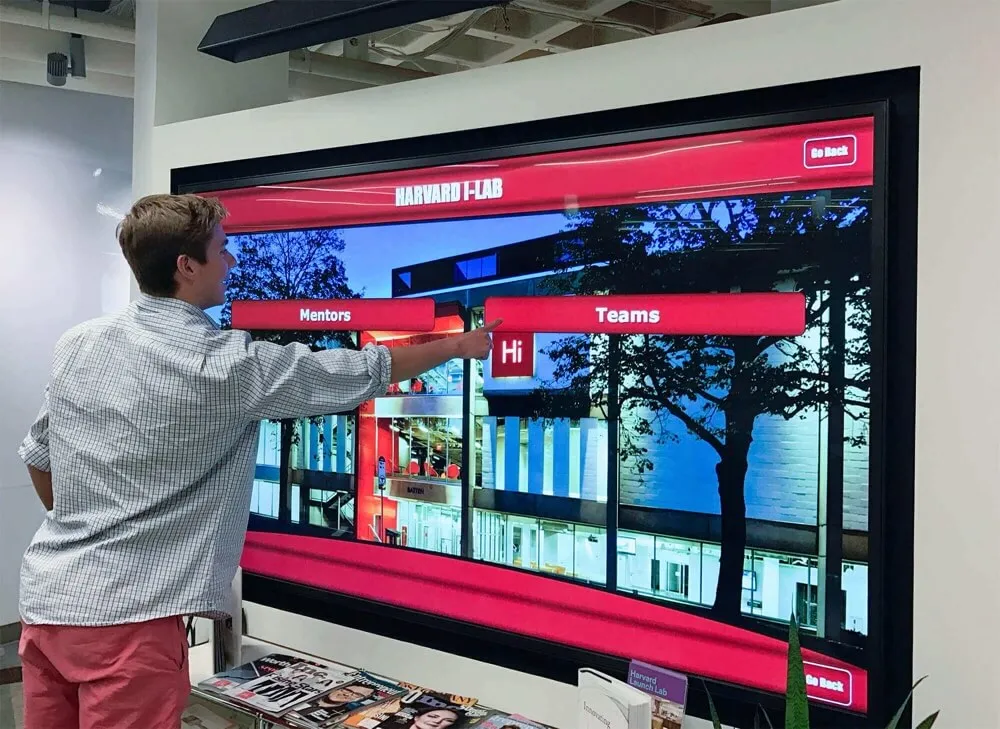
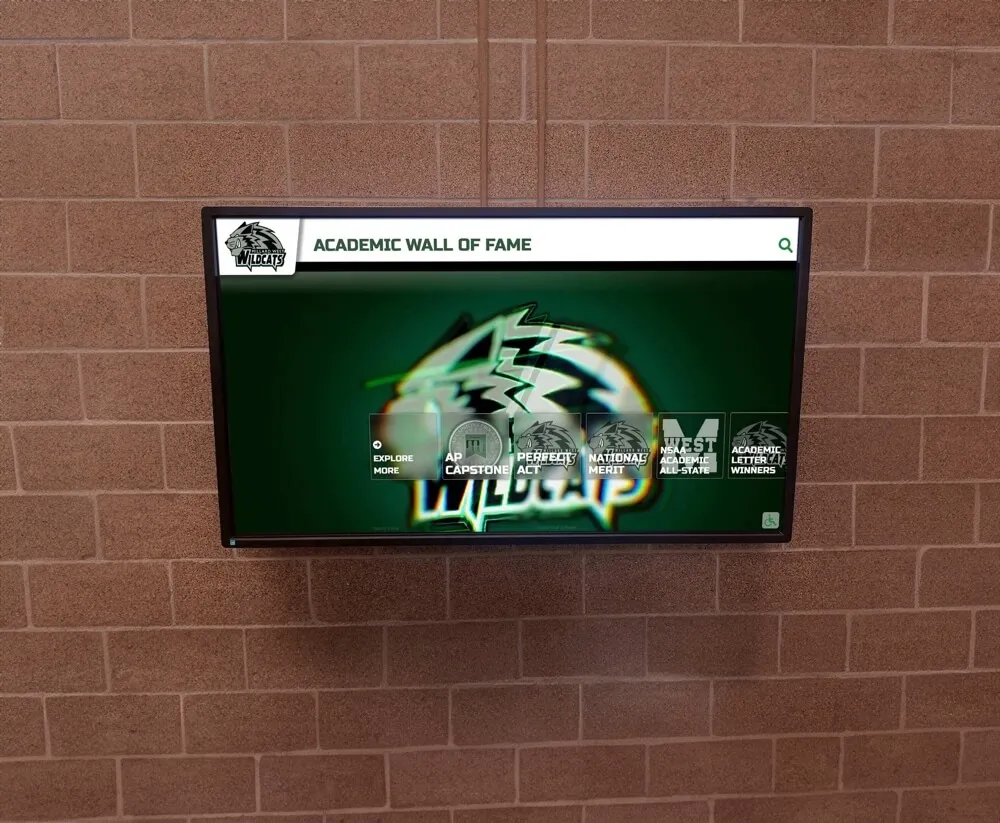
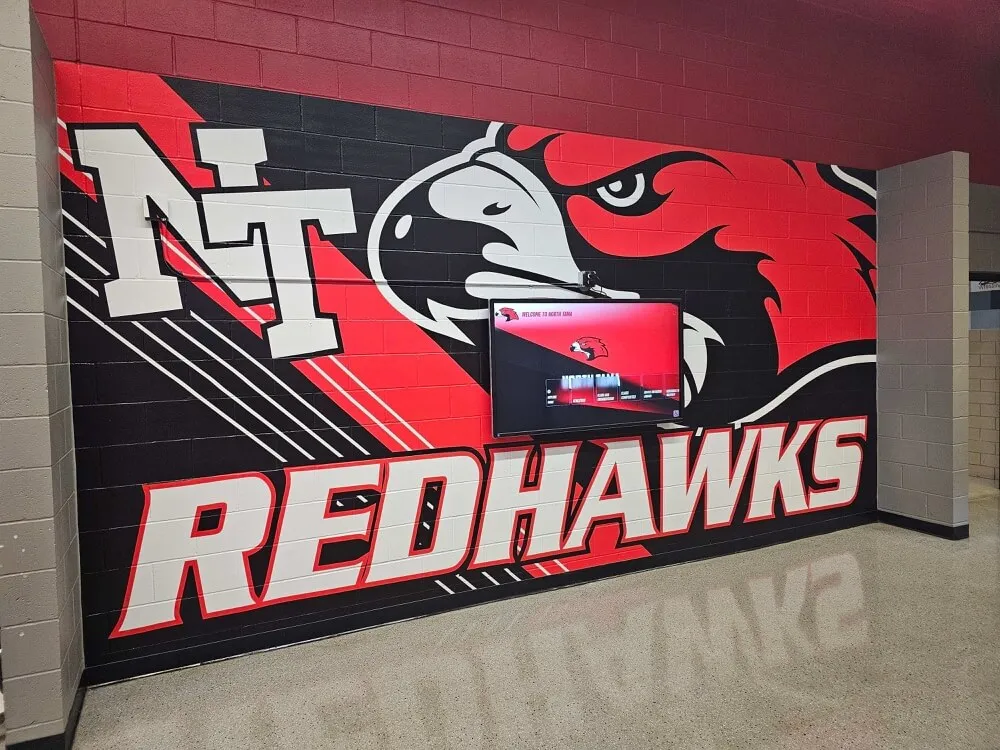
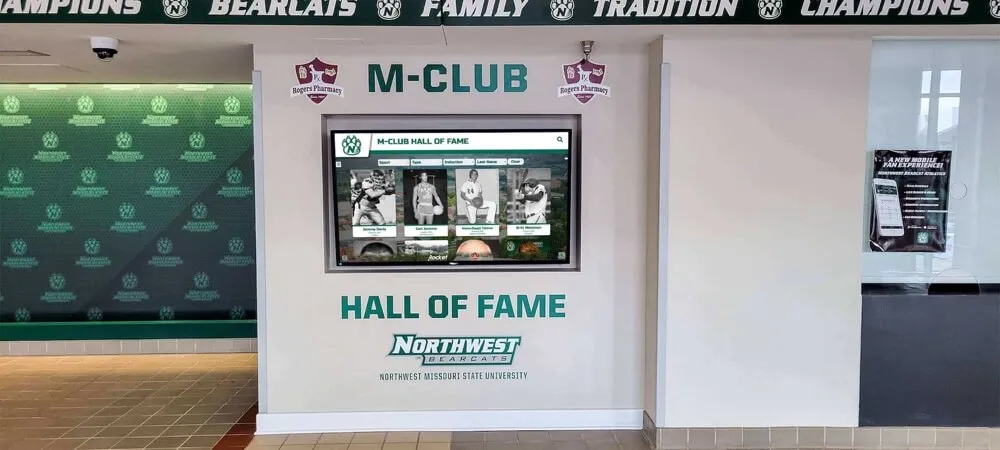
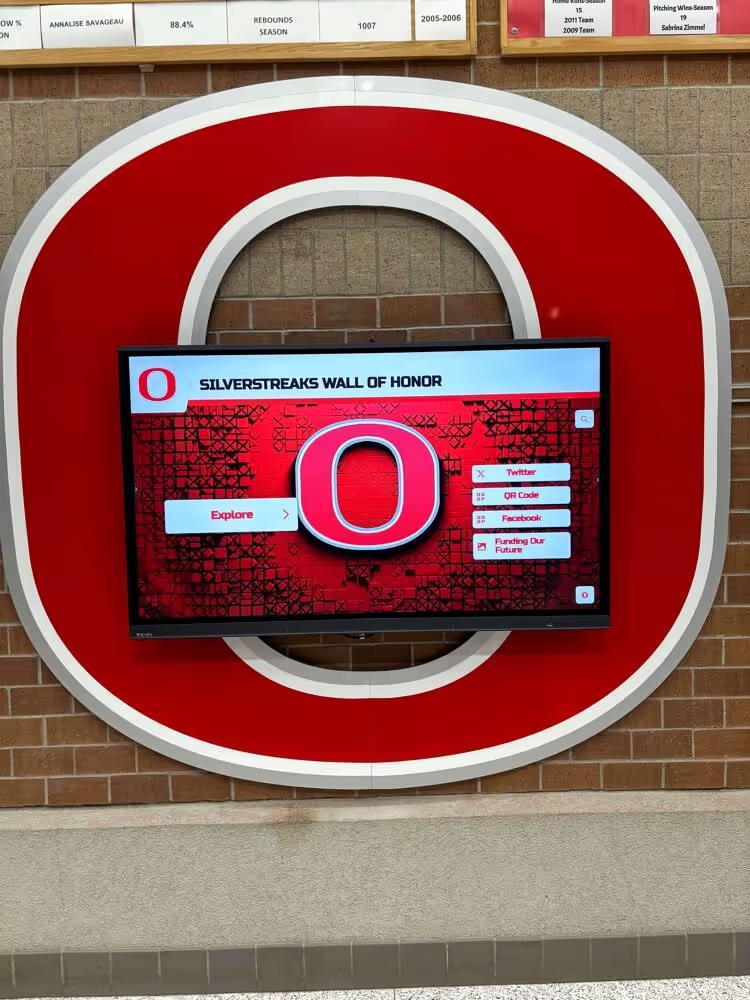
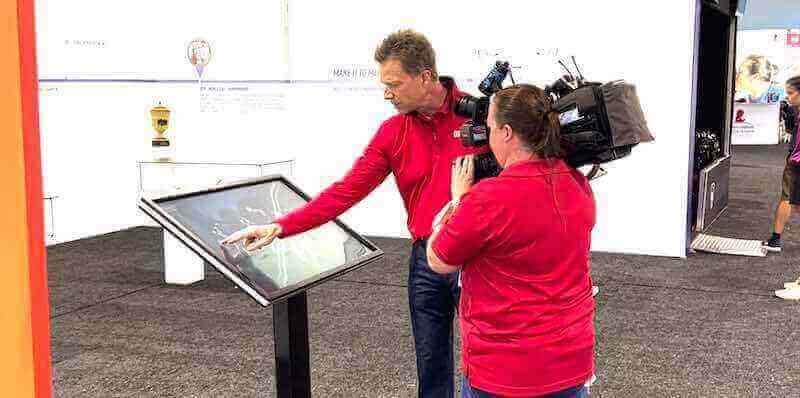
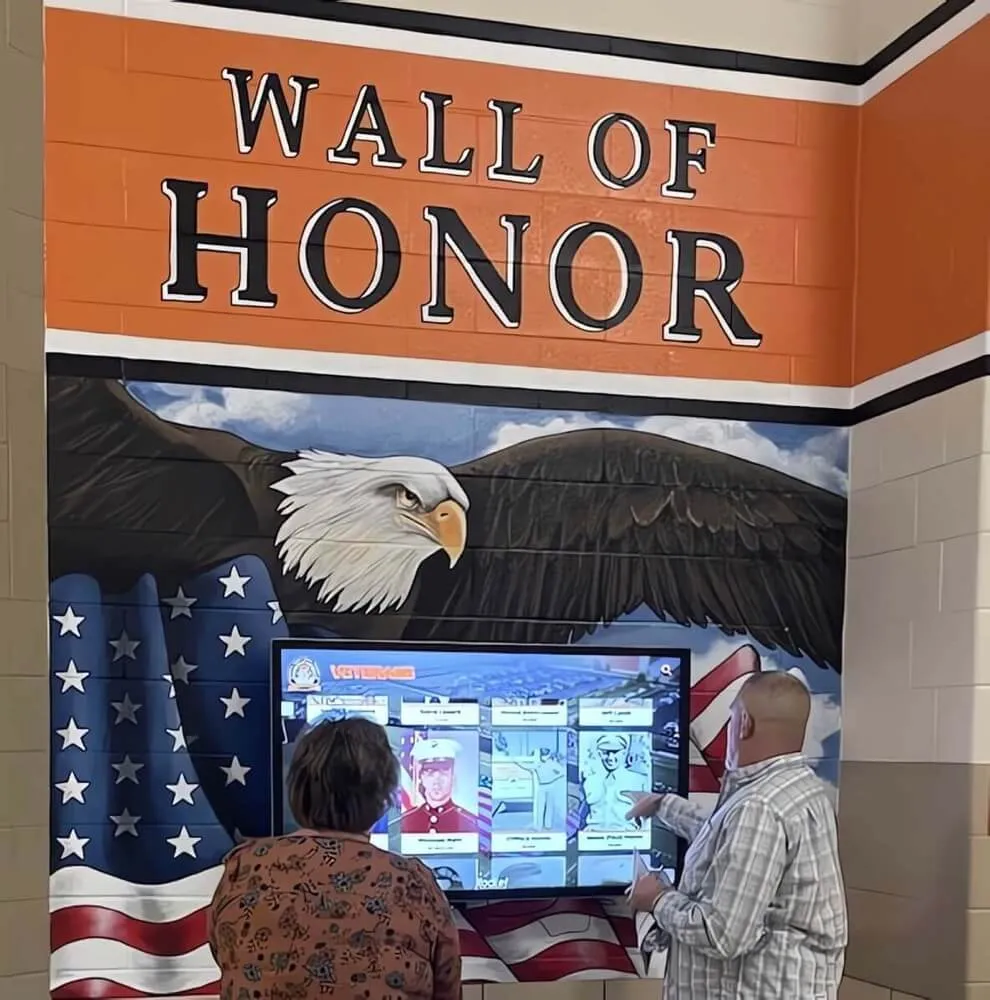
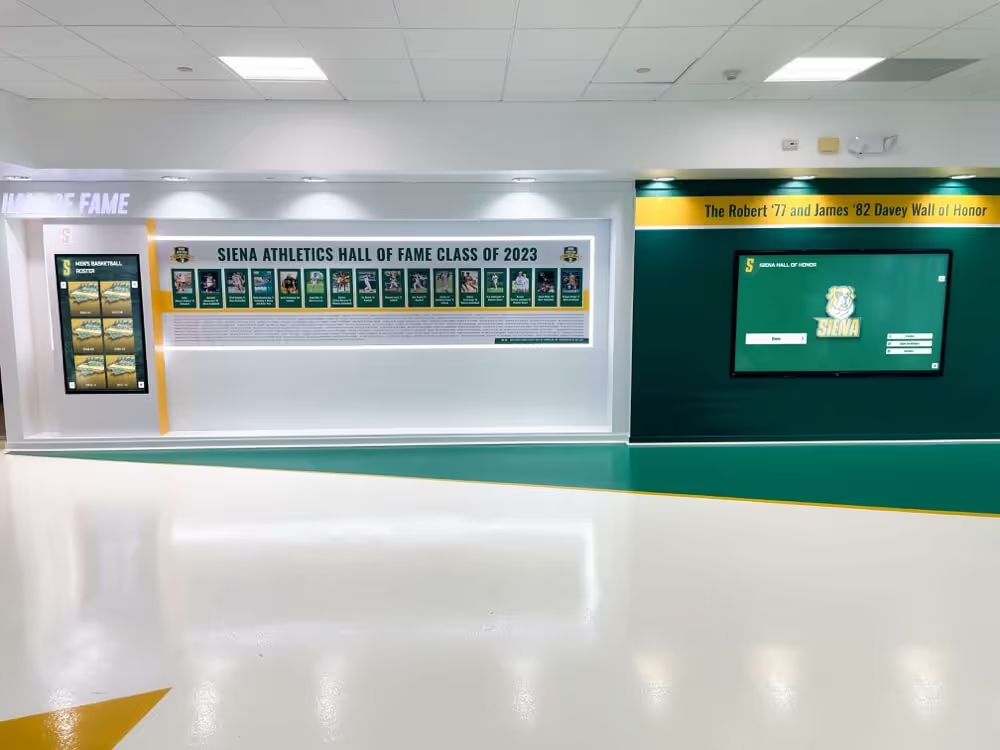
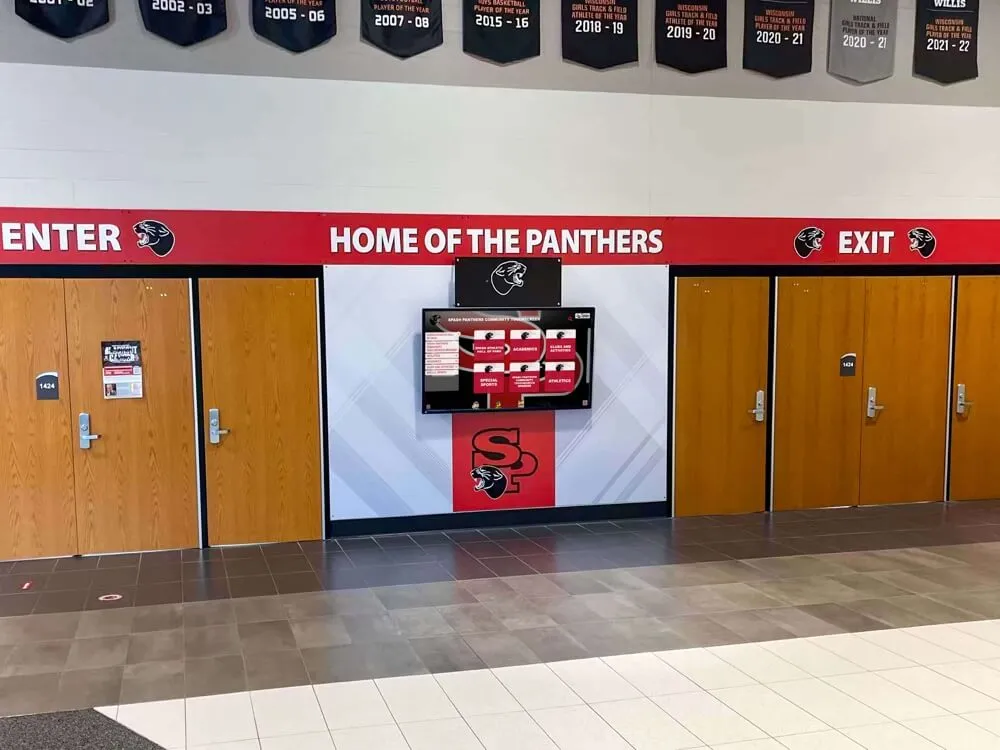
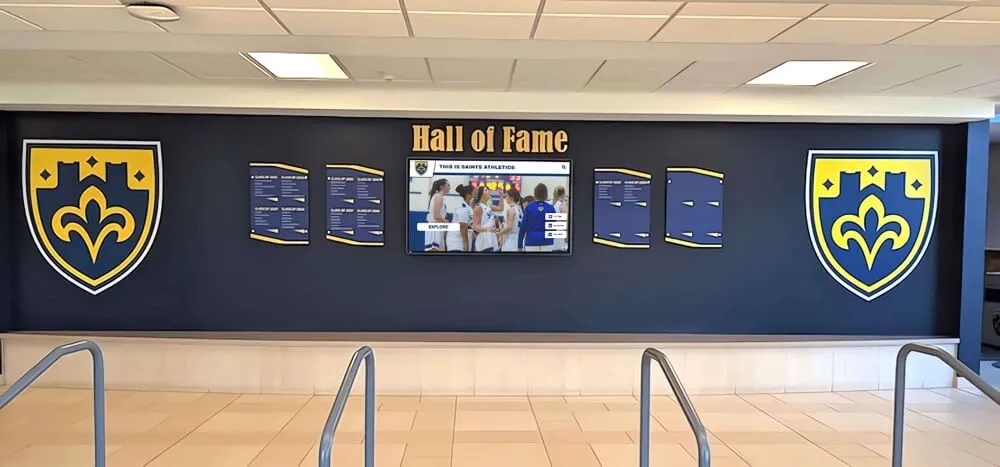
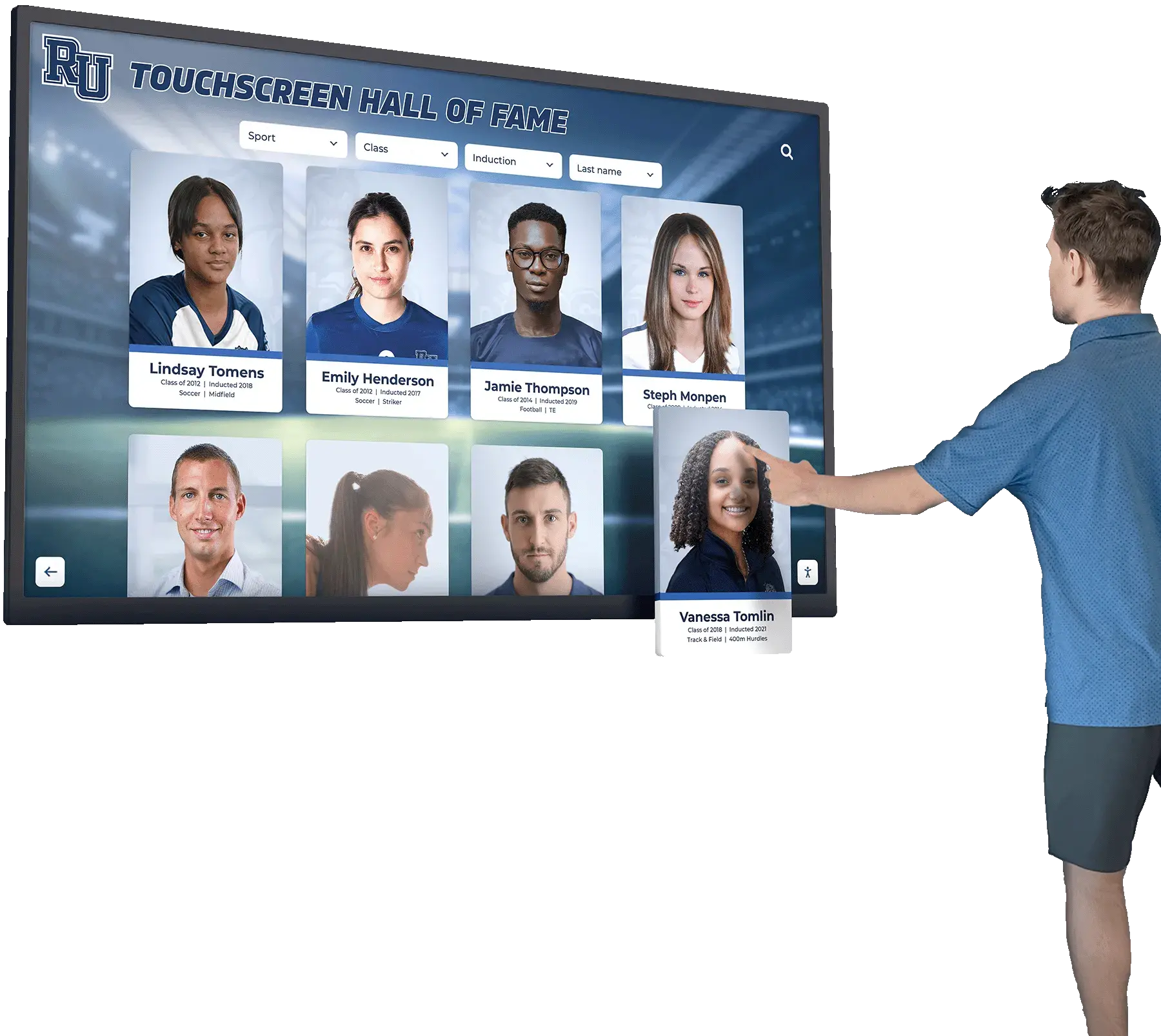
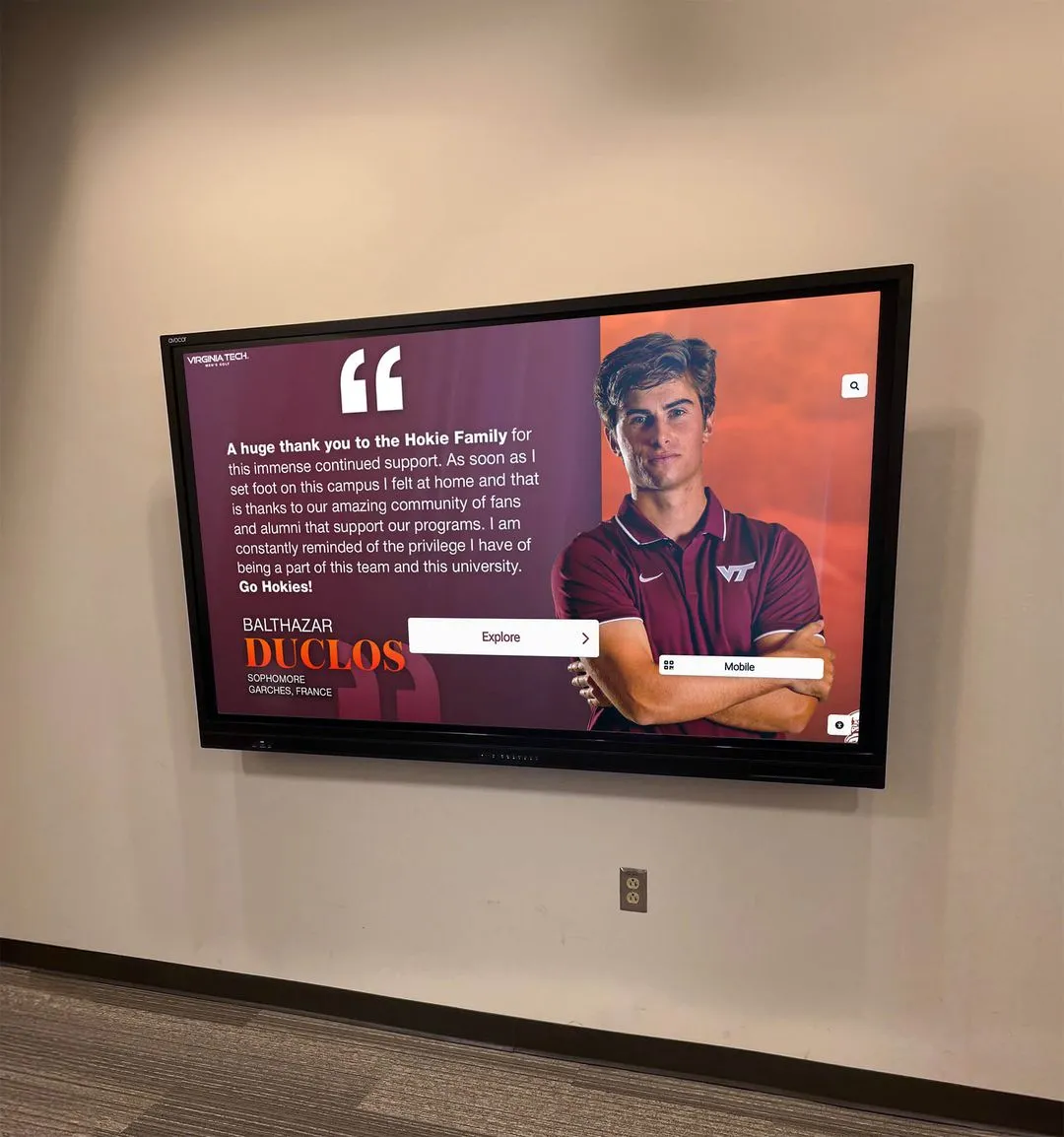
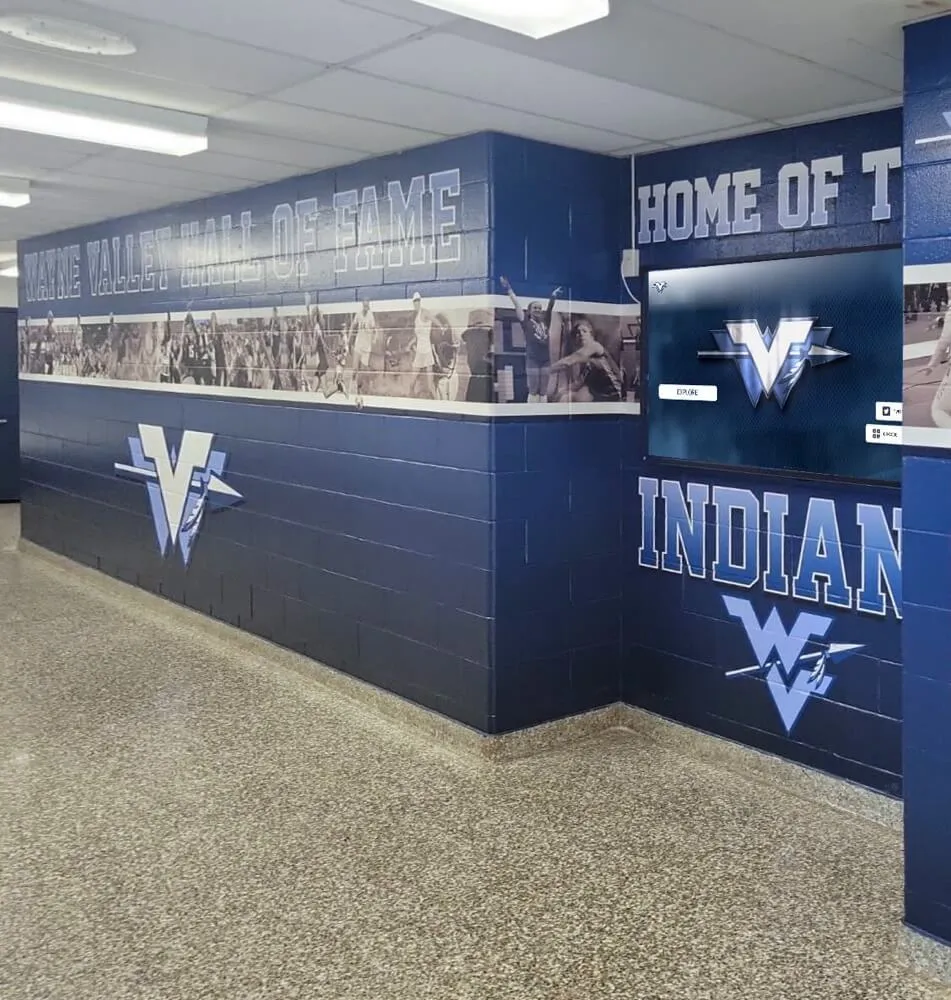
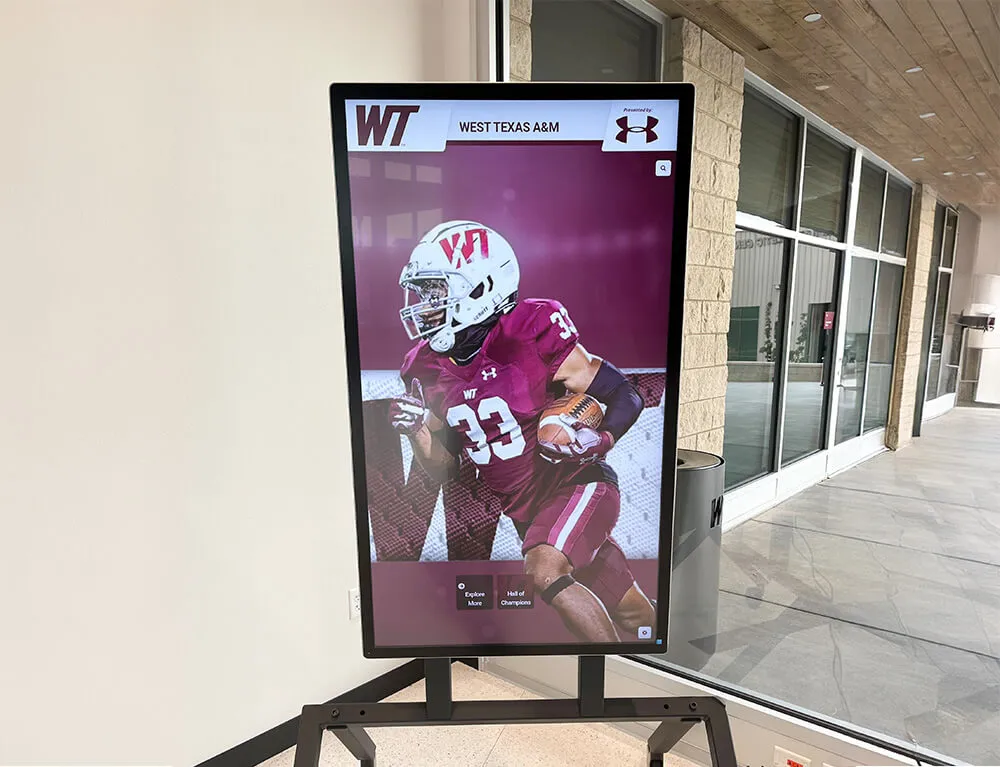
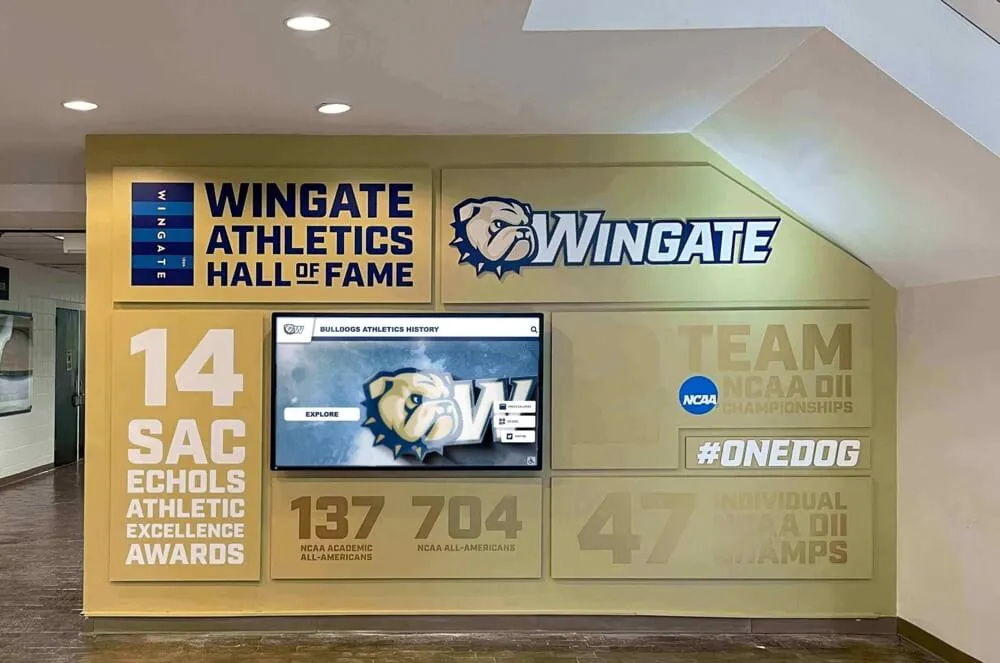
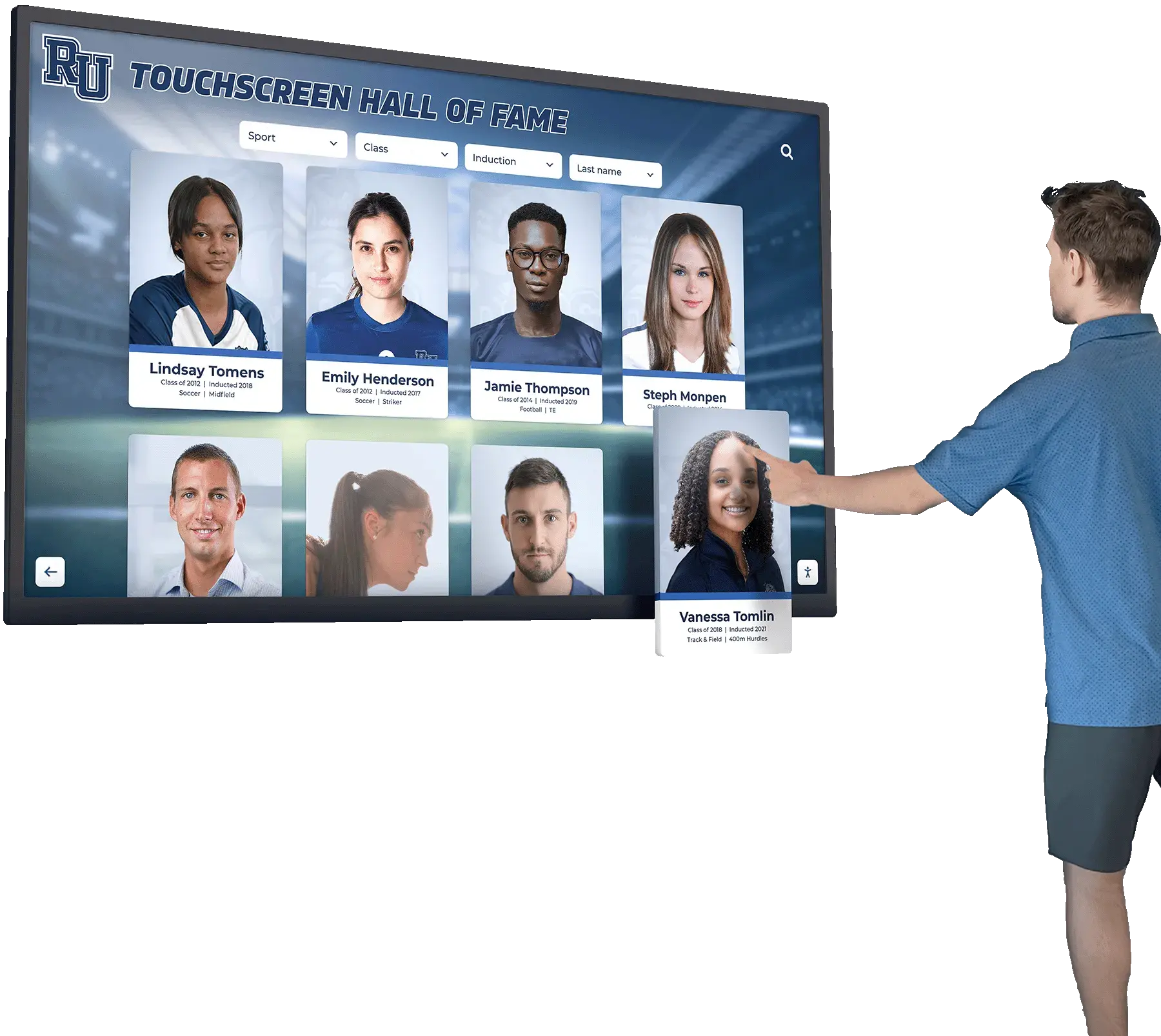
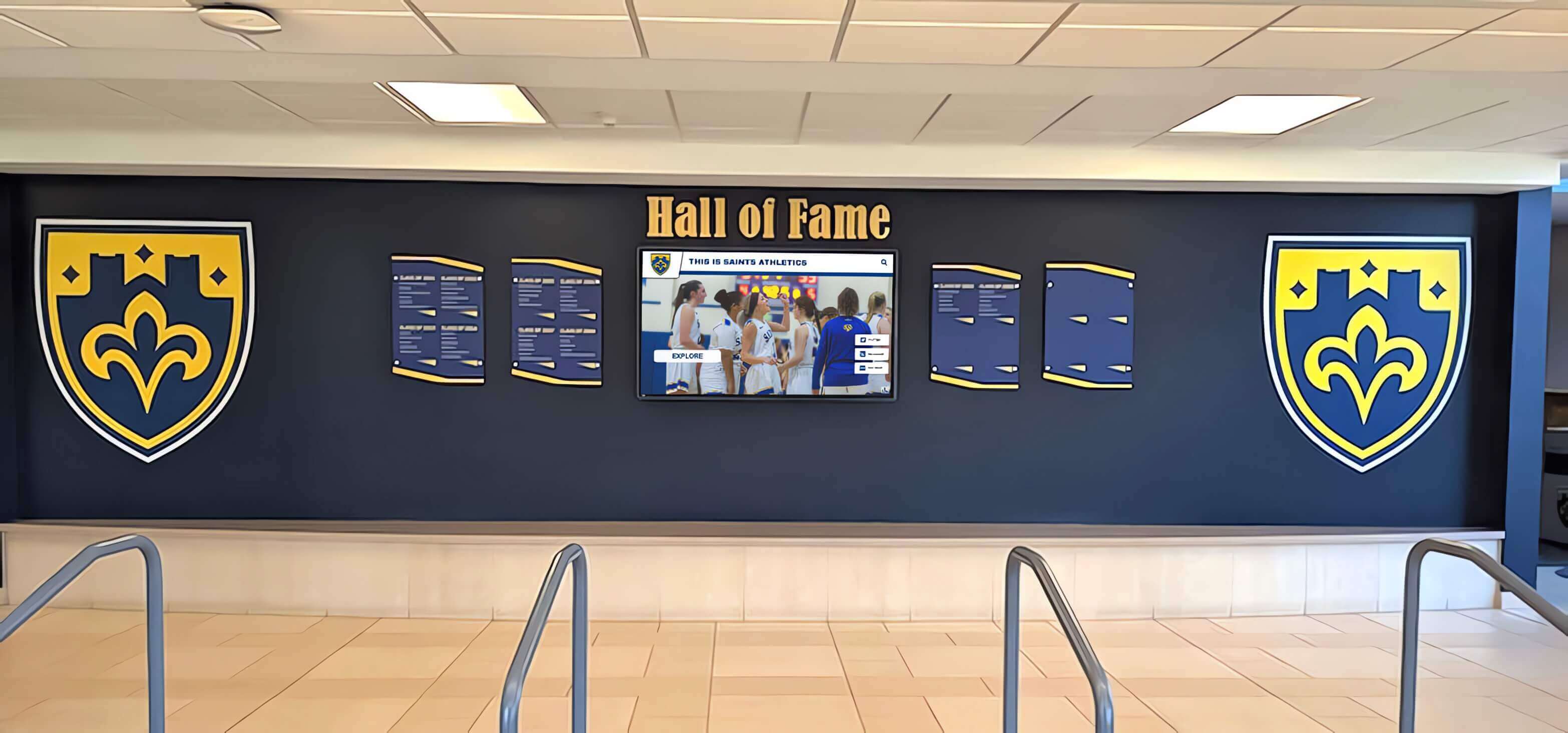
Digital touchscreen recognition systems installed in school lobbies and main hallways offer a fundamentally different model for FBLA recognition. Rather than a static list of names on a plaque, a well-designed digital system creates a living record that accumulates year over year without physical space constraints, updates in minutes rather than weeks, and invites active exploration from students, families, and visitors.
The core content categories for FBLA digital recognition include:
Annual State Qualifier Rosters — updated each spring after the State Leadership Conference, with member photos, event names, and placement results. A visitor can see not just who qualified but in what event and at what competitive level.
National Conference Competitor Records — a permanent, searchable archive of every student who represented the school at the National Leadership Conference, organized by year and event. National qualifiers deserve recognition that persists beyond graduation.
Chapter Officer History — documenting the chapter’s leadership succession going back as far as records exist. Officers who served ten, twenty, or thirty years ago are part of the chapter’s institutional story. A digital system preserves that history accessibly.
Award Highlights — Gold Seal Chapter years, Who’s Who recipients, Business Achievement Award completions at each level, American Enterprise Award honorees. These individual distinctions tell the story of what sustained excellence in FBLA looks like.
Photo Archives — images from SLC and NLC conferences that give current students and new chapter members authentic context for what these competitions involve. Seeing last year’s state qualifiers in professional conference settings makes the goal concrete.
Adviser Recognition — honoring the faculty members who built and sustained the chapter. The adviser who grew a chapter from ten members to eighty over fifteen years deserves institutional acknowledgment alongside the students they developed.
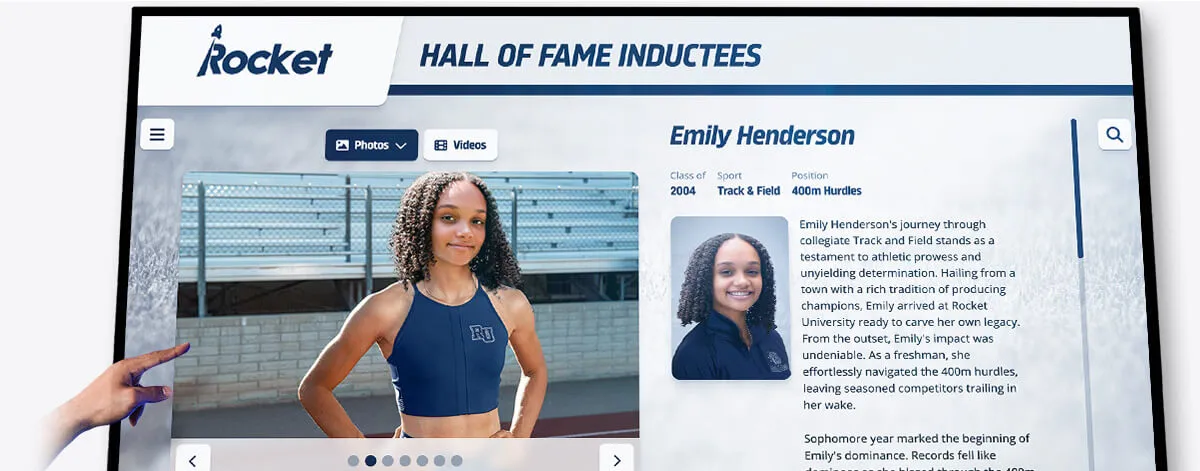
Interactive touchscreen software for school recognition programs provides the content management infrastructure that makes these displays practical for administrators without dedicated technical staff — allowing advisers to update recognition content directly after each conference.
Advantages Over Traditional Physical Displays
No space constraints. A digital system accommodates five decades of FBLA records in the same physical footprint as a single wall panel. Whether a chapter has 50 notable alumni or 500, every achiever has a searchable profile without requiring physical expansion.
Timely updates. An adviser can add State Leadership Conference results within days of returning from the event. Recognition that arrives weeks or months after the achievement has significantly less impact than recognition that arrives when the accomplishment is fresh.
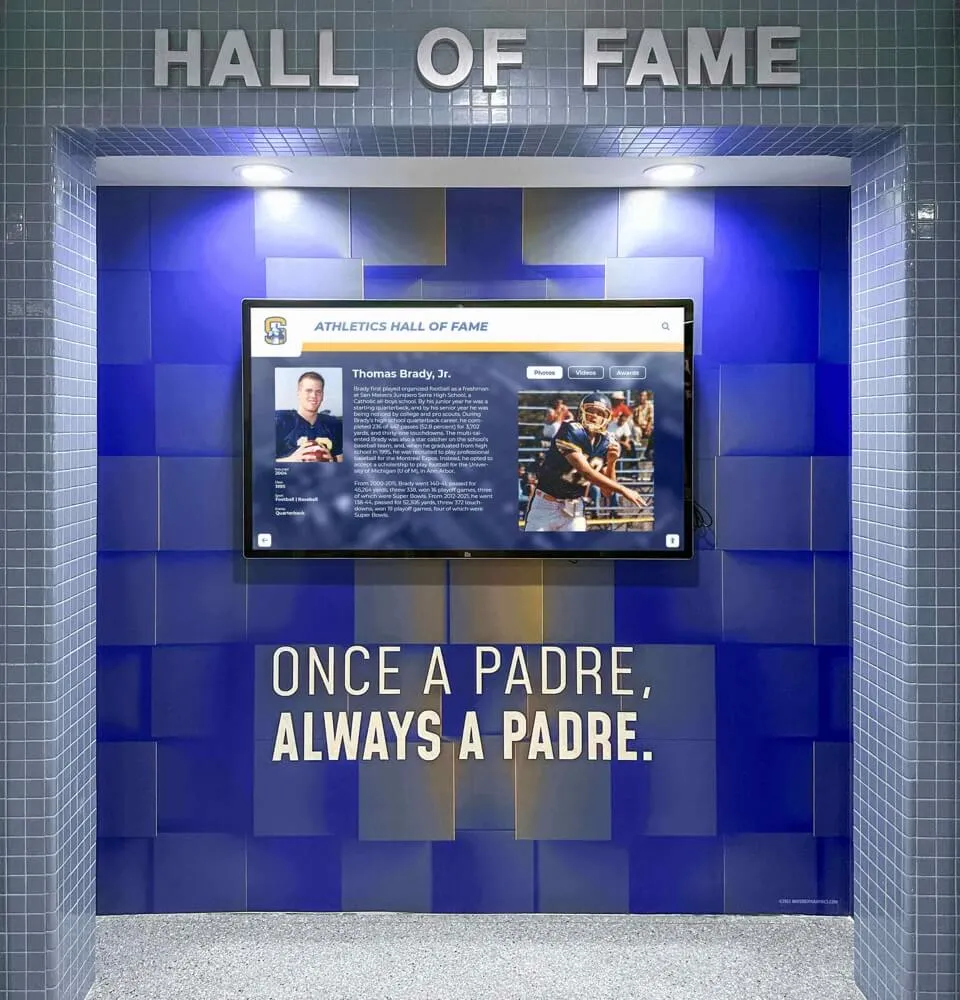
Rich multimedia content. Digital profiles can include photos, video clips from conference presentations, and narrative bios that physical plaques cannot accommodate. A two-minute video of a student’s national-qualifying sales presentation tells a far more compelling story than a nameplate.
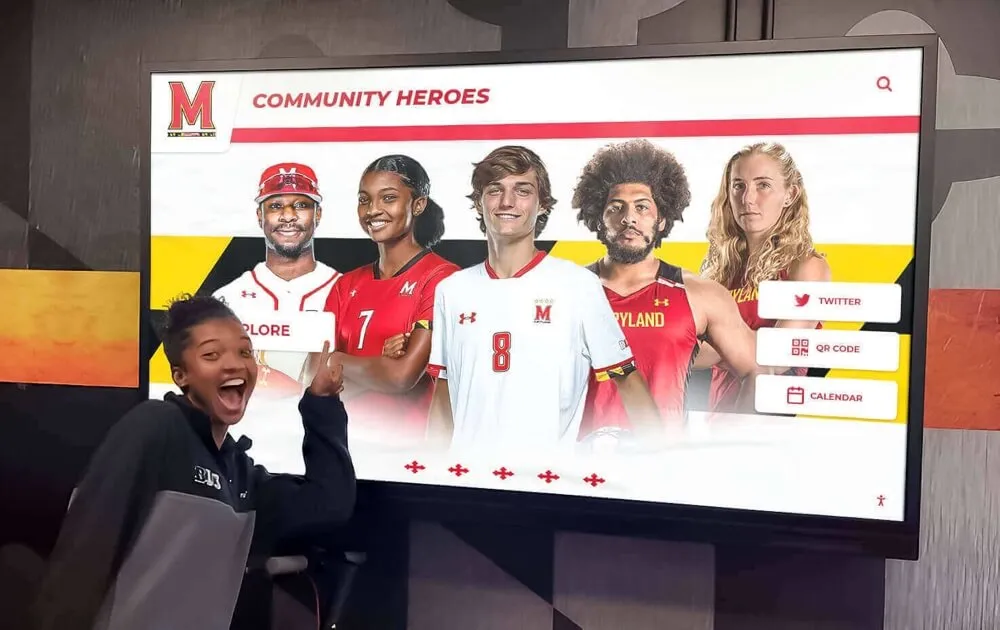
Multi-program integration. FBLA recognition gains institutional authority when it shares display space with athletics, NHS, FFA, performing arts, and other student achievements. A unified system communicates that the school values all forms of excellence at the same level — not by policy statement, but by practice.
Remote accessibility. Cloud-based systems allow families and alumni to access the recognition content from any device, extending the reach of institutional recognition beyond building walls. A grandparent who couldn’t attend the conference can still see their grandchild’s profile in the FBLA display.
Digital trophy and touch wall solutions designed for schools combine physical installation permanence with dynamic digital content — allowing schools to invest in infrastructure that grows more valuable as years of recognition accumulate on the system.
What to Look for When Evaluating Recognition Platforms
Schools evaluating digital recognition systems for FBLA should assess several key capabilities:
Ease of content management. Advisers — not IT staff — will be updating FBLA content after each conference. The content management system should be intuitive enough that a teacher comfortable with email and basic web tools can add new profiles, upload photos, and update event results without outside assistance.
Unlimited content capacity. The platform should never require difficult decisions about which students to include because of storage constraints. Every state qualifier from every year deserves a permanent home in the school’s recognition record.
Multi-program architecture. FBLA is one of many programs schools recognize. The system should accommodate athletics, academics, arts, and other student organizations within a unified display architecture — not require separate systems for each program.
Display quality and hardware. The physical installation should look as professional as the school’s athletic recognition infrastructure. A touchscreen mounted in a custom enclosure with professional content design signals institutional investment. A consumer monitor displaying a slideshow does not.
Support and training. First-time digital display installations require onboarding support. Evaluate vendors on implementation assistance, training resources, and ongoing customer support — not just hardware specifications.
School display software selection guides help administrators ask the right questions during the evaluation process and avoid common implementation mistakes that undermine long-term program success.
Building a Comprehensive FBLA Recognition Program
Phase 1: Define What Deserves Recognition
Before building any physical or digital display infrastructure, schools should document clear criteria for what FBLA achievements earn recognition and at what visibility level. A useful framework:
Tier 1 — High-visibility permanent recognition:
- National Leadership Conference qualifiers and finalists
- National award recipients (Who’s Who in FBLA, America’s Leader BAA)
- Chapter-level national awards (Gold Seal Chapter of Merit)
Tier 2 — Standard permanent recognition:
- State Leadership Conference qualifiers and top-ten finishers
- State-level award recipients (state-specific honors vary by association)
- Multi-year chapter officers who served at the President or VP level
Tier 3 — Documented annual recognition:
- All chapter officers across all positions, each year
- Business Achievement Award completions at each level
- Regional conference qualifiers
- Community service project leaders
Tier 4 — Timely public acknowledgment:
- Conference participation at any level
- Business Achievement Award initiation
- New member induction
- Chapter event participation
This tiered structure ensures recognition is meaningful at each level without diluting high-achievement acknowledgment by treating all participation equally. The framework also gives advisers a defensible answer when parents ask why one student received display recognition and another did not.
Phase 2: Gather Historical Records
Most schools have incomplete records of FBLA competitive history, officer rosters, and award recipients from more than five or ten years ago. Reconstructing that history requires deliberate archival effort:
- School yearbooks typically document chapter officers and sometimes list state qualifiers — a starting point for pre-digital records
- State FBLA associations often maintain competitive event placement records going back decades and can confirm historical results
- Retired advisers frequently retained personal records of chapter history that official school archives don’t contain
- Alumni networks through school social media pages can surface photos, programs, and memories from past conferences that current administrators don’t know exist
The effort to build complete historical records pays dividends for years. A recognition display that shows chapter achievement going back to the 1980s tells a fundamentally different institutional story than one that only covers the last five years.
Phase 3: Select and Implement Display Infrastructure
High school hall of fame buying guides walk through the key decisions in selecting recognition display infrastructure — hardware specifications, software capabilities, installation requirements, and long-term operational costs. For FBLA recognition specifically, the most important implementation decisions are:
Location. A display in a main lobby or high-traffic corridor near the business education department reaches the broadest audience. Placement near athletic displays communicates programmatic equity — business education achievement visible in the same institutional context as athletics.
Content structure. Design the display architecture around how visitors will want to explore: by year, by event category, by student name, by achievement level. Search functionality matters more than visual design for a recognition system that accumulates records over decades.
Update workflow. Establish a clear process for how FBLA achievement results get translated into display content after each conference. The adviser should know exactly what steps are required and how long each takes. If the update process is too complex, content will fall behind.
Integration with other programs. If the school is also recognizing athletics, arts, and academic programs, build a unified display architecture from the start rather than maintaining separate systems that create inconsistent visitor experiences.
Interactive kiosk solutions for schools and organizations provide purpose-built hardware and software platforms designed for the school environment — including content management workflows optimized for advisers and administrators rather than IT professionals.
Phase 4: Connect Recognition to Culture
A display installation is infrastructure. Turning that infrastructure into a recognition culture requires ongoing intentional effort:
Induction events. Create a moment when new FBLA honorees are formally added to the school’s permanent recognition record. Even a brief ceremony in which the adviser updates the display and the student’s profile goes live creates a memorable experience that students share with families and classmates.
Academic honor roll integration. Academic honor roll recognition programs demonstrate how schools can create recognition cadences — quarterly, semester, or annual — that maintain consistent visibility for academic achievement. FBLA recognition programs benefit from the same predictable cadence, so students and families know when to expect formal acknowledgment.
Recruitment tool. Make the FBLA display part of every prospective student and family building tour. Pointing to a ten-year record of State Leadership Conference qualifiers and National Leadership Conference competitors makes a tangible case for chapter quality that a brochure cannot.
Alumni engagement. FBLA alumni who see their competitive records preserved in a school’s permanent display are more likely to return as judges, mentors, and sponsors. Recognition creates connection that outlasts graduation.
Why FBLA Membership Matters Beyond High School
FBLA develops skills that translate directly into college and career success. Students who compete in business events practice structured communication under pressure, applied analytical reasoning, professional judgment, and collaborative problem-solving — capabilities that classroom coursework alone rarely develops to the level required for competitive professional environments.
For college applications, documented FBLA competitive event placements, Business Achievement Award completions, and chapter officer positions signal genuine career interest and demonstrated leadership capability. Business, technology, marketing, and entrepreneurship programs specifically look for these credentials as evidence that applicants have already applied learning in competitive settings — not just studied in isolation.
FBLA also builds professional networks that outlast the competitive events themselves. Members meet peers from across their state and country at conferences, develop relationships with business professionals through chapter partnerships, and access scholarship opportunities sponsored by national and state organizations. A student who competed at the National Leadership Conference has a conversation-starting credential and a peer network from every state — resources most high school graduates don’t have.
Schools that treat FBLA recognition with the same seriousness as athletic and academic recognition communicate clearly to students, families, and communities that business education and career preparation are genuine institutional priorities — not elective afterthoughts to be accommodated when resources allow.
Conclusion
Future Business Leaders of America represents one of the most rigorous competitive programs available to high school students — a program that tests applied knowledge, professional communication, collaborative problem-solving, and leadership under conditions that mirror real business environments. The students who qualify for State Leadership Conferences and compete at the National Leadership Conference have earned recognition that belongs in a school’s permanent institutional record alongside its most celebrated athletic and academic achievements.
Closing the recognition gap for FBLA members doesn’t require extraordinary resources — it requires intentional decisions about where achievements appear, how long they remain visible, and what institutional weight they carry. Digital touchscreen recognition systems provide the infrastructure to make those decisions sustainable over time, accumulating a chapter’s competitive history in a format that current students, prospective families, and alumni can all access and explore.
Rocket Alumni Solutions builds interactive recognition systems for schools that want to give every form of student achievement — FBLA, athletics, academics, arts, and career education — a permanent, high-visibility home in their buildings. If your school is ready to recognize Future Business Leaders of America members with the permanence and visibility their accomplishments have earned, explore what a customized digital recognition installation can do for your community.