



Key Takeaways
Master essential softball catching drills that develop elite framing, blocking, and pop time skills. Proven training routines coaches use to build championship-caliber backstops.
Why Specialized Catching Drills Create Elite Backstops
Effective catching development requires dedicated skill work that addresses the unique technical, physical, and mental demands of the position. Random practice doesn’t build the refined capabilities that define championship-level catchers.
The Multidimensional Nature of Elite Catching
Softball catching performance integrates multiple specialized skill systems working simultaneously. A catcher facing a 0-2 count with a runner on second must simultaneously:
- Receive the pitch with framing mechanics that maximize strike probability
- Block potential balls in the dirt while keeping runners from advancing
- Process pitch selection and communicate effectively with the pitcher
- Prepare for defensive responsibilities if the ball is put in play
- Manage game tempo and energy for the entire defensive unit
This complexity explains why catchers require position-specific training programs that isolate, develop, and integrate these distinct skill components progressively. Championship programs implement structured catching drills systematically, creating measurable defensive improvements that translate directly to game situations.
Connecting Practice Excellence to Recognition Programs
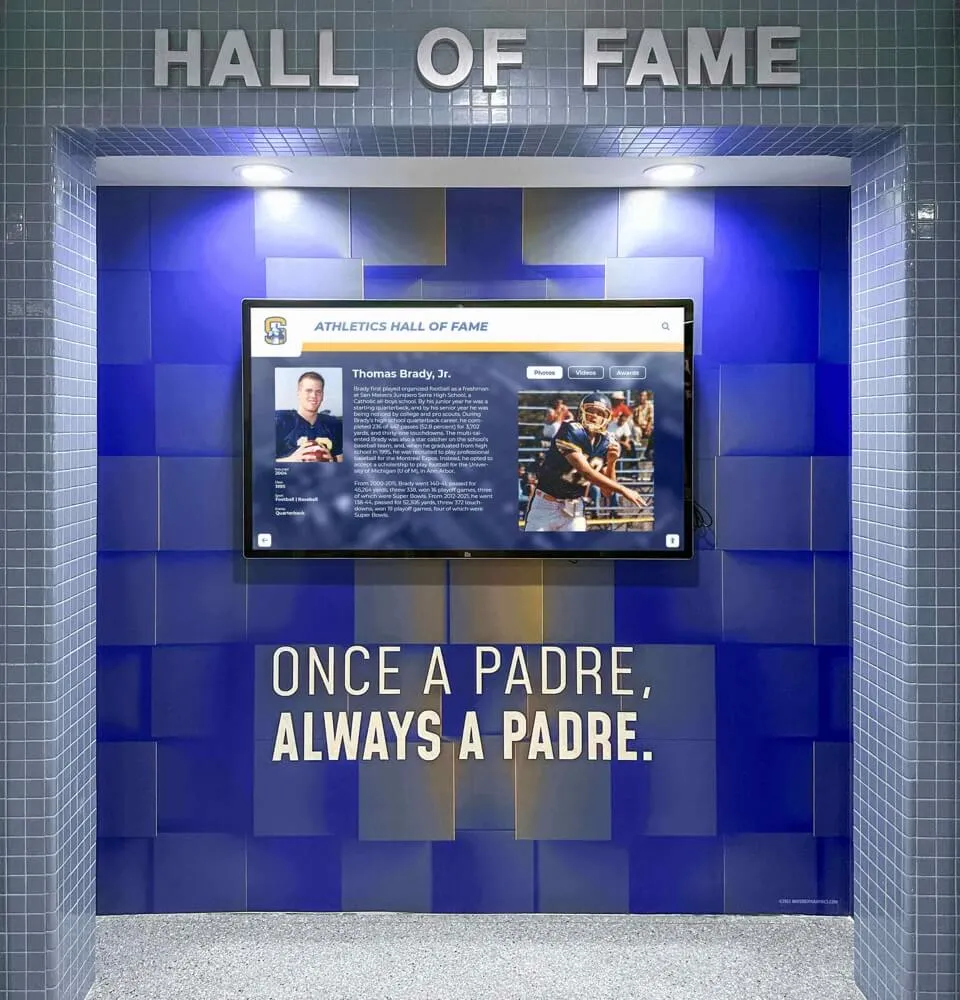
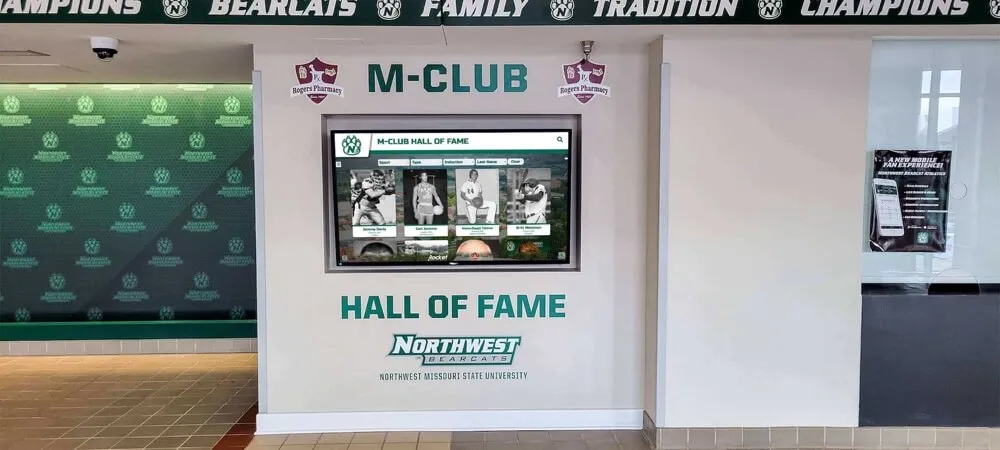
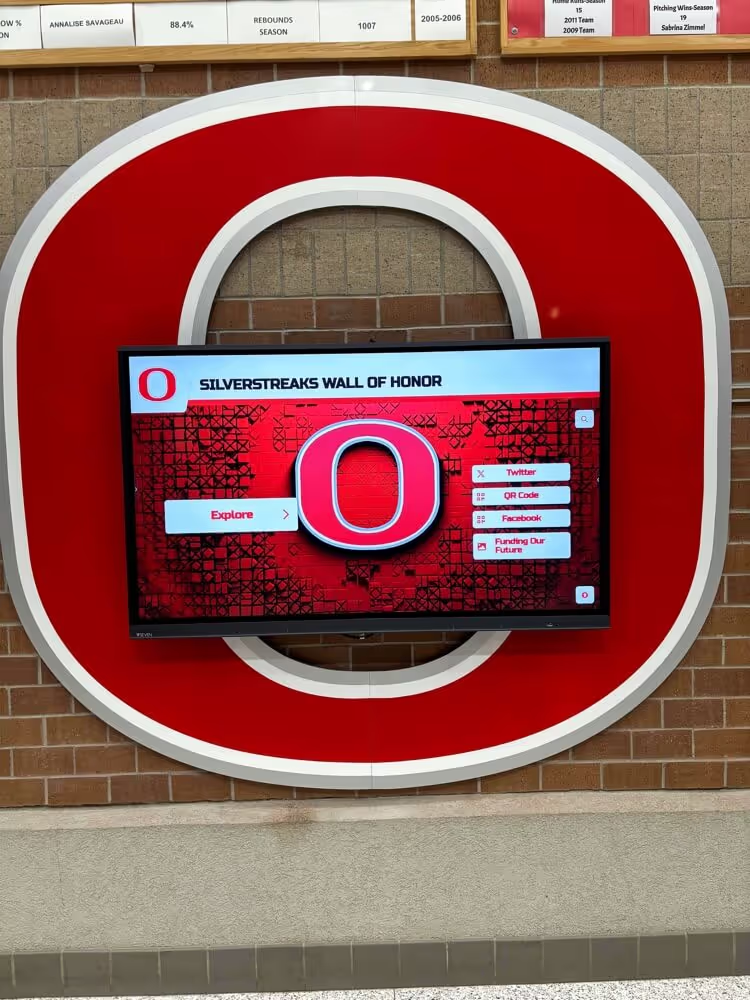
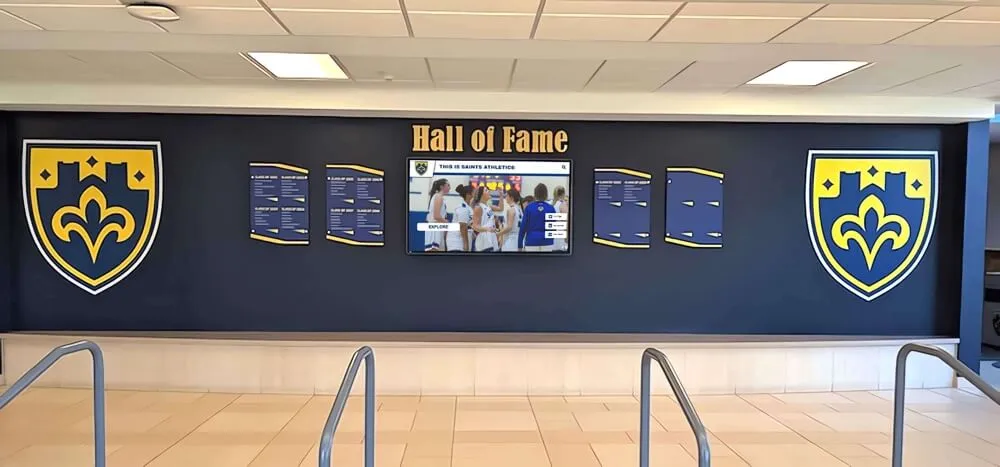
The defensive specialists whose statistics appear on athletic record boards achieved those numbers through preparation that started with fundamental catching drills executed with championship-level intensity. Modern digital displays make this connection explicit, showcasing not just final statistics but the defensive skills and work ethic that produced them.
When current players see alumni recognized for caught stealing percentages, passed ball prevention, or career games caught, they understand those achievements began with the same drills they’re practicing today. Programs that celebrate defensive excellence alongside offensive production create balanced recognition that honors the complete game.
Softball Catching Drills: Complete Skill Development Table
The following drills form a comprehensive catching development system addressing every dimension of elite backstop performance. This scannable reference organizes drills by primary skill target for easy practice planning.
| Drill Name | Primary Skill | Secondary Skill | Equipment Needed | Intensity Level |
|---|---|---|---|---|
| Barehand Receiving | Framing | Soft hands | Ball, partner | Low |
| Framing Four Corners | Framing | Zone coverage | Full gear, pitcher | Medium |
| Tennis Ball Framing | Framing | Hand-eye coordination | Tennis balls, partner | Low |
| Center Mass Blocking | Blocking | Body positioning | Full gear, soft balls | Medium |
| Lateral Blocking Series | Blocking | Lateral movement | Full gear, multiple balls | High |
| Short-Hop Reaction | Blocking | Quick reflexes | Full gear, partner | High |
| Footwork Fundamentals | Pop Time | Exchange mechanics | Ball, bases | Low |
| Quick Release Progression | Pop Time | Throwing accuracy | Full gear, bases | Medium |
| Live Steal Simulation | Pop Time | Game pressure | Full gear, runners, pitcher | High |
| Pitch-Block-Throw Combo | Integration | All skills | Full gear, complete setup | High |
| Foul Ball Tracking | Defensive awareness | Communication | Full gear, helmet | Medium |
| Bunt Defense Reads | Fielding | Decision making | Full gear, infielders | Medium |
Framing Drills: Maximizing Strike Probability
Pitch framing represents the most valuable skill elite catchers provide. Research consistently shows that exceptional framers add 15-25 runs above average per season through their ability to convert borderline pitches into called strikes—a contribution comparable to solid offensive production.
1. Barehand Receiving: Foundation of Soft Hands
Before adding equipment complexity, catchers must develop the fundamental receiving mechanics that make all framing possible. Barehand work isolates hand movement and wrist action without glove interference.
Implementation: Partner positions 10-15 feet away, delivering firm tosses to various locations around the strike zone. Catcher receives barehanded, focusing exclusively on:
- Quiet reception: Catching the ball with minimal glove movement
- Stick the pitch: Holding position after reception without pulling back
- Subtle manipulation: Tiny wrist adjustments that bring borderline pitches toward the zone
- Relaxed hands: Tension-free reception that allows natural “give” on impact
Progression Variables:
- Increase throwing velocity gradually
- Add movement patterns (drop down/rise up) to simulate pitch types
- Introduce random sequencing so catcher can’t anticipate location
- Work high-volume sets (50+ repetitions) to build muscle memory
Advanced catchers use barehand work throughout their careers for mechanical maintenance, returning to this fundamental drill whenever framing execution deteriorates during seasons.
2. Framing Four Corners: Zone Command
This drill develops framing consistency across the entire strike zone, ensuring catchers can maximize strikes regardless of pitch location.
Setup and Execution: Pitcher delivers from regulation distance with catcher in full gear. Work in sets targeting specific locations:
Set 1: Bottom of Zone Pitcher throws 10 pitches at knees or below. Catcher focuses on receiving low strikes without dropping glove early, using subtle upward wrist action on borderline low pitches to show them in the zone.
Set 2: Outside Corner Focus entirely on away strikes, especially those catching the black or just off. Key technique: Receive the pitch and hold it on the corner rather than pulling it back across the plate—a common error that signals to umpires the pitch missed.
Set 3: Inside Corner Work inside strikes with emphasis on quiet reception. Catchers who stab at inside pitches create movement that makes strikes appear like balls. Elite framers receive inside pitches smoothly, holding them in position.
Set 4: High Strikes Shoulder-high pitches require different mechanics. Catchers work on receiving with slight downward give rather than reaching up aggressively, presenting high strikes as controlled pitches rather than balls.
Championship catchers whose defensive skills earn recognition in end-of-season athletic awards typically demonstrate elite framing across all four corners rather than just their natural strengths.
3. Tennis Ball Framing: Hand-Eye Coordination Enhancement
Tennis balls’ smaller size forces catchers to develop precise hand-eye coordination and focus that transfers directly to softball reception.
Drill Structure: Partner tosses tennis balls from 12-15 feet, targeting strike zone locations. Catcher works barehanded or with tennis racket to:
- Track small target through entire flight path
- Make precise reception adjustments
- Develop hand quickness needed for subtle framing
Advanced Variation: Use colored tennis balls (yellow, green, orange). Partner calls color mid-flight. Catcher must track, identify, and receive correctly—building the visual processing speed needed for pitch recognition and framing decision-making under game pressure.
Blocking Drills: Preventing Runs and Controlling the Running Game
Elite blocking separates championship catchers from average backstops. Passed balls directly impact run prevention, change pitcher confidence, and embolden base stealers. Consistent blocking creates defensive reliability that pitching staffs trust completely.
4. Center Mass Blocking: Foundation Technique
Before working lateral movement, catchers must perfect the fundamental blocking position and technique for pitches directly in front.
Proper Blocking Mechanics:
- Drop and drive: Explode from receiving stance to knees simultaneously with pitch trajectory recognition
- Glove position: Center chest with thumbs together, creating large surface area
- Chin tuck: Protect throat while keeping eyes on the ball
- Round the back: Create ball-deflecting surface that keeps blocks in front
- Knees together: Eliminate five-hole gaps balls can sneak through
Drill Execution: Coach positions 20 feet away with bucket of soft training balls or softer practice balls. Delivers balls in dirt directly at catcher’s center mass at game-realistic velocity. Catcher focuses on:
- Quick recognition and reaction (drop immediately on ball trajectory read)
- Blocking fundamentals (proper body position every repetition)
- Recovery speed (locate blocked ball and simulate throw)
Volume Recommendations: Championship catchers complete 25-50 center mass blocks daily during season, maintaining muscle memory and conditioning for explosive movements that blocking demands. The athletes recognized on athletic hall of fame displays for defensive excellence typically logged thousands of blocking repetitions throughout their careers.
5. Lateral Blocking Series: Covering the Entire Plate
Pitches in the dirt rarely bounce conveniently to the catcher’s center mass. Lateral blocking develops the footwork and body control needed to reach pitches off the plate while maintaining proper blocking position.
Progressive Lateral Blocking Sequence:
Phase 1: Near-Lateral Blocks Coach delivers balls 1-2 feet to either side. Catcher practices:
- Reading direction quickly
- Stepping or shuffling laterally while dropping
- Maintaining proper blocking angle (facing pitcher)
- Keeping ball in front despite lateral movement
Phase 2: Full-Extension Lateral Blocks Increase distance to 3-4 feet to either side, requiring maximum lateral range. Focus shifts to:
- Explosive lateral movement (dive if necessary)
- Getting any body part in front of the ball
- Recovering to make potential throw
Phase 3: Random Sequencing Mix center mass, near-lateral, and full-extension blocks randomly. Develops:
- Quick reads and decision-making
- Position-specific conditioning
- Mental toughness through high-intensity volume
Championship Standard: Complete 40-60 total blocks (center, left, right combinations) in 8-10 minute period, simulating game-intensity defensive demands.
6. Short-Hop Reaction Drill: Developing Elite Reflexes
The most challenging pitches to block are short hops that bounce immediately in front of the plate. This drill develops the quick-twitch reactions needed for these difficult blocks.
Setup: Partner or coach positions close (10-12 feet) and deliberately throws short hops with varying velocities and spins. The shortened distance reduces reaction time, training faster visual processing and physical response.
Focus Points:
- Read spin and trajectory immediately off release
- Anticipate bounce point
- Adjust blocking position for short-hop timing
- Stay aggressive rather than bailing out
Mental component: Building confidence to attack short hops rather than avoiding them. Catchers who bail out of short hops create passed balls and wild pitches that cost games.
Pop Time Drills: Controlling the Running Game
Pop time—the interval between pitch contact and ball arrival at second base—determines how effectively catchers control the running game. Elite pop times (under 1.9 seconds in softball) neutralize steal attempts and force opponents to run less aggressively.
7. Footwork Fundamentals: The Foundation of Quick Pop Times
Lightning-fast arm strength means nothing without efficient footwork that channels power into accurate throws. Footwork development must precede maximum-effort throwing.
Basic Footwork Pattern:
Right-Handed Catchers:
- Receive pitch
- Right foot replaces left foot (gaining ground toward second base)
- Left foot steps toward target
- Shoulders square to second base at release
Left-Handed Catchers:
- Receive pitch
- Left foot gains ground toward target
- Right foot steps and drives throw
- Similar shoulder alignment at release
Drill Without Ball: Practice footwork patterns in slow motion initially, perfecting mechanics before adding speed. Use verbal cadence: “Receive… Right foot… Left foot… Throw.” Gradually increase speed while maintaining mechanical precision.
Drill With Ball: Add catch-and-throw once footwork becomes automatic. Partner delivers from 20 feet. Focus on:
- Clean exchange from glove to hand
- Footwork execution without looking down
- Throwing accuracy to target
8. Quick Release Progression: Developing Exchange Speed
The exchange—transferring the ball from glove to throwing hand—represents the most controllable variable in pop time improvement. Elite catchers minimize exchange time through hundreds of purposeful repetitions.
Exchange Drill Progression:
Stage 1: Stationary Exchange Work Standing position, partner delivers chest-high tosses. Catcher focuses exclusively on:
- Catching with glove thumb up (optimal exchange position)
- Meeting glove with throwing hand immediately
- Four-seam grip secured without looking
- Hand follows ball out of glove (no dead time)
Complete 25-50 repetitions daily until exchange becomes completely automatic.
Stage 2: Exchange from Receiving Position Partner delivers from pitcher’s distance. Catcher works from game stance:
- Receive in proper catching position
- Execute exchange mechanics
- Complete throw to second base
Track pop times and identify specific mechanical inefficiencies causing delays.
Stage 3: Exchange Under Pressure Add baserunner stealing. Create competitive environment with multiple catchers rotating, tracking pop times and throw accuracy. Competition drives improvement by creating game-realistic pressure.
Programs that celebrate defensive excellence through recognition programs highlighting athletic achievement inspire catchers to pursue the disciplined skill work required for elite pop times.
9. Live Steal Simulation: Game-Realistic Application
All mechanical drills ultimately serve one purpose: controlling baserunners in game situations. Live steal simulation integrates all pop time components under realistic conditions.
Full Setup:
- Pitcher throwing from regulation distance
- Runner at first base
- Catcher in full gear
- Middle infielders covering second base
Execution: Pitcher delivers with runner attempting steal. Catcher executes complete defensive sequence:
- Receive pitch with proper framing
- Quick exchange and footwork
- Accurate throw to covering infielder
- Communication and backup responsibilities
Tracking Metrics:
- Pop time from pitch contact to base arrival
- Throwing accuracy (on-target percentage)
- Caught stealing success rate
- Decision-making (when to attempt throw vs. holding)
Championship catchers complete live steal work 2-3 times weekly during season, maintaining game-speed execution that translates directly to competitive performance. The defensive specialists whose careers coaches honor through personalized recognition gifts typically demonstrated elite pop time development through systematic training.
Integrated Catching Drills: Complete Skill Application
Championship catchers must integrate all specialized skills seamlessly during games. These integrated drills combine framing, blocking, throwing, and decision-making in game-realistic sequences.
10. Pitch-Block-Throw Combination Drill
This high-intensity drill simulates the most common defensive sequence catchers face: receiving a pitch, blocking one in the dirt, then making a throw.
Drill Sequence:
- Pitcher delivers strike—catcher frames properly
- Pitcher delivers ball in dirt—catcher blocks
- Catcher recovers and throws to second base (simulating runner stealing on wild pitch)
Focus Integration:
- Framing mechanics don’t compromise blocking readiness
- Quick recovery from block to throwing position
- Maintaining composure through multi-skill sequence
- Physical conditioning for sustained intensity
Complete 8-10 repetitions (enough for legitimate conditioning stress but not so many that fatigue compromises mechanics). Championship preparation requires catchers to execute elite techniques even when tired.
11. Foul Ball Tracking and Communication
Catchers must pursue foul balls aggressively while communicating with infielders to prevent collisions and coordinate who makes the play.
Drill Setup: Coach deliberately pops balls up in foul territory various distances and directions. Catcher practices:
- Removing mask properly (toss in opposite direction of ball flight)
- Tracking ball while running
- Communicating loudly with infielders
- Making catch with proper technique
- Understanding priority rules (who has right-of-way)
Advanced Application: Add infielders pursuing same foul balls. Practice communication protocols that prevent collisions while ensuring someone makes the play. Programs that develop complete catchers create defensive specialists worthy of recognition on comprehensive athletic achievement displays.
12. Bunt Defense Reads and Execution
Catchers serve as the quarterback for bunt defense, reading offensive intentions and making quick decisions about fielding responsibilities.
Drill Components:
Read Phase: Offensive player squares to bunt. Catcher identifies bunt early and communicates with infield (calling “Bunt! Bunt!” to alert defense).
Decision Phase: Ball is bunted. Catcher reads trajectory and determines:
- Can I field this cleanly?
- Which base is the play?
- Who covers which base on the play?
Execution Phase: Catcher charges, fields, and throws to appropriate base while infielders execute their assignments.
Rotation Drill: Set up various bunt scenarios (suicide squeeze, bunt for hit, sacrifice bunt) with runners. Catcher practices reads and decisions across different situations, building the defensive awareness that separates adequate catchers from elite field generals who control games.
Building Championship Catchers Through Systematic Development
Elite catching performance doesn’t happen accidentally. It results from systematic skill development implemented consistently across seasons, building the specialized capabilities that define championship backstops.
Progressive Skill Development Throughout the Season
Preseason (Weeks 1-4): Emphasis on fundamental mechanics without time pressure. Focus on:
- Proper framing technique development
- Blocking body position and fundamentals
- Footwork mechanics for pop time
- High-volume repetition building muscle memory
Early Season (Weeks 5-8): Increase drill intensity and add game-realistic pressure:
- Add velocity to blocking drills
- Track pop times and establish baselines
- Integrate multiple skills in combination drills
- Begin live situational work
Mid-Season (Weeks 9-12): Maintain skills while managing accumulated fatigue:
- Reduce volume, maintain intensity
- Focus on weakest areas identified through games
- Mental preparation and game management emphasis
- Recovery and injury prevention protocols
Late Season/Playoffs: Peak performance through refined execution:
- Lower volume, highest quality repetitions
- Game-specific situational work
- Confidence-building through demonstrated competence
- Mental toughness and competitive focus
Measuring and Recognizing Catching Excellence
Championship programs track catching-specific metrics that quantify defensive value:
Framing Metrics:
- Called strike percentage on borderline pitches
- Strike zone expansion impact (strikes gained above average)
- Umpire consistency ratings
Blocking Metrics:
- Passed balls per games caught
- Percentage of balls in dirt kept in front
- Scoring prevention on wild pitches
Pop Time Metrics:
- Average pop time to second base
- Caught stealing percentage
- Throwing accuracy on steal attempts
Overall Impact:
- Opponent stolen base attempts (deterrence effect)
- Pitcher performance with specific catchers
- Win-loss record in games caught
Programs that celebrate defensive excellence through modern recognition systems create culture that values complete players. Digital athletic displays allow schools to showcase catching-specific achievements alongside offensive statistics, honoring the specialized skills that championship backstops provide.
Creating a Culture That Celebrates Complete Excellence
The most successful softball programs recognize that championships require elite performance across all positions and skill sets. While offensive production often receives the most attention, defensive excellence—particularly from catchers—frequently determines championship outcomes.
Modern recognition systems allow programs to celebrate catching excellence appropriately. Interactive displays can showcase:
- Career games caught and defensive statistics
- Caught stealing percentages and pop time records
- Defensive runs saved and framing metrics
- Leadership impact and pitcher development success
- Championship contributions and clutch defensive plays
When programs honor complete players through comprehensive recognition, they communicate clear values: Every position matters. Defensive skills deserve equal celebration. Championship culture requires excellence in all dimensions of the game.
This inclusive recognition philosophy inspires complete player development. Athletes understand that elite catching skills earn the same honor as offensive records, motivating the disciplined skill work required for defensive mastery.
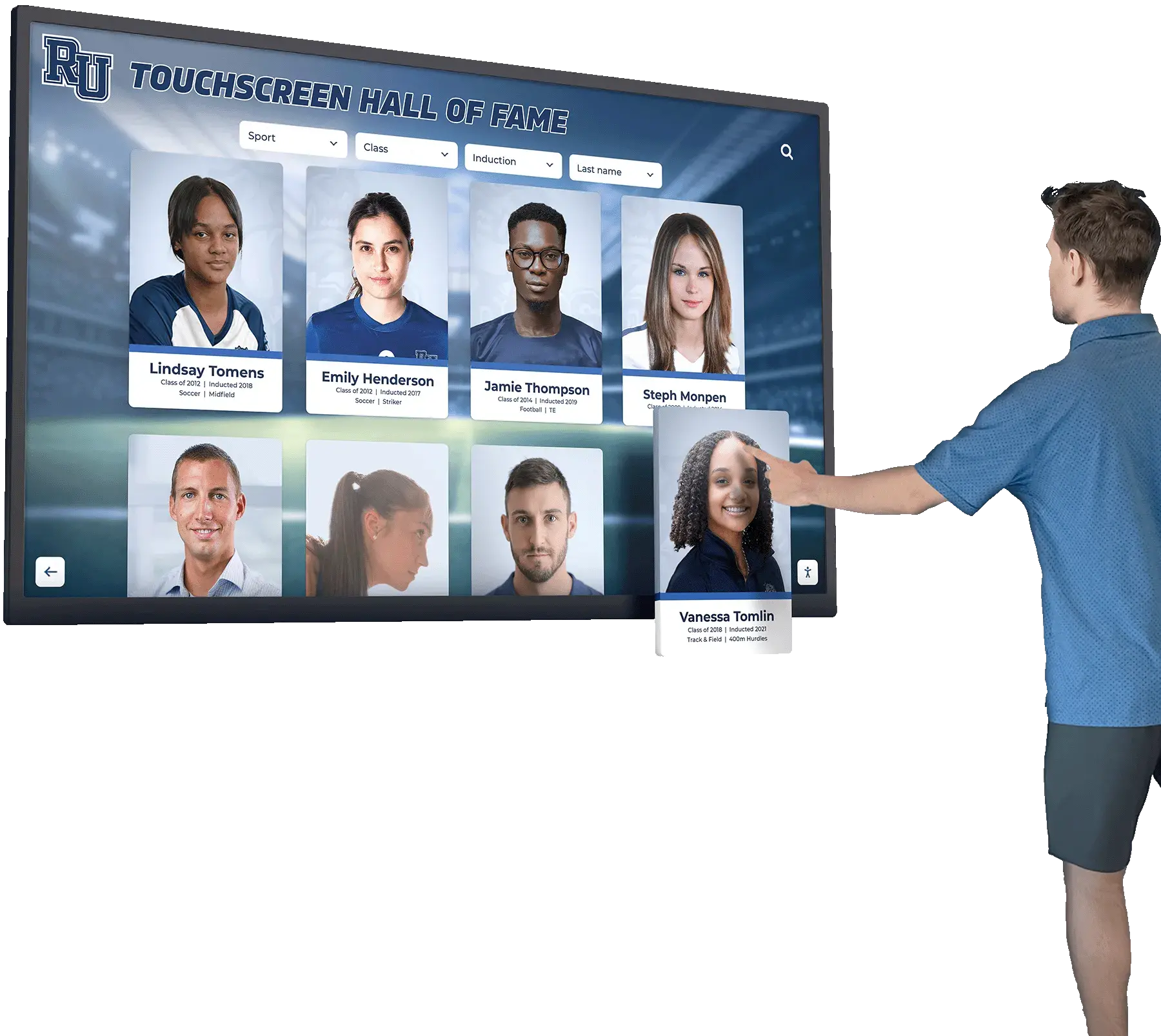
Schools and universities looking to celebrate their defensive specialists and championship catchers can explore modern recognition solutions that showcase complete athletic achievement. Rocket Alumni Solutions provides interactive touchscreen displays that allow programs to highlight position-specific excellence, defensive metrics, and the complete skill sets that championship backstops bring to their teams—creating engaging recognition that inspires current players while honoring the elite catchers who earned their place in program history.
Championship catchers are built through thousands of purposeful repetitions focused on framing, blocking, and pop time development. By implementing these proven drills systematically and recognizing catching excellence appropriately, programs create the defensive anchors who control games, elevate pitching staffs, and ultimately determine championship outcomes.