



Key Takeaways
A practical digital hall of fame rights expiration tracker template and renewal workflow for schools—covering photo licenses, consent forms, video rights, and removal procedures before permissions lapse on public inductee profiles.
A digital hall of fame rights expiration tracker is a scheduled inventory that records every media asset published on inductee profiles—photographs, video clips, licensed content, and biographical excerpts—alongside the date each permission was granted, its expiration date, and the renewal or removal action required before it lapses. Schools that maintain this tracker prevent the legal exposure, display gaps, and community-relations issues that come from unknowingly publishing content after its permission window has closed.

Why Permissions Expire on Public Recognition Profiles
Not all content published on a school hall of fame profile carries the same rights status. A photograph taken by a staff member during a school event and stored in district archives typically falls under institutional ownership and does not expire. But much of the media that makes recognition profiles compelling—action shots from contracted photographers, press images sourced from wire services, video clips from broadcast coverage, and biographical passages republished from print or digital media—carries a time-limited permission or license.
Four conditions most often cause permissions to lapse:
Licensed press and sports photography. Commercial sports photography agencies and individual contracted photographers frequently license images for a defined term—commonly one to three years. When that term ends, the right to display the image in any public-facing context expires, even if the image has been on the profile for years without issue.
Consent-form-based permissions. Schools that obtained signed consent from inductees or their families to use photos and biographical details may have done so under forms that specified a time period or a particular use (a printed program, a specific display installation). When the program or display changes—such as migrating from a physical trophy case to a publicly accessible digital platform—the original consent may not cover the new context.
Third-party video rights. Highlight clips sourced from television broadcasts, news segments, or commercial video producers carry copyright held by the producer, not the school. Most such uses require a license that has an explicit expiration date or a per-use restriction that does not extend to permanent digital display.
Estate-managed rights. For inductees who have passed away, the right to use their image and likeness in a commercial or institutional context may be governed by estate or publicity-rights law in your state. These rights do not automatically carry forward from a prior consent; they require separate authorization from the estate.
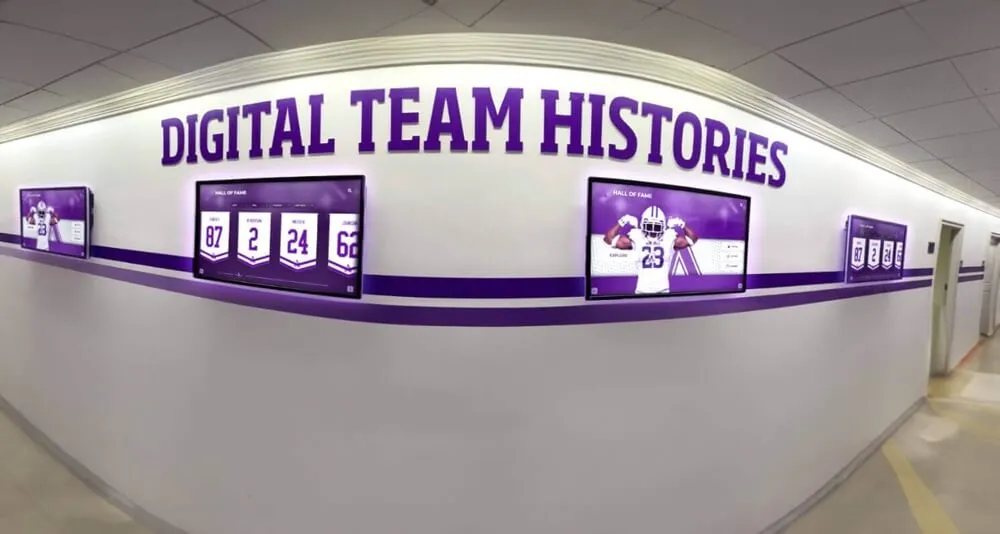
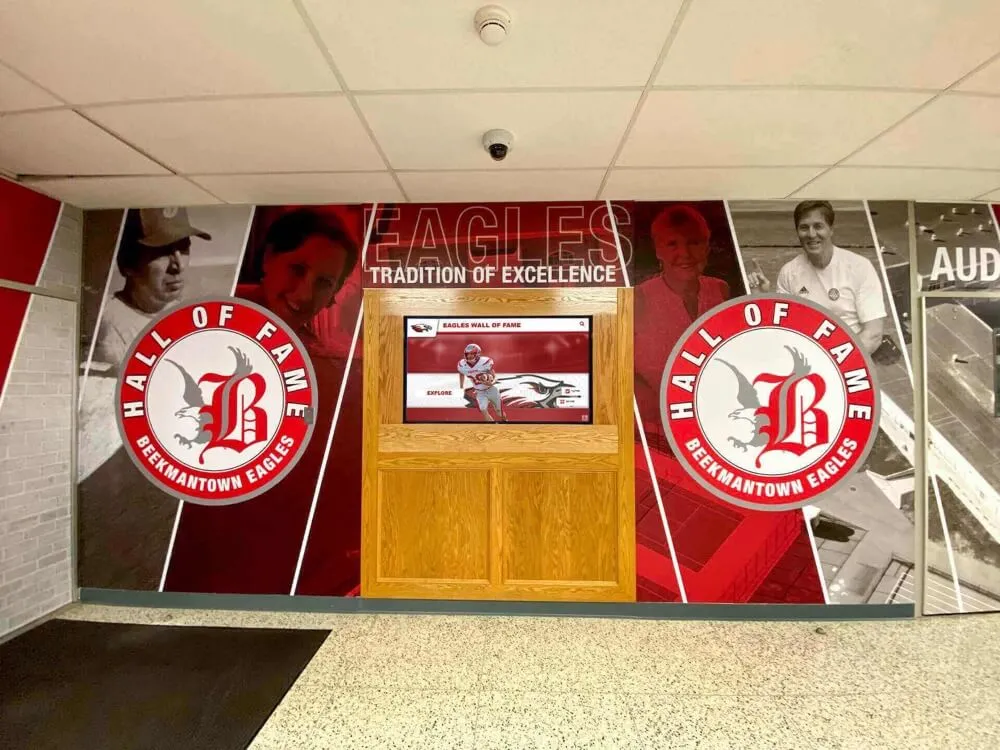
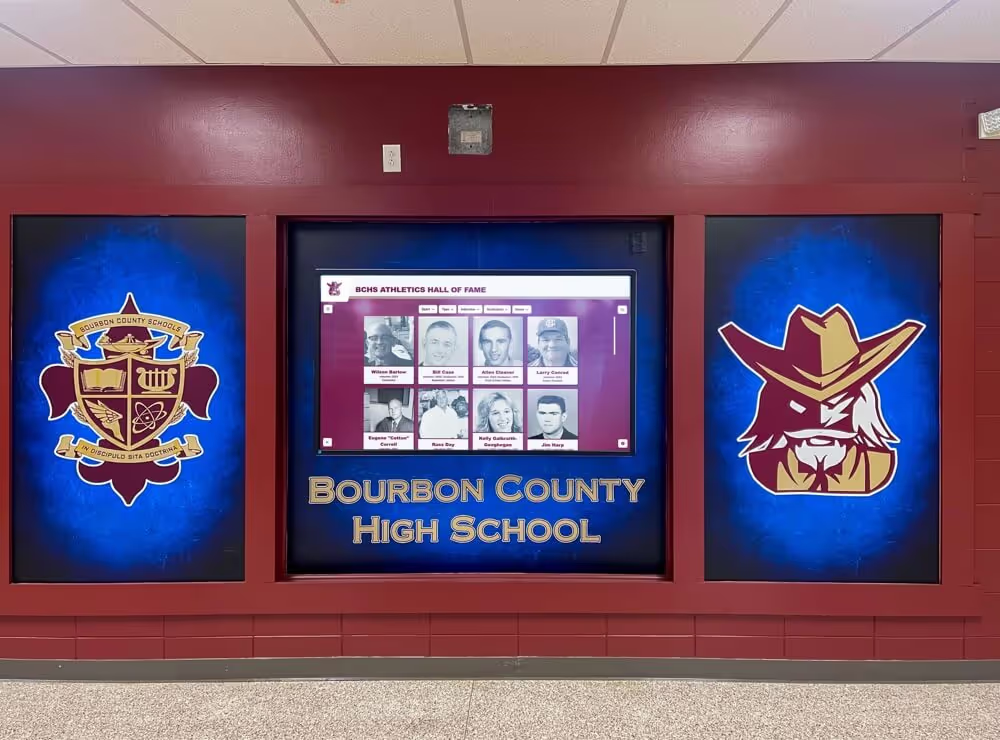
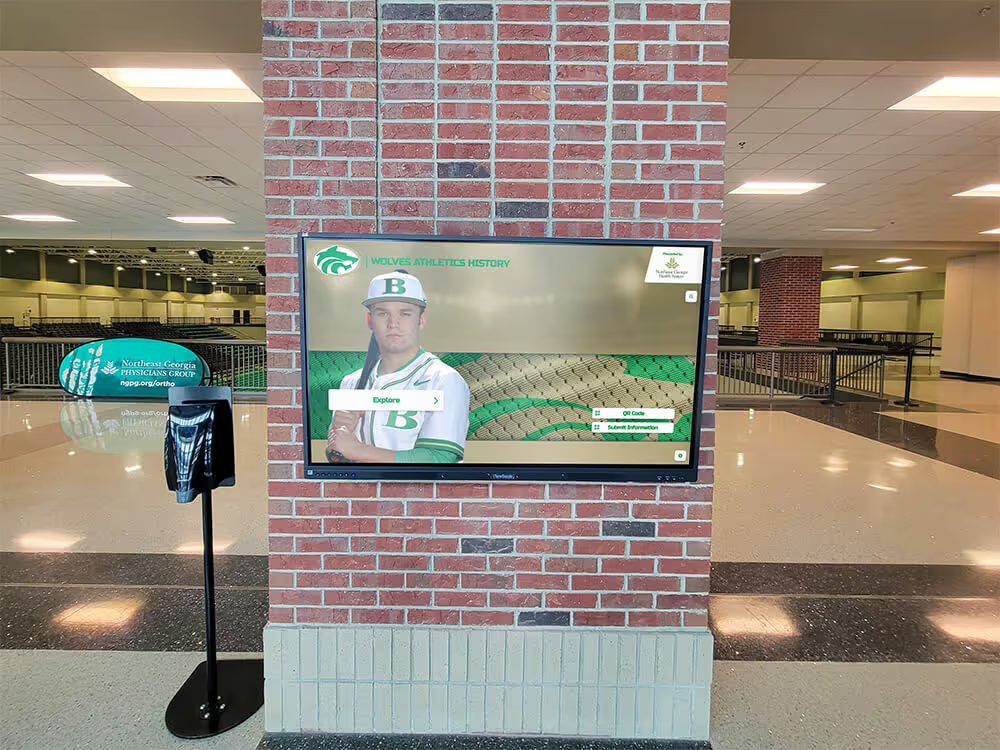
Understanding which profiles are most at risk is the first step. Schools that have built out detailed photo galleries, timelines, and inductee profiles for rich storytelling carry a correspondingly higher volume of media assets—and a larger rights-tracking obligation.
The Digital Hall of Fame Rights Expiration Tracker: Template
The tracker is a living document, not a one-time audit. Every asset added to a public inductee profile should be logged at the time it is published, including the permission source and any expiration date. The template below covers the essential fields; add columns specific to your institution as needed.
| Field | What to Record |
|---|---|
| Profile Name | Inductee’s full name as displayed |
| Asset ID | Internal reference number (e.g., HOF-IMG-0042) |
| Asset Type | Portrait photo / action photo / licensed press photo / video clip / text excerpt |
| Asset Description | Brief description (e.g., “1988 state championship game, AP wire photo”) |
| Source | Who supplied the asset (AP, Getty, contracted photographer name, family, school archives) |
| License or Permission Type | Work-for-hire / signed consent / commercial license / fair use / institutional archive |
| Date Permission Granted | Date the license was signed or consent was received |
| Expiration Date | Exact date the permission ends, or “Permanent” if confirmed in writing |
| Renewal Contact | Name and email of the rights holder or family contact |
| Current Status | Active / Expiring within 90 days / Expired / Removed / Renewal in Progress |
| Action Required | Renew by [date] / Replace with in-house photo / Remove if not renewed / None |
| Last Reviewed | Date of last audit check for this row |
A tracker covering 50 inductees with an average of three to five media assets per profile is a manageable spreadsheet of 150 to 250 rows. Programs with deeper archives, video libraries, or larger inductee rosters should consider organizing the tracker by class year or sport, with a summary dashboard tab that surfaces only the rows with upcoming expirations.
The Five Asset Types Schools Need to Track
1. Inductee Portrait Photographs
Portraits are the most visible element of any public inductee profile. Rights status varies significantly by source:
- School-archived portraits (taken by district staff, stored in school records): Generally institution-owned; confirm no individual photographer agreement limits reuse.
- Family-supplied portraits: Require written consent for public display; family consent should specify the platform, duration, and scope.
- Commissioned portraits: Rights depend on the contract with the photographer; without a work-for-hire clause, the photographer retains copyright.
- Yearbook portraits: Usage rights for yearbook photos may be shared with the photography vendor; confirm your district’s vendor agreement.
2. Action and Sport Photographs
In-game photography taken by school staff or boosters under explicit authorization typically belongs to the institution. Photography by independent contractors—common for significant events like state championships—requires a license or work-for-hire agreement that explicitly transfers or licenses display rights to the school.
3. Licensed Press or Wire-Service Photography
Press photographs sourced from wire services (AP, Getty, USA TODAY Sports) carry clearly defined license terms. Downloading an image from a licensed archive for one use does not automatically grant permanent display rights. These assets should always have a documented license agreement attached to their tracker row, with the expiration date entered at the time of publication.
4. Video Highlight Clips
Video is the highest-risk asset type for rights lapse. Broadcast footage carries multilayered rights: the footage itself belongs to the broadcaster, individual performances may carry separate rights, and music in highlight reels carries its own synchronization license. Unless the school produced the video entirely in-house using institutional resources, assume external rights apply and verify the license scope before publishing to a public display.
5. Biographical Text Sourced Externally
Biographical passages quoted or adapted from newspaper profiles, alumni magazines, or other publications may require permission depending on length, context, and the school’s relationship with the publisher. Even brief quotations embedded in an inductee’s official biography should have a source note in the tracker.
Renewal Workflow: 7 Steps
When the tracker flags an asset as expiring within 90 days, the following workflow guides the renewal process from first contact through documentation.
Step 1: Pull the expiring asset rows. Filter your tracker for any asset with an expiration date within the next 90 days. Generate a working list sorted by expiration date, earliest first.
Step 2: Verify the asset is still in active use. Before initiating renewal, confirm the asset is still live on the public profile. If the profile has been updated and the asset is no longer displayed, mark it “Removed” in the tracker and close the row.
Step 3: Identify the current rights holder. Use the Renewal Contact field in the tracker. For commercial licenses, this may be a vendor account manager or a licensing portal. For family-supplied consent, it is the inductee or next of kin. Confirm the contact is current before reaching out.
Step 4: Send a written renewal request. Contact the rights holder in writing—email is acceptable for most situations—and include: the specific asset being renewed (name, date, description), the context in which it is displayed (a school hall of fame platform, publicly accessible), the renewal term being requested, and a deadline for response that gives you time to act before the expiration date.
Step 5: Document the response. If the rights holder agrees to renewal, obtain a written confirmation—updated license, a signed renewal consent form, or a reply email that constitutes agreement—and attach it to the relevant tracker row. If the rights holder declines or does not respond by the deadline, move immediately to Step 6.
Step 6: Remove or replace unrenewed assets. Assets without confirmed renewal by the expiration date come offline on that date. Remove them from the public-facing display and log the removal in the tracker. If a replacement asset is available (an in-house photo, a family-supplied alternative), publish the replacement and log the new permission in a new tracker row.
Step 7: Update the tracker. Record the new expiration date, the name of whoever handled the renewal, and the date the tracker was updated. Archive the documentation for the renewed permission in the same folder or system used for the original.

Building a Rights Tracking Calendar
The tracker is only useful if it is reviewed on a schedule. Build two recurring calendar events:
Annual full audit (recommended: July or August). Before a new school year begins, review every row in the tracker regardless of expiration date. Confirm that permanent permissions are documented, that no undocumented assets have been added to profiles during the year, and that the renewal contact information is current. This is also the right time to audit newly inducted profiles that may not have been fully documented at publication.
90-day rolling review (monthly). On the first business day of each month, filter the tracker for expirations in the next 90 days and initiate the renewal workflow for each. A monthly review ensures no expiration date slips through the gap between annual audits.
Annual operational cycles—like the gym floor maintenance schedules that schools plan around peak-use periods, similar to the planning required for gym floor refinishing timelines—demonstrate that schools are accustomed to managing recurring physical maintenance on defined schedules. Rights tracking is the equivalent for digital content: it is not a one-time project but an ongoing operational function that benefits from the same calendar discipline.
What to Do When Permissions Have Already Lapsed
If your first audit reveals that one or more assets have been published past their expiration date without renewal, act in this sequence:
- Remove the asset immediately. Do not delay removal while waiting for a retroactive renewal. Continued publication without a valid license compounds the exposure.
- Log the removal. Record the date of removal, the reason (expired permission), and who completed the removal in the tracker.
- Contact the rights holder. Explain what occurred and inquire whether a retroactive license or a prospective renewal is available. Do not represent that the asset is still offline permanently until you have confirmed the path forward.
- Replace if possible. If the profile now has a visible gap—a missing portrait, an incomplete biography—consider whether an in-house photograph or family-supplied alternative can fill it without requiring a third-party license.
- Document everything. The documentation trail showing that you identified the lapse, removed the asset, and took corrective action matters if the rights holder raises a concern later.
Choosing Software That Supports Rights Management
A platform built for school recognition programs will not automatically manage licensing on your behalf, but it can make the operational workflow significantly easier. When evaluating or comparing options, look for:
Asset-level metadata fields. The ability to attach a source, date, and notes to each individual photo or video within an inductee’s profile—separate from the profile biography—is a baseline requirement for tracking. Platforms that treat all profile content as a single undifferentiated record make per-asset tracking much harder.
Administrative-only views. The ability to remove an asset from public display while retaining it in an administrative view (with the removal reason and date logged) is important for records continuity. A platform that can only publish or delete—with no intermediate archived state—creates a gap in your institutional record.
Export capabilities. The ability to export a complete list of assets with metadata supports building and maintaining the tracker spreadsheet, especially for programs with large inductee rosters.
A school trophy display software comparison guide is a useful starting point for evaluating platforms on the criteria that matter for governance and rights management—not just aesthetics and features.

Rights Tracking for Multi-Location Displays
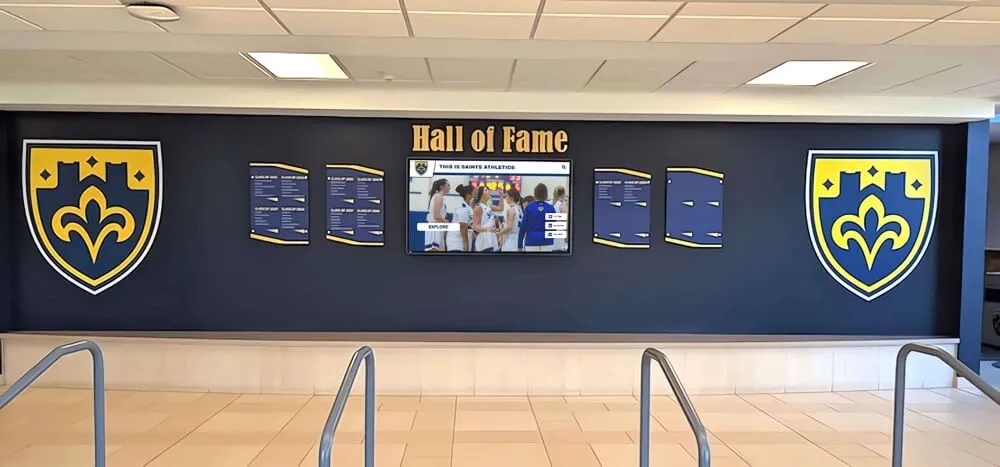
Schools that publish hall of fame content across more than one location—a lobby touchscreen, a gymnasium display wall, a website directory, or informational screens in residence or student housing—face a compounded rights obligation: a single asset displayed in four places may require that the license explicitly covers each context.
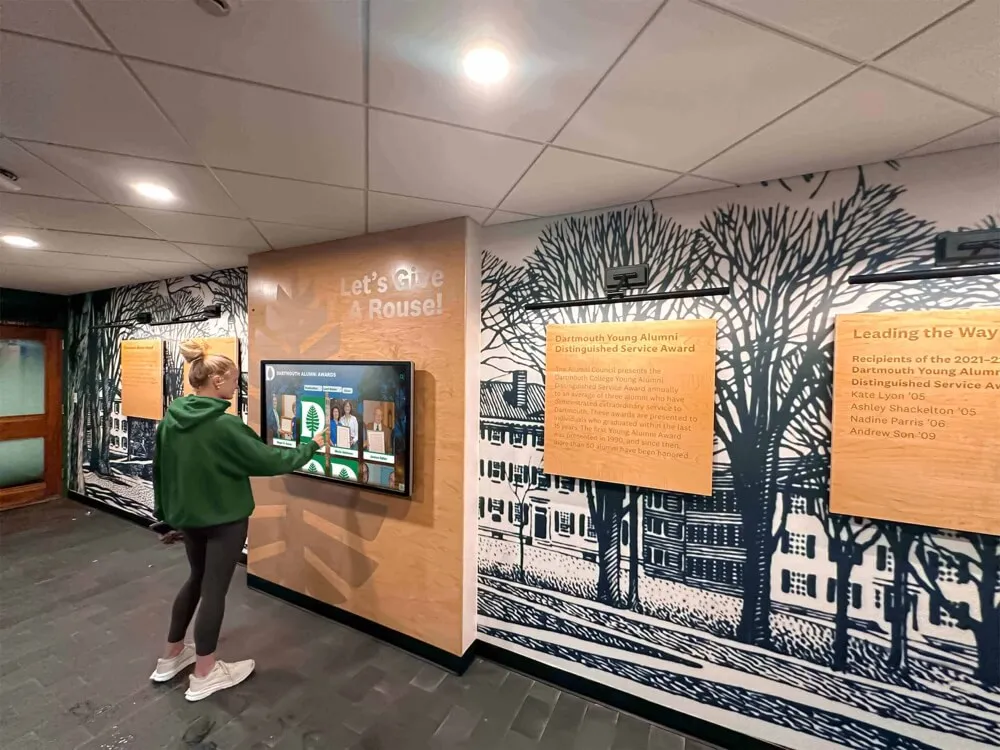
Interactive informational displays in college residence halls and similar multi-context installations demonstrate that institutional digital content increasingly appears in more venues than the original permission anticipated. When a photo was licensed for “school hall of fame display use,” determine whether that language covers a web-accessible profile, a residential building’s informational kiosk, and a printed program—or only the original lobby installation.
Add a column to your tracker for “Display Contexts Covered” and document each venue where the asset appears. If the license does not explicitly cover a context, treat that context as unauthorized until confirmed in writing.
Rights Considerations by Recognition Category
Different types of inductees carry different rights risk profiles. Use the table below to prioritize your audit.
| Inductee Category | Primary Rights Risk | Priority Level |
|---|---|---|
| Active varsity athletes (recent graduates) | Family consent may not have specified digital display | High |
| Deceased inductees | Estate or publicity rights may apply | High |
| Coaches and staff | Employment-era photography may have unclear ownership | Medium |
| Academic honorees | Profile photos often sourced from yearbooks with vendor rights | Medium |
| Donors and community members | Consent forms often cover physical displays only | High |
| Legacy inductees (30+ years ago) | Original consent predates digital display; may need re-authorization | High |
Programs that recognize athletes across many sport classifications—from varsity to junior varsity to club-level—should define which tiers fall within the formal rights-tracking scope. For context on how schools define competitive tiers and why the distinction matters for documentation, see this overview of what varsity means in the context of school sports recognition.
Designing Profiles to Reduce Rights Risk
Reducing long-term rights exposure starts at the content selection stage, before any asset is published. Several practices reduce the volume of third-party-licensed content that needs tracking:
Commission in-house portraits at the time of induction. A photograph taken by school staff or a contracted photographer under a work-for-hire agreement at the induction ceremony creates an institutional asset that does not require a separate license for ongoing display. This portrait becomes the default for the public profile, and licensed third-party assets serve as supplementary content.
Obtain written consent at the induction ceremony. Inductees and their families are present and engaged at the induction event. That is the right moment to collect a signed consent form that covers digital display, website publication, and any other contexts the program currently uses—with a renewal provision built into the form’s language.
Prefer linked attribution over republished content. For biographical text sourced from newspapers or alumni publications, linking to the original source rather than reproducing the text in the profile avoids the republication rights question entirely.
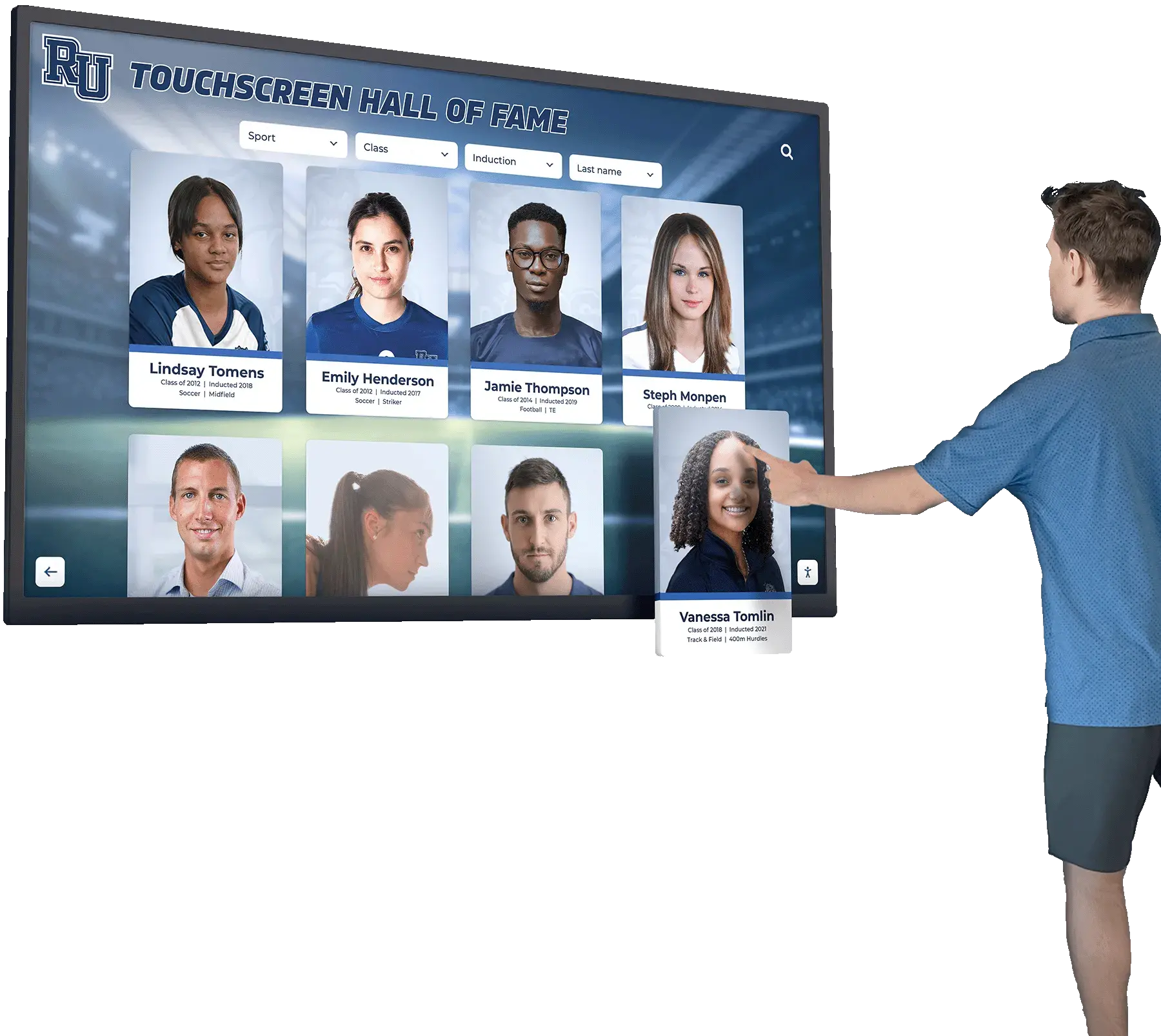
Thoughtful profile design—including image placement, content structure, and the relationship between text and visual assets—is covered in depth in this guide to designing a digital hall of fame touchscreen display layout. Design decisions made at the layout stage affect which assets you need, which in turn affects the scope of your rights tracking obligation.
The Rights Tracker as Institutional Record
A well-maintained rights expiration tracker does more than prevent lapsed permissions. Over time it becomes an institutional record of how the program has managed its content obligations—evidence that media use has been deliberate, documented, and governed rather than accidental.
This record matters in three situations:
When an inductee or rights holder raises a question. A tracker that shows the original permission date, the license type, and every renewal creates a clear, documented response to any inquiry. Programs that cannot produce this documentation are in a significantly weaker position.
When the platform changes. Schools that migrate from one display system to another need to know which assets carry transferable rights and which are licensed only for a specific platform or vendor relationship. The tracker answers that question before the migration, not after.
When staff changes. Athletic directors, display coordinators, and booster administrators turn over. A maintained tracker transfers institutional knowledge about every asset’s rights status to incoming staff without requiring them to reconstruct it from scratch.
Rights Expiration Tracker: Quick-Start Checklist
Use this checklist when building or auditing your tracker for the first time:
- List every inductee profile that is publicly accessible (touchscreen, website, printed directory)
- For each profile, list every distinct media asset currently displayed
- Identify the source of each asset (who took the photo, who supplied the video, where the text came from)
- Determine the rights basis for each asset (work-for-hire, signed consent, commercial license, institutional archive)
- Record the expiration date—or confirm “permanent” in writing—for each asset
- Log the renewal contact name and email for every non-permanent asset
- Set calendar reminders at 90 days and 30 days before each expiration date
- Assign a named staff role as the rights tracking owner
- Schedule an annual full audit, separate from the rolling 90-day reviews
- Store all permission documentation (signed forms, license agreements, email confirmations) in a named archive folder linked to the tracker
Frequently Asked Questions
What is a digital hall of fame rights expiration tracker?
A digital hall of fame rights expiration tracker is a structured inventory that records every media asset published on inductee profiles—photographs, video clips, licensed content, and biographical excerpts—along with the date each permission was granted, its expiration date, and the renewal or removal action required before it lapses. It is reviewed on a defined schedule and owned by a named staff role such as the display coordinator or athletic records steward.
Which types of media permissions expire most often on school hall of fame profiles?
Licensed press and wire-service photographs (typically one- to three-year license terms), video highlight clips from news broadcasts or third-party producers, action photography from contracted sports photographers with defined agreement terms, and consent-based permissions obtained from inductees or families but not renewed after a stated period. Portraits taken by school staff under work-for-hire arrangements generally do not expire, but the consent for public digital display may have its own terms.
How far in advance should schools start the renewal process?
Ninety days is the standard lead time. That window provides enough time to contact the rights holder, negotiate updated terms if needed, receive a signed renewal or license extension, and update the tracker before the permission lapses. Set calendar reminders at both 90 days and 30 days before expiration so a second check occurs if the first contact goes unanswered.
What should a school do if a permission has already lapsed?
Remove the asset from public display immediately. Do not wait for renewal before taking it offline. Log the removal date and reason in the tracker, then contact the rights holder to determine whether a retroactive license is available. Replace the removed asset with an in-house photograph or a family-supplied alternative if possible.
Can a digital hall of fame platform automate rights expiration tracking?
Most platforms do not automate rights tracking because permission terms vary too widely to support universal rules. However, platforms with robust administrative interfaces—asset-level metadata fields, export capabilities, audit logs, and administrative-only views—can support your tracking workflow. The tracker document lives outside the platform, but the platform’s content management tools determine how quickly and cleanly you can act on what the tracker surfaces.
See How a Purpose-Built Platform Supports Rights Management
Rocket Alumni Solutions gives school recognition programs the administrative infrastructure—asset management, profile archiving, audit logs, and role-based access—to support a disciplined rights expiration tracking workflow. Schedule a walkthrough to see the content management tools in context.
Request a Demo