



Key Takeaways
Run a digital hall of fame error prevention audit to protect inductee profile forms from accidental deletions, invalid dates, and irreversible edits. Covers WCAG requirements, a numbered audit process, and a remediation checklist for school staff.

What Is Error Prevention and Why It Matters for Inductee Profile Forms
Error prevention in the context of a web form is the set of design controls that reduce the likelihood of a user submitting invalid data, triggering an irreversible action, or losing entered content without warning. The term covers three levels of protection that build on each other:
- Validation — the system checks input against known constraints before accepting a submission.
- Confirmation — the system requires a second explicit action before executing a destructive or irreversible change.
- Reversibility — the system retains a prior state so a submitted change can be undone.
WCAG 2.1 Success Criterion 3.3.4 (Error Prevention – Legal, Financial, Data, Level AA) requires that for any page where a user can cause a legal commitment or financial transaction, or modify or delete user-controllable data, at least one of three safeguards is present: the submission is reversible, the data is verified and the user is given the opportunity to correct errors, or a review-and-confirm step is provided before final submission.
For a school hall of fame, the relevant condition is modifying or deleting user-controllable data. Every inductee profile in the CMS is user-controllable data. An athletic director who deletes an inductee record, a staff member who overwrites a published biography with a draft, or an archives coordinator who bulk-archives a filtered set of profiles is performing exactly the type of data operation SC 3.3.4 is designed to protect.
The related criteria complete the picture. SC 3.3.1 (Error Identification, Level A) requires that when an input error is detected, the error is described to the user in text—a red border alone does not satisfy this requirement. SC 3.3.3 (Error Suggestion, Level AA) requires that when an error is detected and a valid correction can be suggested, the system provides that suggestion. SC 3.3.6 (Error Prevention – All, Level AAA) extends the SC 3.3.4 requirement to all forms, not only those involving legal or data-critical submissions.
Recognition programs that publish profiles for display alongside achievement awards across digital formats face a practical version of this requirement: a published inductee profile is a public record. An error that slips through the form workflow does not stay in the CMS—it reaches the touchscreen in the lobby and the website visited by the inductee’s family. Error prevention at the form level is the last reliable barrier before incorrect data becomes public.
The Four High-Risk Form Actions on Inductee Profile Pages
A digital hall of fame CMS typically exposes four categories of form action that carry elevated risk of irreversible or hard-to-correct errors. The table below maps each action to its most common failure mode and the WCAG criterion it implicates.
| Form Action | Most Common Failure | WCAG Criterion |
|---|---|---|
| Delete profile | Single-click delete with no confirmation dialogue | SC 3.3.4 — no confirmation before data deletion |
| Publish / overwrite draft | Saving a draft silently replaces the published version | SC 3.3.4 — submission not reversible or confirmed |
| Date field entry (graduation year, induction year) | Field accepts out-of-range values (e.g., 1750 or 2150) without warning | SC 3.3.1 — error not identified; SC 3.3.3 — no valid range suggested |
| Bulk action (archive all, unpublish all, change category) | Action applies to more profiles than intended due to a broader-than-expected filter | SC 3.3.4 — no confirmation stating scope of change |
| Required field left blank (name, sport, year) | Form submits with blank fields and saves an incomplete profile | SC 3.3.1 — error not identified in text |
| Portrait image overwrite | Uploading a new image replaces the existing one without a comparison step | SC 3.3.4 — submission not reversible |
| Category reassignment | Changing an inductee’s sport category without confirming which category is being left | SC 3.3.3 — no suggestion of what will change |
| Status change (draft → published → archived) | Status change takes effect immediately with no intermediate confirmation | SC 3.3.4 — irreversible without a reversibility mechanism |
The highest-risk row is deletion. A deletion failure costs the most: years of editorial work, biographical text, historical photographs, and athlete statistics may not be recoverable if the platform does not maintain a version history or a soft-delete with a recovery window.
How to Run a Digital Hall of Fame Error Prevention Audit
An error prevention audit does not require source code access or a developer’s involvement in the discovery phase. The audit uses the CMS forms themselves as the test environment. Plan for two to four hours to cover the full set of form actions on a typical recognition platform.

The audit tests each high-risk form action listed in the table above by attempting to trigger the failure condition deliberately. Because the goal is to document the presence or absence of safeguards—not to commit errors to production—use a test inductee record created specifically for the audit and delete it afterward.
Bring a spreadsheet with one row per form action. Columns should capture: the action tested, the failure mode attempted, whether a safeguard appeared, what the safeguard said or did, and the WCAG criterion implicated when a safeguard is absent.
Step 1 — Test Required Field Validation
Open the inductee profile creation form. Submit it with the inductee name field empty. Then submit with the graduation year empty. Then submit with the sport or award category unselected.
For each submission, record:
- Does an error message appear in text (not only in a color change)?
- Does the error message name the specific field that failed validation, rather than displaying a generic “Please fill out this form” alert?
- Does focus move to the field that caused the error, or does the user have to search for it?
A passing result provides a text message that names the field (“Graduation Year is required”), places it adjacent to the field, and moves keyboard focus to it. A failing result uses only a red border, displays only a vague “Required fields are missing” alert, or allows submission with blank fields.
Step 2 — Test Date Range Validation
Locate the graduation year and induction year fields. Enter the following values and submit after each:
- A year before the school was founded (or before 1800 as a conservative baseline)
- The current year plus fifty
- A two-digit year (e.g., “26” instead of “2026”)
- A year in the correct format but outside the plausible inductee range (e.g., 1300)
For each entry, record:
- Does the system reject the value with a text error identifying the valid range?
- Does the error suggest the correct format or range (“Enter a year between 1900 and 2026”)?
- Does the form accept the value silently and save an implausible graduation year to the profile?
A silent acceptance is a SC 3.3.1 failure. Accepting an implausible year without comment produces published profiles with obviously incorrect data that undermines the credibility of the recognition program. School archives that maintain records across multiple generations of inductees—spanning athletic history from national honor induction cohorts to decades of athletic champions—are especially vulnerable to date errors that pass undetected through a form with no range validation.
Step 3 — Test the Delete Action
Create a test inductee profile. Navigate to the delete control (typically a trash icon, a “Delete profile” button, or a menu item). Activate it.
Record:
- Does a confirmation dialogue appear before the deletion executes?
- Does the dialogue name the inductee whose profile will be deleted (“Delete Jane Doe, Basketball, Class of 2001?”) rather than asking generically “Are you sure?”
- Does the dialogue require a positive confirmation (“Delete” or “Yes, delete this profile”) rather than defaulting to destructive action on any key press?
- Is there a recovery mechanism—a soft delete, a recycle bin, or a version history—that allows restoration within a defined window?
A delete that executes on a single click without a named confirmation is an unambiguous SC 3.3.4 failure. It is also the failure most likely to produce a call to an IT administrator or a platform support line on the morning of an induction ceremony when a staff member trying to remove a duplicate entry accidentally deletes the wrong profile.
Step 4 — Test Draft-vs-Published Overwrite
If the platform supports draft states, create a draft version of an existing published profile. Make visible changes to the biography. Save the draft.
Record:
- Does the platform display the published version and the draft version as distinct states before saving?
- Does saving the draft warn that it will overwrite the currently published version?
- Can the published version be restored if the draft save was unintended?
The absence of any comparison or warning before a draft save replaces a published profile is a SC 3.3.4 failure. Programs that use the CMS to maintain a public-facing display—where the published profile is visible on a lobby touchscreen during a school employee and staff recognition event or an awards ceremony—cannot accept an overwrite workflow with no safety net.
Step 5 — Test Bulk Actions
If the platform supports bulk operations—archive all, unpublish all, change sport category for all selected—apply a filter to a subset of profiles and initiate a bulk action.
Record:
- Does the system state how many profiles will be affected before the action executes (“This action will affect 23 inductee profiles”)?
- Does a confirmation step name both the action and the scope (“Archive all 23 Basketball inductees from 1990–2000?”)?
- Is the action reversible, or does it commit the change immediately with no undo?
A bulk action that applies to more profiles than the operator intended—because the active filter was inadvertently too broad—can alter or hide dozens of records in a single click. The scope-confirmation requirement in SC 3.3.4 directly addresses this: a user must be able to verify what they are committing before they commit it.
Step 6 — Document Findings
Complete one row per finding in a spreadsheet:
| Column | Content |
|---|---|
| Form action | Delete / Date entry / Draft overwrite / Bulk action |
| Failure mode tested | Single-click delete / Out-of-range year / Silent overwrite |
| Safeguard present? | Yes / Partial / No |
| Safeguard description | “Named confirmation modal appeared” / “Red border only, no text” |
| WCAG reference | SC 3.3.1 / SC 3.3.3 / SC 3.3.4 |
| Priority | High / Medium / Low |
| Proposed remediation | Add named confirmation modal / Add range validation with text message |
Organize findings by the form action category before sharing with your platform vendor. An organized finding document lets the vendor address all date validation issues in a single form update rather than treating each field as a separate ticket.
Remediation Patterns for Common Error Prevention Failures
Pattern 1: Named Confirmation Modal for Destructive Actions
Every delete, archive, and permanent-status-change action should trigger a modal that names the specific record being affected and requires a positive acknowledgment:
<div role="dialog" aria-modal="true" aria-labelledby="confirm-delete-title" id="confirm-delete">
<h2 id="confirm-delete-title">Delete inductee profile?</h2>
<p>You are about to permanently delete the profile for <strong>Jane Doe, Basketball, Class of 2001</strong>. This action cannot be undone.</p>
<button type="button" id="confirm-delete-cancel">Cancel</button>
<button type="button" id="confirm-delete-confirm">Delete profile</button>
</div>
The dialogue names the inductee, states that the action cannot be undone, and requires a click on a clearly labeled destructive button. Cancel is the first focusable element so that pressing Enter or Space after the dialogue opens does not accidentally confirm the deletion.
Pattern 2: Date Range Validation with Specific Error Messages
Date fields that accept graduation year and induction year should validate against a plausible range and provide a specific correction suggestion:
<label for="graduation-year">Graduation Year</label>
<input type="number" id="graduation-year" name="graduation-year"
  min="1900" max="2030"
  aria-describedby="graduation-year-error">
<span id="graduation-year-error" role="alert" class="error-message" hidden>
  Please enter a graduation year between 1900 and 2030.
</span>
The role="alert" attribute causes screen readers to announce the error message without requiring focus to move to the error span. The aria-describedby attribute associates the error message with the input field so assistive technology users hear the constraint when they focus the field. The min and max attributes enforce the range at the browser level, but the explicit error message handles cases where browser validation is suppressed or bypassed.
Pattern 3: Soft Delete with a Recovery Window
Rather than permanently deleting a profile immediately, platforms can implement a soft delete that moves the record to a recoverable state for a defined period:
- Staff clicks Delete — confirmation modal appears naming the inductee
- Staff confirms — profile is moved to a “Deleted” queue, unpublished from the public display
- Profile remains in the queue for 30 days (or a platform-defined window)
- Any administrator can restore the profile from the queue within the recovery window
- After the window expires, the record is permanently removed
This pattern satisfies the reversibility requirement of SC 3.3.4 without requiring the staff member to anticipate that they might need to undo the action. The recovery window absorbs the most common real-world scenario: a staff member realizes the deletion was a mistake in the following days, not the following seconds.
Pattern 4: Required Field Validation with an Error Summary
Required field validation should be implemented at the form level, not only at the field level, and should provide a summary of all missing fields when the form is submitted with multiple errors:
<div role="alert" id="form-error-summary" hidden>
<h3>Please correct the following before saving:</h3>
<ul>
<li><a href="#inductee-name">Inductee Name is required</a></li>
<li><a href="#graduation-year">Graduation Year is required</a></li>
</ul>
</div>
The error summary uses role="alert" to announce immediately on injection, contains links that jump to each errored field, and is placed at the top of the form or immediately above the submit button where it will be visible and announced without scrolling.
Pattern 5: Bulk Action Scope Confirmation
Bulk actions should display the exact count and a representative sample of the affected records before execution:
<div role="dialog" aria-modal="true" aria-labelledby="bulk-confirm-title" id="bulk-confirm">
<h2 id="bulk-confirm-title">Archive 23 inductee profiles?</h2>
<p>This will archive the following profiles (showing 5 of 23):</p>
<ul>
<li>Jane Doe – Basketball – Class of 2001</li>
<li>Mark Chen – Swimming – Class of 1998</li>
</ul>
<p>Archived profiles will be removed from the public display but can be restored from the archive queue.</p>
<button type="button">Cancel</button>
<button type="button">Archive 23 profiles</button>
</div>
Displaying the count in the confirmation button itself (“Archive 23 profiles”) reinforces the scope at the moment of commitment. Showing a sample of affected records allows the staff member to verify the filter was applied correctly before confirming.
Connecting the Audit to Your School’s Recognition Program
Error prevention failures accumulate in recognition platforms for the same reason they appear in other data management systems: the forms were designed by developers who expected experienced database administrators to use them, not school staff maintaining records on an annual induction cycle. A staff member who manages hall of fame profile forms once or twice a year—often during the busy period before an awards ceremony—is more likely to trigger a deletion by mistake than a developer who uses the system daily.
For athletic directors and recognition-program owners, the audit findings also establish a baseline for conversations with platform vendors about what the system is expected to protect. A vendor who knows that your school's hall of fame spans forty years of athletic history and is maintained by part-time staff is better positioned to prioritize confirmation modals and date validation than one who has not been given that context.
The timing of the audit matters. Programs that add new inductees after each spring sports season, before a fall academic ceremony, or ahead of welcome-back recognition events at the start of the school year are most at risk of form errors in the weeks immediately before those deadlines, when staff are working under time pressure. Conducting the audit during a quieter period—summer, winter break, early spring—gives findings time to reach the platform vendor and be resolved before the high-activity window opens.
Programs that recognize donors alongside athletic inductees carry an additional reason to prioritize error prevention. A donor profile that is accidentally deleted or published with an incorrect gift year undermines the thank-you and stewardship relationship that recognition is designed to build. Programs that manage donor acknowledgment correspondence alongside digital profiles benefit from the same confirmation and validation safeguards that protect athlete records—the stakes on the donor-relations side may be even higher.
Audit Timing: When to Prioritize an Error Prevention Review
Not all periods carry equal risk for form errors. The following events should each trigger a targeted error prevention check:
Before adding a new inductee class. The weeks preceding an induction ceremony are the highest-risk window for accidental deletions and incomplete submissions. Run the audit before staff begin entering the new class, not after the entries are live.
After a platform CMS update. Vendor updates to the CMS interface sometimes change form controls—moving the delete action, changing the confirmation workflow, or adding new bulk-action options—without documentation. After any platform update, verify that confirmation modals and validation messages are still in place.
When onboarding a new staff member to the CMS. A new administrator encountering the platform’s form interface for the first time is more likely to trigger an accidental deletion or submit an incomplete profile. Conduct the audit before onboarding new users and use the findings to set expectations about which safeguards exist and which are absent.
After introducing a new recognition category. New categories often introduce new form fields—award dates, honor tiers, eligibility criteria—each of which is a new validation risk if the field accepts out-of-range values or allows blank submissions.
Before and after migrating inductee data. Data migration from a legacy system to a new platform is the highest-risk event in a recognition program’s lifecycle. Validate that every migrated profile has correct date fields, complete required fields, and no duplicate entries before the new platform goes live. An audit immediately after migration—testing sample profiles for data integrity—catches migration errors before they become published content.
Programs that maintain public-facing digital displays alongside physical kiosks—schools selecting display hardware for recognition walls and trophy cases—should include error prevention in the platform evaluation criteria, not only the display hardware evaluation. The most reliable kiosk in the lobby delivers no value if the CMS behind it provides no protection for the data it displays.
Quick-Reference Error Prevention Audit Checklist
Use this checklist at each review cycle. A pass requires a safeguard—validation text, confirmation modal, or reversibility mechanism—to be present for every high-risk form action.
Required Field Validation
- Submitting with an empty Name field produces a text error naming the field
- Submitting with an empty Graduation Year field produces a text error naming the field
- Submitting with no Sport or Category selected produces a text error naming the field
- Error messages appear in text, not only through color or icon changes
- Keyboard focus moves to the first errored field after a failed submission
- A multi-field error summary appears when more than one field fails validation
Date Range Validation
- Entering a year before 1900 (or the school’s founding, if later) is rejected with a specific text error
- Entering a year more than five years in the future is rejected with a specific text error
- The error message states the valid year range (“Enter a year between 1900 and 2026”)
- Two-digit year entries are rejected or normalized with a warning
- Graduation year and induction year fields accept only numeric input
Delete and Destructive Actions
- Clicking Delete on a profile opens a named confirmation dialogue before executing
- The confirmation dialogue names the specific inductee being deleted
- A soft-delete or recycle bin allows recovery within a defined window
- Permanently deleting from the recycle bin requires a second confirmation
- The delete confirmation does not default to destructive action on any key press
Draft and Publish Workflow
- Saving a draft that will overwrite a published profile triggers a warning
- The warning names the published profile and the draft version being substituted
- The platform maintains a version history or revision log accessible to administrators
- Status changes (draft → published → archived) require explicit confirmation
Bulk Actions
- Initiating a bulk action displays the count of affected profiles before execution
- The confirmation dialogue names the action and the count (“Archive 23 profiles?”)
- A sample of affected profiles is displayed for scope verification
- Bulk archive and bulk unpublish are reversible, or the confirmation states they are permanent
Tool-Assisted Verification
- Browser accessibility checker (axe DevTools or equivalent) run on the profile creation form
- Keyboard-only navigation tested on the delete confirmation flow
- Screen reader announcement tested on error messages (confirm
role="alert"is announced) - WCAG SC 3.3.1, SC 3.3.3, and SC 3.3.4 reviewed against all findings
Working With Your Platform Vendor on Error Prevention

If your hall of fame runs on a purpose-built recognition platform, error prevention at the CMS level is a vendor responsibility that should be addressed in the original platform evaluation. Platforms that provide confirmation modals, date validation with specific error messages, and soft-delete with recovery windows do so at the template level—every school using the platform benefits automatically. Platforms that do not provide these safeguards require each school to identify errors after they have already reached published profiles.
Organize your audit findings by the form action category before contacting the vendor. Include the exact failure mode you tested—the input you entered, the action you attempted—and the result. A specific finding ("Entering 1750 as a graduation year was accepted silently and saved to the profile") is easier for a developer to reproduce and fix than a general complaint about date validation.
Questions to bring to your vendor:
- Does the inductee profile creation form require all mandatory fields before allowing submission, with descriptive text errors for each missing field?
- Does the graduation year and induction year field validate against a configurable minimum and maximum, with a text error message stating the valid range?
- Does the delete action require a named confirmation modal that identifies the specific profile being deleted?
- Is there a soft-delete or recycle-bin mechanism that allows restoration within a defined recovery window?
- Does saving a draft version of a published profile warn the administrator before overwriting the live record?
- Do bulk actions display the count of affected profiles in the confirmation step?
- Does the platform maintain a version history or revision log that allows administrators to see what changed and when?
- Is there a staging environment where form behavior can be tested without risk to production profile data?
Schools evaluating platforms for a first-time deployment or a replacement of a legacy system should include these questions alongside accessibility criteria such as HTML lang attribute and screen reader conformance. Error prevention and accessibility are complementary: both concern the gap between a platform’s design intent and the reality of how school staff and visitors actually interact with it.
Building Error Prevention Into the Content Workflow
A single audit establishes the baseline state of form safeguards on the current platform. Maintaining accurate inductee data over time requires integrating an error prevention check into the content workflow for every subsequent change.
The most durable approach is a platform that provides confirmation modals, date validation, and soft-delete as structural features—present for every form, every action, every staff member, without requiring per-profile manual checks. When the platform handles it, a new athletic director onboarded to the CMS for the first time inherits the same safeguards as an experienced administrator.
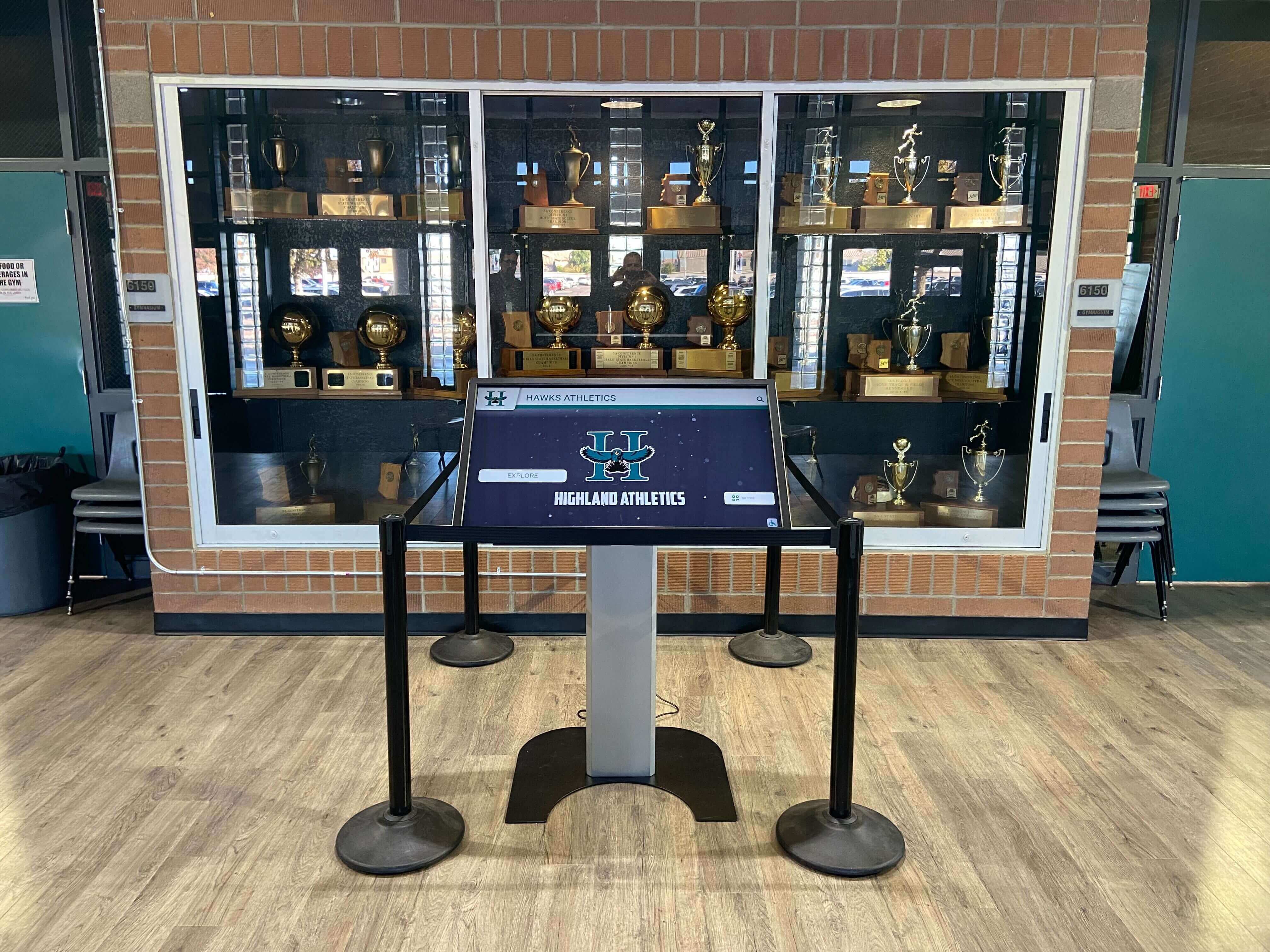
For programs that add inductees on a predictable annual cycle—after each spring signing season, before fall induction ceremonies, or alongside senior recognition events at the end of the school year—that structural guarantee is the difference between managing an ongoing audit burden and making a one-time platform investment in safeguards that protect every subsequent data entry.
Recognition programs serve inductees, their families, and the school community for decades. An athletic department that maintains records from a school’s founding cohort to last spring’s signing class is stewarding a historical archive that grows more irreplaceable every year. Error prevention in the forms where that archive is built and maintained is not a nice-to-have: it is the infrastructure that makes long-term stewardship possible.