



Key Takeaways
Run a digital hall of fame ARIA-atomic audit to confirm that dynamic result counts, search status messages, and filter state changes are announced with enough context for screen reader users. Step-by-step guide for school administrators and IT teams.
aria-atomic. A digital hall of fame ARIA-atomic audit checks every live region on the interface—result counts, search status messages, filter confirmations, loading indicators, and error notices—to confirm that each one announces a complete, contextual phrase rather than a bare fragment. This guide walks school IT staff, athletic directors, and accessibility coordinators through every step of that audit without requiring access to the platform's source code.
What ARIA Live Regions Do in a Hall-of-Fame Interface
Most content on a hall of fame webpage or kiosk is static: inductee names, portrait images, career summaries, and sport categories are loaded once and do not change while a visitor browses. ARIA live regions exist for the content that does change—content that updates in response to a visitor’s action without a full page reload.
On a school athletic hall of fame, live regions typically carry:
- Result counts — “Showing 48 inductees” that updates when a visitor filters by sport, decade, or award type
- Search status messages — “Searching…” while a query runs, then “Found 6 inductees matching ‘Johnson’”
- Filter confirmation — “Filter applied: Women’s Soccer” or “3 filters active”
- Loading states — “Loading inductee profiles…” or “Loading class of 1998…”
- Error notices — “No inductees found for that search. Try a broader term.”
- Sort confirmations — “Sorted by year inducted, newest first”
A screen reader user cannot see these updates visually, so the browser’s accessibility API must push the announcement automatically when the text changes. The role="status" or aria-live="polite" attributes on those elements are what trigger that announcement. The aria-atomic attribute controls how much of the region gets announced.
When a hall of fame developer writes the result count as a region where only the number is updated—the JavaScript replaces “48” with “12” while the surrounding “Showing … inductees” text stays unchanged—a screen reader with aria-atomic absent or set to false announces only “12.” A visitor using NVDA or VoiceOver hears “twelve” with no indication that it is a count, no indication of what was filtered, and no indication that the list on screen has changed. The audit’s job is to find every place this happens and confirm whether aria-atomic="true" is present and correctly applied.
What aria-atomic Controls: A Practical Comparison
The table below shows how the same live region behaves under each aria-atomic setting. Understanding this distinction is the conceptual foundation of the audit.
| Scenario | aria-atomic Setting | What the Screen Reader Announces | Is This Sufficient? |
|---|---|---|---|
| Result count updates from 48 to 12 after a filter | aria-atomic="true" | “Showing 12 inductees” (full region text) | Yes |
| Result count updates from 48 to 12 after a filter | aria-atomic="false" or absent | “12” (only the changed text node) | No — no context |
| Search status changes to “Found 6 inductees matching Johnson” | aria-atomic="true" | “Found 6 inductees matching Johnson” | Yes |
| Search status changes to “Found 6 inductees matching Johnson” | aria-atomic="false" | “Found 6” or “Johnson” depending on which node changed | No — fragment only |
| Error: “No inductees found for Basketball” | aria-atomic="true" | “No inductees found for Basketball” | Yes |
| Error message node changes but surrounding label stays | aria-atomic="false" | “Basketball” or blank (no audible change) | No |
| Loading indicator: “Loading…” then “Ready” | aria-atomic="true" | “Loading…” then “Ready” | Yes — if both are complete phrases |
| Filter applied: “Filter active: Women’s Soccer” | aria-atomic="true" | “Filter active: Women’s Soccer” | Yes |
| Filter label changes, pill text updates independently | aria-atomic="false" | “Women’s Soccer” (the changed child node) | Marginal — may lack context |
| Sort confirmation: “Sorted by year, ascending” | aria-atomic="true" | “Sorted by year, ascending” | Yes |
The rule that emerges from this table: whenever the meaningful unit of information spans more than the DOM node that JavaScript updates, aria-atomic="true" is necessary. For most hall-of-fame status messages, that means the attribute should be present on every live region.
The Five Live Region Types Most Likely to Fail the Audit

Hall of fame platforms differ in their architecture, but the live region failures that appear in audits cluster around five interaction patterns. Knowing which patterns fail most often lets a school IT team focus the audit on high-probability problem areas before expanding to a full sweep.
Schools that support youth athlete recognition programs often display large inductee rosters where search and filter are the primary navigation tools — making live region correctness especially important for families and community members who rely on assistive technology.
1. The Result Count Region
The result count is the most commonly audited live region on a hall of fame interface because it updates on almost every interaction. Developers often build it as:
<div role="status">Showing <span id="count">48</span> inductees</div>
When the filter changes, the JavaScript updates #count from “48” to “12.” Without aria-atomic="true" on the outer div, most screen readers announce only “12.” The fix is either to add aria-atomic="true" to the outer region, or to rewrite the JavaScript so it replaces the entire phrase as a single text node: “Showing 12 inductees.” Both approaches work; the second is more robust because it does not depend on aria-atomic behavior varying across screen readers.
2. The Search Status Message
Search interfaces on hall of fame platforms frequently show a message while the query runs (“Searching…”) and then replace it with a results summary (“Found 6 inductees matching ‘Johnson’”). When these are implemented as two separate text updates to different child nodes within the same region—or as a single node replacement that screen readers treat as a mutation on the parent—aria-atomic determines whether the transition is announced coherently. A region missing aria-atomic="true" may announce “Searching” and then “6” with no connection between them.
3. Filter State Badges or Chips
Many hall of fame platforms display active filters as removable chips or badges: “Basketball × Women’s Soccer ×”. When a visitor removes a filter, the chip disappears and the result count updates. If the region containing these chips uses role="status" without aria-atomic="true", removing a chip may produce no announcement at all—the DOM mutation removes a node rather than adding text, and some screen readers do not announce removals unless the live region’s full text is re-rendered. Schools that display wrestling awards or other sport-specific recognition alongside multi-sport filter panels are especially likely to encounter this pattern.
4. Loading Indicators Tied to Asynchronous Fetches
When a hall of fame platform loads inductee profiles asynchronously—common on large archives representing decades of athletic history—a loading indicator such as “Loading class of 1998…” may appear in a live region while the request completes. These regions are often built with aria-live="assertive" to interrupt any ongoing screen reader announcement. If aria-atomic is absent, the announcement depends on which text node changes. An assertive region that announces “1998” instead of “Loading class of 1998” is technically present but practically useless.
5. Error and Empty-State Messages
When a search returns no results, a hall of fame platform typically shows a message: “No inductees found for ‘Kowalski’. Try a broader search term.” This message often shares a container with the result count. If the result count region becomes “0” and the error message appears in a sibling element, two live regions may fire in rapid succession. Screen readers handle simultaneous live region announcements unpredictably; the correct approach is a single region with aria-atomic="true" that renders the complete status—count and message together—so only one coherent announcement fires.
How to Run a Digital Hall of Fame ARIA-Atomic Audit
This audit requires only a modern browser and takes roughly thirty to sixty minutes for a typical hall of fame interface. Developer access to source code is not required for the discovery and testing phases; it is required only for remediation.
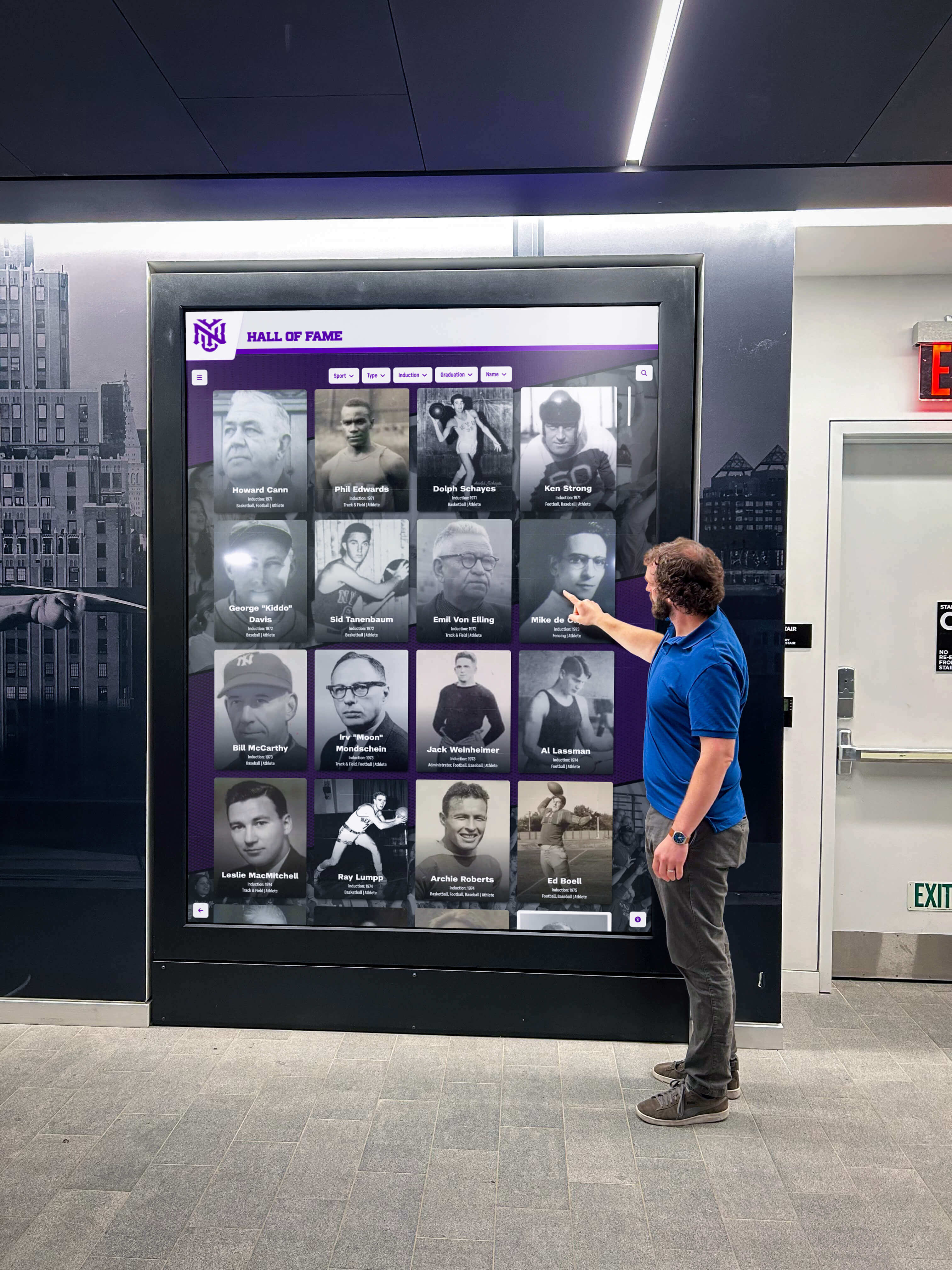
Step 1 — Inventory Every Live Region Using DevTools
Open the hall of fame interface in Chrome or Edge. Open DevTools (F12 or Ctrl+Shift+I on Windows; Cmd+Option+I on Mac). In the Elements panel, use the search function (Ctrl+F within the panel) to find each of the following attribute strings in sequence:
aria-liverole="status"role="alert"role="log"aria-atomic
For each match, record the element’s tag, its location in the interface (result count area, search input, filter panel, error container), the aria-live value (polite or assertive), and whether aria-atomic is present and what value it carries. Create a simple table with one row per live region before moving to step 2. A recognition display touchscreen configuration audit often surfaces these regions in the display software’s accessibility layer even when the physical hardware configuration is the primary focus.
Step 2 — Trigger Each Live Region and Listen
Activate a screen reader before beginning this step. On Windows, use NVDA (free download from nvaccess.org) with Chrome. On macOS, activate VoiceOver with Cmd+F5 and use Safari. On a touchscreen kiosk in a school hallway, use the device’s built-in accessibility mode if available.
For each live region identified in Step 1:
- Position keyboard focus away from the live region so no focus-based announcement fires.
- Trigger the change: apply a sport filter, run a search, remove a filter chip, or trigger an empty-state by searching for a term with no matches.
- Listen to what the screen reader announces immediately after the change.
- Record the full announcement text verbatim.
- Compare the announcement to the visible text change on screen.
A correctly configured live region with aria-atomic="true" should announce a complete, self-contained phrase. A failing region announces a fragment—a number, a word, or nothing at all.
Step 3 — Inspect aria-atomic Values for Each Failing Region
For each live region where the announcement was a fragment or was absent, return to DevTools and examine the element closely:
- Is
aria-atomicpresent on the live region element? - If present, is it set to
trueorfalse? - Is the live region attribute on the outermost container, or on a child element that only wraps part of the text?
- Does the JavaScript update a child
<span>whilearia-atomicis on a parent<div>that also contains static text outside the<span>?
The last point is a common source of confusion: aria-atomic="true" on the outermost element should cause the screen reader to announce the full region, including static text siblings of the updated <span>. But some screen reader and browser combinations only honor this when the live region container is a single flat element with no intervening roles on its children. If the child <span> has its own role or aria-live attribute, it may override the parent’s aria-atomic setting.
Step 4 — Verify aria-relevant Is Not Overriding Atomic Behavior
aria-relevant is a companion attribute to aria-live that specifies which types of DOM changes trigger an announcement: additions, removals, text changes, or all three. The default value is "additions text". When aria-relevant is set to "removals" or "all" on a live region, the screen reader may fire announcements for node removals—such as a filter chip being removed—in addition to text updates. Combined with aria-atomic="false", this can produce a flood of partial announcements.
Check each live region for an aria-relevant attribute. If it is present and set to anything other than the default, document it and evaluate whether the non-default value is intentional. In most hall of fame interfaces, aria-relevant is not needed; the default behavior of announcing text additions is sufficient. Removing a non-default aria-relevant attribute and adding aria-atomic="true" often resolves multiple announcement failures simultaneously.
Step 5 — Test the Empty-State and Error Message Paths
Navigate to each error path:
- Submit a search that returns zero results (use a string that no inductee name or sport contains, such as “zzzzz”)
- Remove all filters so the full roster appears, then confirm the result count announcement
- Test any inline validation messages on search or filter inputs
For each path, listen to what the screen reader announces and compare to the visible message. An error message in a role="alert" region with aria-atomic="true" should announce the full error text immediately, even if the user has not moved focus to it. A role="alert" region without aria-atomic="true" may announce only the portion of the error text that changed, which is especially problematic when the error message uses a template that inserts the failing search term: “No inductees found for [term].”
Step 6 — Document Findings and Assign Remediation Priority
Compile the audit into a findings table using the structure below. Share this with your platform vendor or IT team.
| Live Region | Location | Aria-Live Value | Aria-Atomic Present? | Aria-Atomic Value | Announcement Observed | Expected Announcement | Priority |
|---|---|---|---|---|---|---|---|
| Result count | Above inductee grid | polite | No | — | “12” | “Showing 12 inductees” | High |
| Search status | Search input area | polite | Yes | false | “Johnson” | “Found 6 inductees matching Johnson” | High |
| Filter chips | Filter bar | status | No | — | Silent | “Filter removed: Basketball, Showing 48 inductees” | Medium |
| Loading indicator | Inductee grid | assertive | No | — | “Loading” | “Loading inductee profiles, please wait” | Medium |
| Error message | Below search input | alert | Yes | true | “No inductees found for zzzzz” | “No inductees found for zzzzz” | Pass |
| Sort confirmation | Sort dropdown | polite | No | — | Silent | “Sorted by graduation year, ascending” | Low |
Common aria-atomic Failure Patterns and Their Fixes
The table below maps the failure patterns observed most frequently on school hall of fame platforms to their remediation approach. This table is suitable for sharing with a vendor’s support team as a structured remediation request.
| Failure Pattern | Root Cause | Recommended Fix |
|---|---|---|
| Result count announces a bare number | aria-atomic absent; JavaScript updates only the number <span> | Add aria-atomic="true" to the outermost live region container |
| Search status announces partial phrase | aria-atomic="false" explicitly set on the region | Change to aria-atomic="true" |
| Filter chip removal produces no announcement | aria-relevant set to "additions text" (default); removals not tracked | Add a confirming text update to the region on chip removal, or set aria-relevant="all" with aria-atomic="true" |
| Error message announces only the search term | Error container is a child region with its own aria-live; parent aria-atomic does not reach it | Move aria-live and aria-atomic to a single container wrapping both label and dynamic text |
| Loading indicator announces then falls silent | JavaScript sets text to “Loading…” then updates to empty string when complete | Update the region to “Ready” or “Inductees loaded” rather than clearing it; use aria-atomic="true" |
| Sort confirmation announces nothing | Sort confirmation region is not a live region | Wrap sort confirmation text in a role="status" container with aria-atomic="true" |
| Multiple simultaneous announcements override each other | Two separate aria-live regions update at the same time | Merge status messages into a single region; use a queue pattern to serialize updates |
Connecting the Audit to Broader Hall-of-Fame Accessibility Practice
A digital hall of fame ARIA-atomic audit addresses a single layer of the accessibility stack. It belongs alongside related audits that cover the full visitor experience. Schools that have already reviewed their recognition display touch sensitivity from a hardware perspective and their inductee page reading order from a DOM perspective can add this audit to address the dynamic announcement layer specifically.
For IT teams supporting yearbook-connected recognition programs that feed inductee content into both print and digital formats, confirming that the digital hall of fame’s live regions are correctly configured ensures that accessibility work done in the content pipeline is not undermined at the announcement layer.
For schools that recognize youth athletes and program champions alongside multi-decade athletic hall of fame archives, the live region audit is especially important: families and community members who attend recognition events represent a wide range of abilities and assistive technology use cases. A screen reader user who attends an induction ceremony and later visits the hall of fame kiosk should be able to search for the evening’s honorees and receive a full, contextualized announcement of the results—not a bare number.
The audit results should be reviewed alongside Latin honors eligibility and awards criteria processes in districts where academic achievement is displayed alongside athletic recognition. Both types of recognition data flow through the same live region infrastructure, and a finding in the athletic inductee search will typically reproduce in any academic honors search on the same platform.
What Correct aria-atomic Implementation Looks Like in Practice
The following code pattern represents the correct structure for a hall of fame result count live region. It is included here as a reference for sharing with a vendor’s development team when requesting remediation.
Current (failing) pattern:
<div role="status">
  Showing <span id="result-count">48</span> inductees
</div>
When JavaScript runs document.getElementById('result-count').textContent = '12', a screen reader with aria-atomic absent announces only “12.”
Corrected pattern — Option A: Add aria-atomic:
<div role="status" aria-atomic="true">
  Showing <span id="result-count">48</span> inductees
</div>
The screen reader now announces “Showing 12 inductees” when the count updates.
Corrected pattern — Option B: Update the full text node:
<div role="status" id="result-region">
  Showing 48 inductees
</div>
JavaScript runs document.getElementById('result-region').textContent = 'Showing 12 inductees', replacing the entire text. This approach is the most robust because it provides complete context even when a screen reader ignores aria-atomic.
Option B is preferred when the surrounding phrase also conveys filter context: “Showing 12 inductees in Women’s Basketball” requires the JavaScript to construct the full phrase anyway, making a single text node replacement natural.
Audit Scope Reference Table
Use this table to confirm the scope of a completed audit before signing off.
| Audit Area | Items to Check | Typical Finding Rate | Notes |
|---|---|---|---|
| Result count region | 1–3 per interface | High — most platforms fail this | Check all filter pathways, not just the first |
| Search status messages | 2–4 states (idle, searching, results, no results) | High | Test the no-results path explicitly |
| Filter chips and badges | 1 per filter type | Medium | Removal path is harder to catch than addition |
| Loading indicators | 1–2 per async operation | Medium | Test slow network by throttling in DevTools |
| Error and empty-state messages | 2–3 per input | Medium | Template-inserted values most often fail |
| Sort confirmations | 1 per sortable column | Low — often absent entirely | Confirm a live region exists before testing atomic |
| Inline form validation | 1 per input field | Low on hall of fame search | More relevant on nomination or contact forms |
Rocket Alumni Solutions builds WCAG-conformant live regions into the hall of fame platform so result counts, search status, and filter confirmations announce complete, contextual phrases to every screen reader from day one. Schools that want to confirm their current display is correctly configured — or that are evaluating a new platform — can see the live region implementation in context during a personalized walkthrough.