



Key Takeaways
Discover the best coach hall of fame display ideas for schools and athletic programs—from traditional plaques to interactive digital systems that permanently honor legendary coaches.
Coaches build programs. They recruit raw talent, install systems, instill culture, and produce championship teams year after year—often for decades in the same hallways and locker rooms. Yet when athletic departments plan hall of fame displays, coaches are frequently an afterthought, added as a separate wing only after the athlete recognition program is already established. A dedicated coach hall of fame display corrects that imbalance, giving the people who shape athletic programs the permanent, prominent recognition their careers earned.
This guide covers everything needed to plan, design, and implement a coach hall of fame display—from choosing a format and deciding what to include, to running a credible nomination process and making the case for modern digital systems that scale with a program’s growing history.
Why Coaches Deserve Dedicated Hall of Fame Recognition
Athletes rotate through programs every four years. Coaches often define them for four decades. The coach who turned a struggling program into a perennial state contender, who sent dozens of athletes to college on scholarships, who mentored students through moments that had nothing to do with the scoreboard—that person’s impact extends far beyond any single season or graduating class.
Traditional athletic halls of fame focus almost exclusively on athletes. Win totals, all-conference selections, state tournament appearances, and post-graduation professional achievements fill the profiles. Coaches, if recognized at all, often get a banner on the gym wall or a plaque tucked near the locker room entrance that most students never stop to read.
A purposeful coach hall of fame display changes this dynamic. It signals to current coaches that longevity and excellence are rewarded. It shows current athletes the standard set by the people who shaped their program. And it communicates to prospective coaches considering open positions that this institution takes its history and its people seriously.

Types of Coach Hall of Fame Displays
Traditional Physical Displays
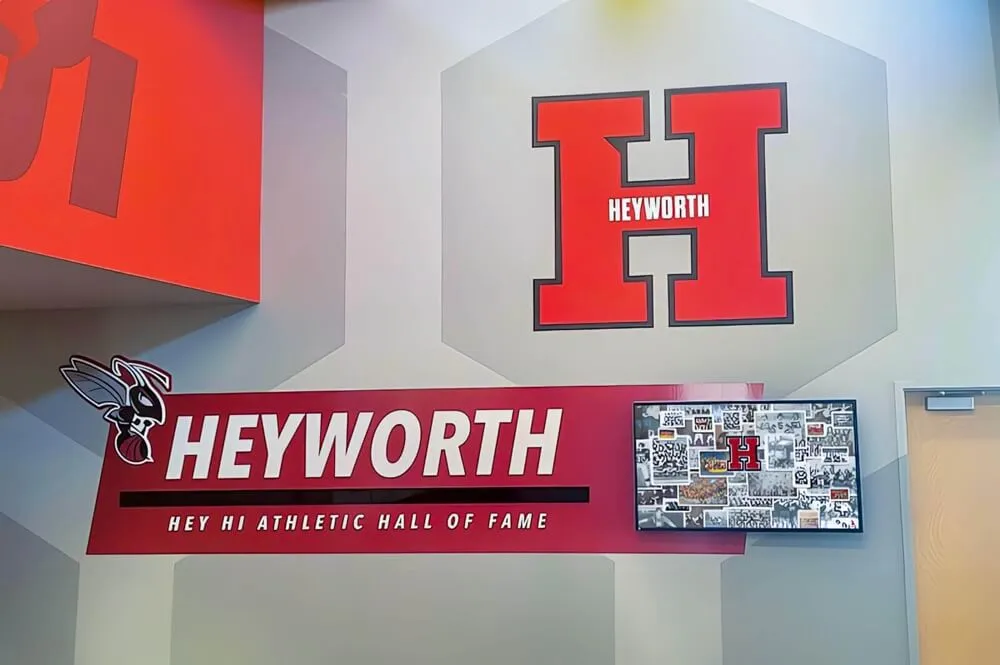
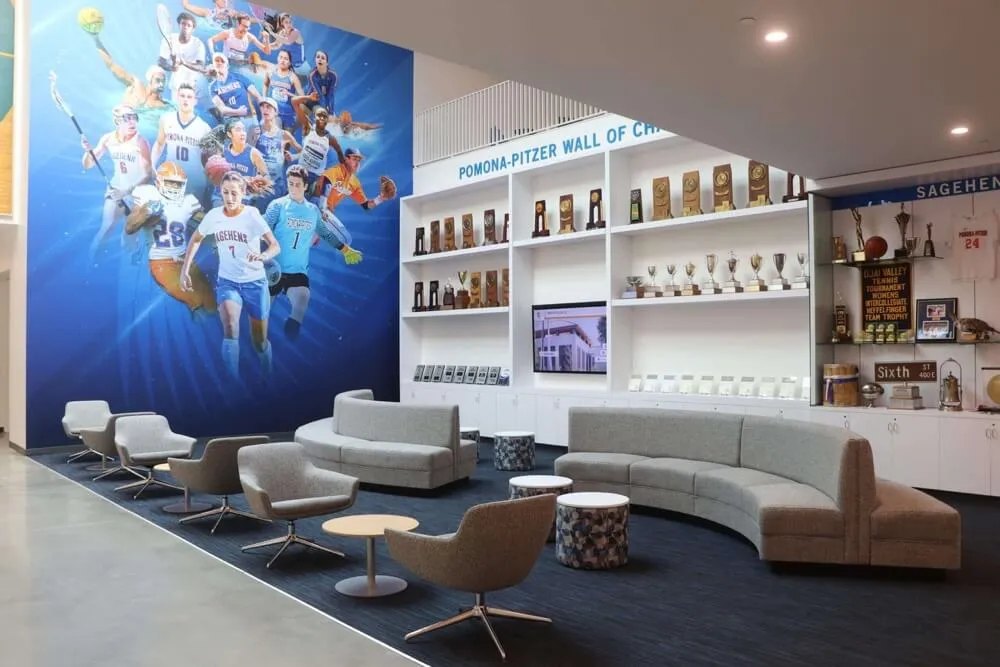
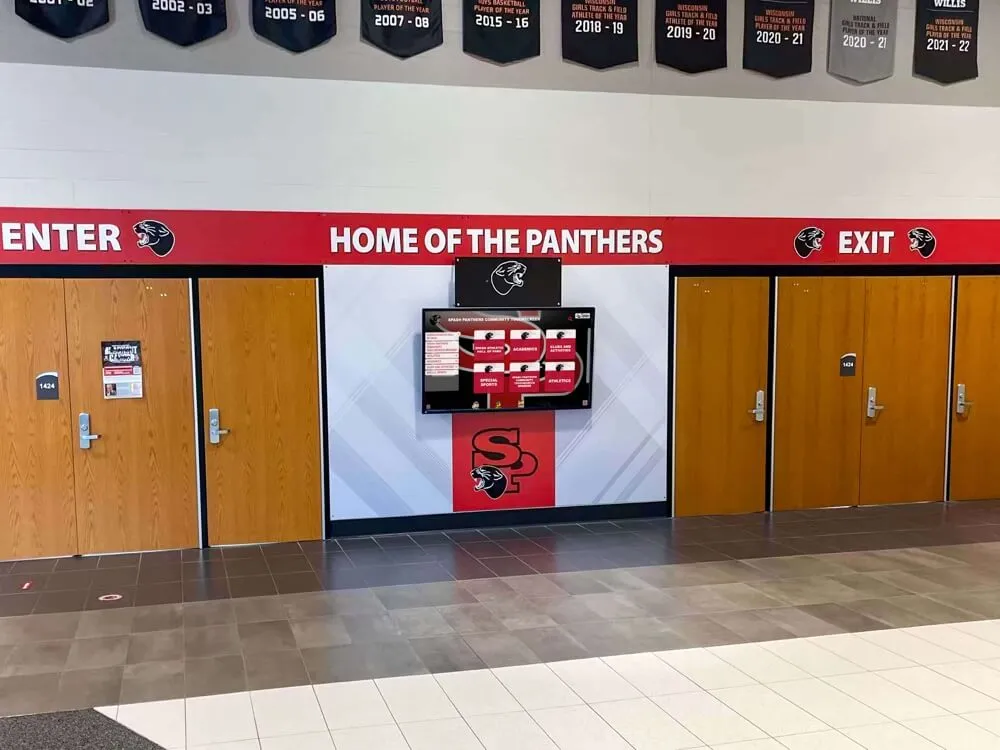
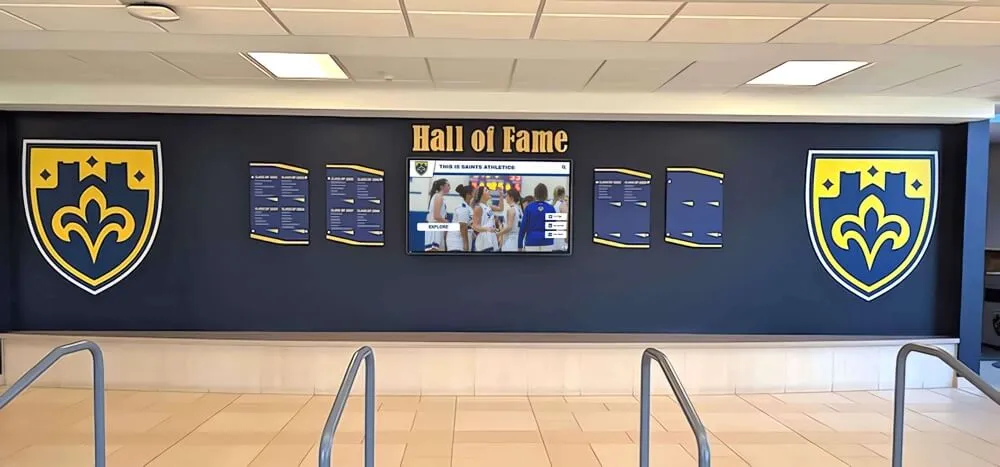
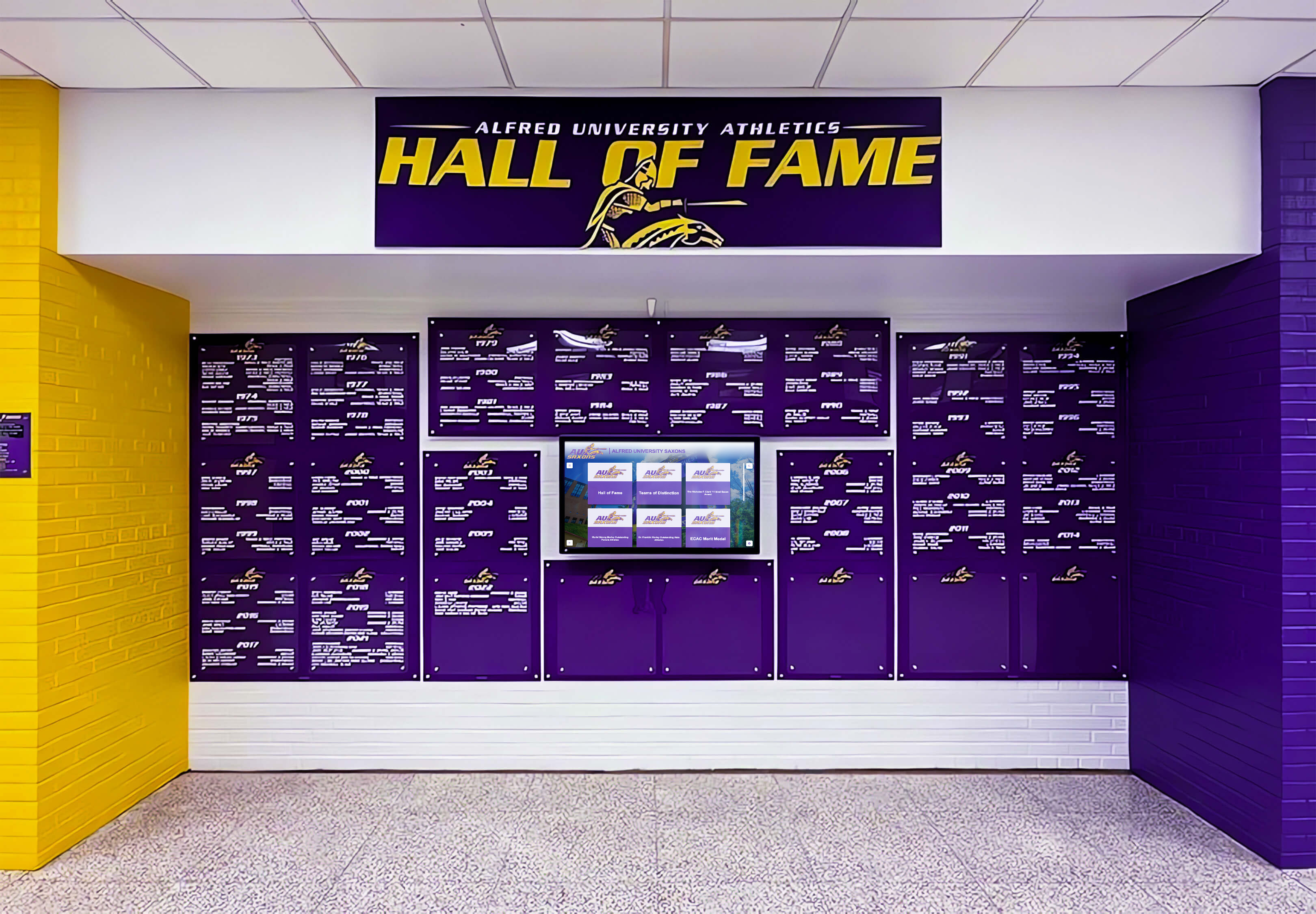
The most familiar coach hall of fame display consists of framed photographs with engraved nameplates, mounted chronologically along a hallway wall. Some schools use custom shield plaques—similar to those found in dedicated athletic hallways—bearing the coach’s name, sport, years of service, and career record. Others use illuminated display cases featuring trophies won under a coach’s tenure alongside a biographical panel.
Traditional displays carry genuine gravitas. There is something permanent and dignified about a physical plaque that a digital screen cannot fully replicate. For programs with modest budgets and a small number of honorees to recognize, a well-designed physical display represents a practical and elegant solution.
The limitations emerge over time. Physical space fills. Adding new inductees requires wall expansion or difficult decisions about removing existing materials. Updating information—correcting a career stat, adding a post-retirement achievement, replacing a faded photograph—requires physical replacement rather than a simple content update. And the amount of information a physical display can present is inherently constrained: a nameplate might hold 50 words; a truly comprehensive coaching biography needs 500.
Exploring traditional vs. digital display options for schools provides a detailed comparison of the long-term trade-offs, including costs, maintenance requirements, and the expanding recognition capacity that schools consistently underestimate when launching programs.
Digital Interactive Displays
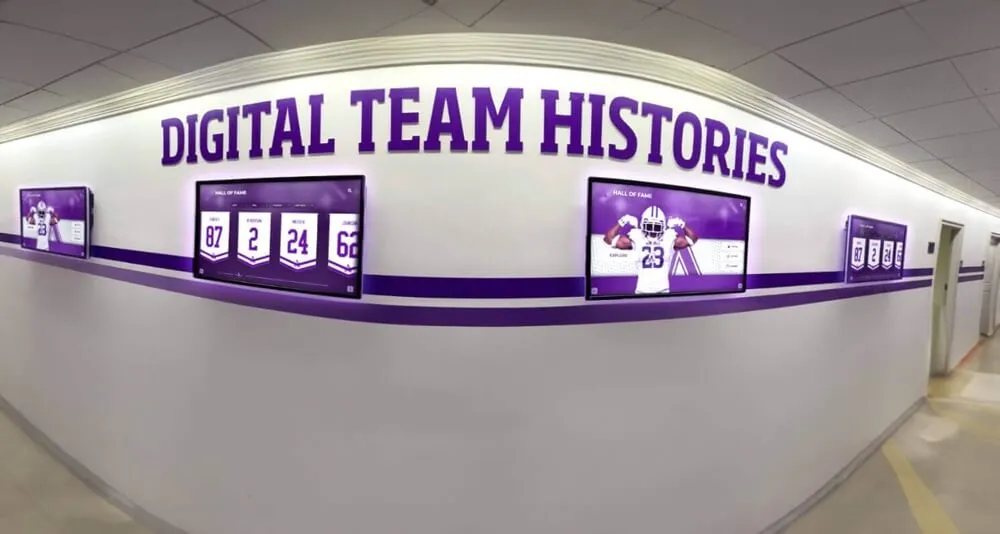
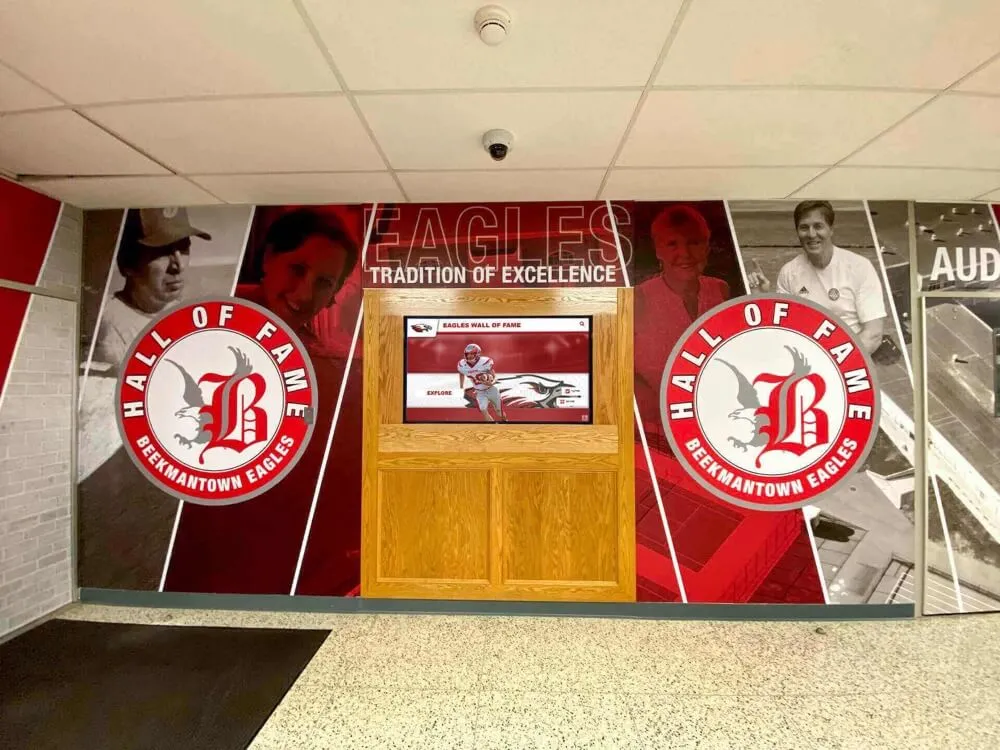
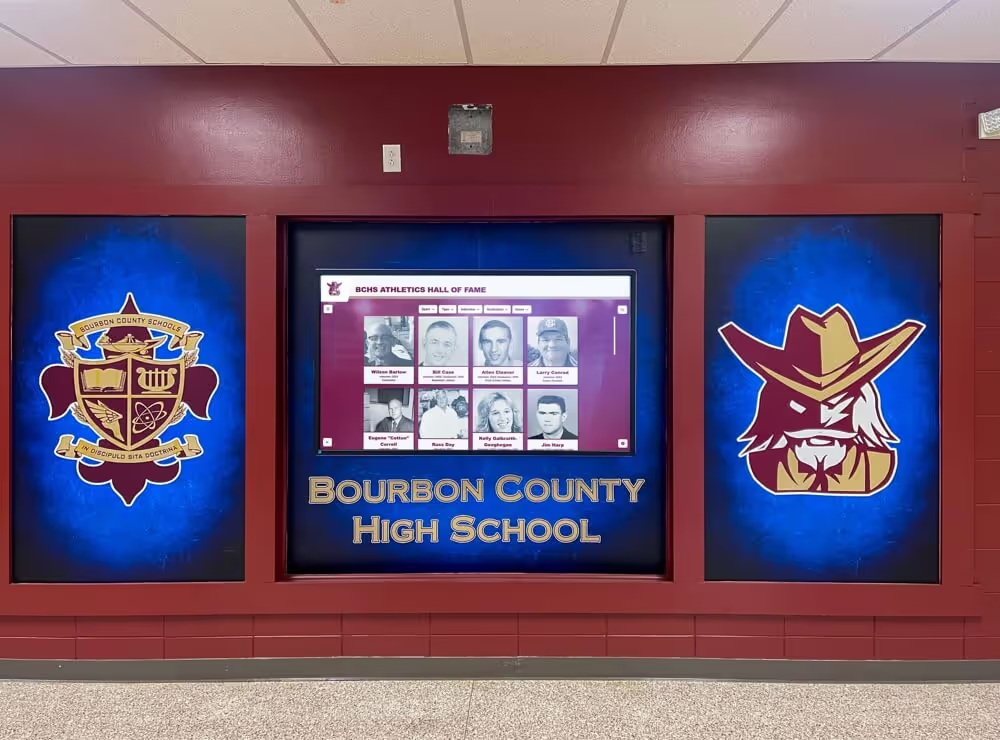
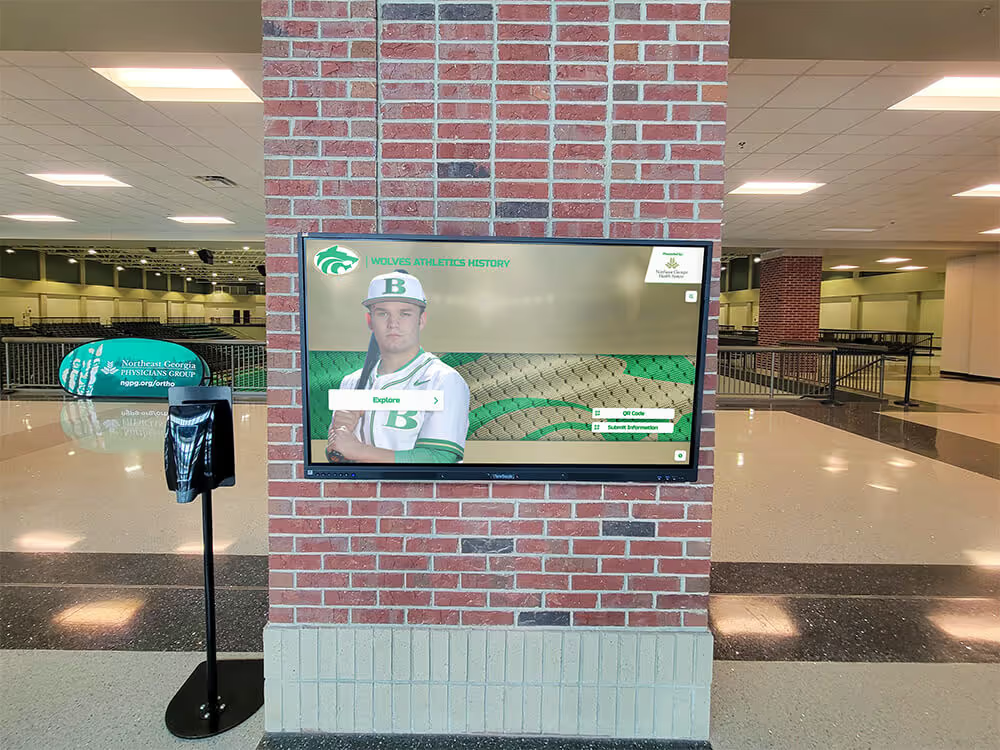
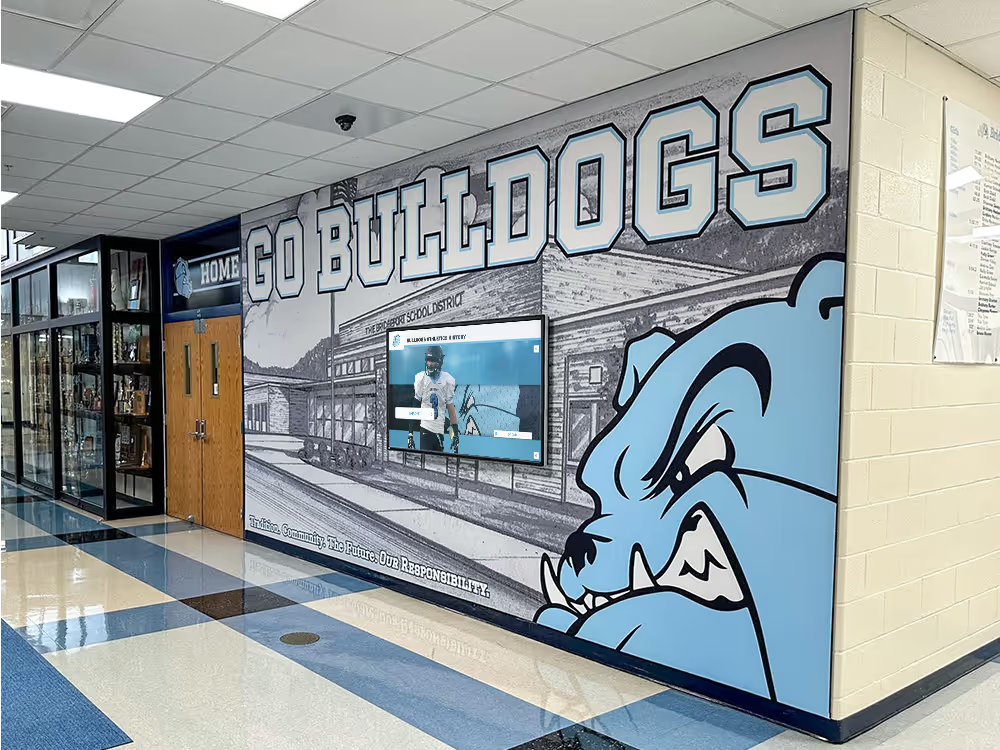
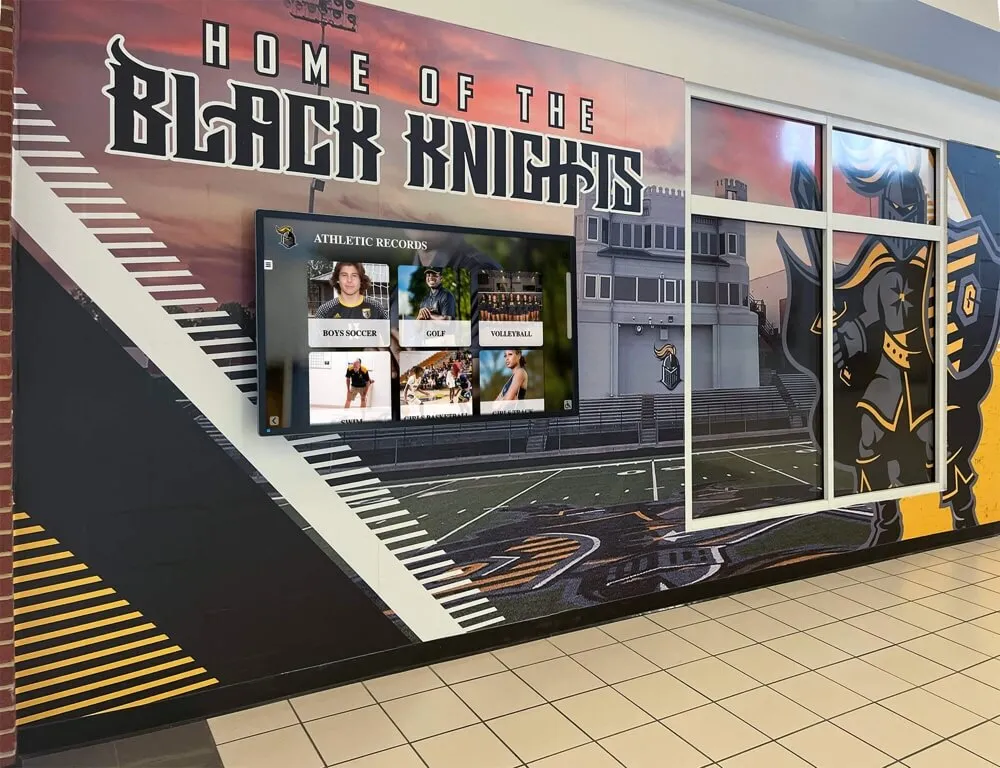
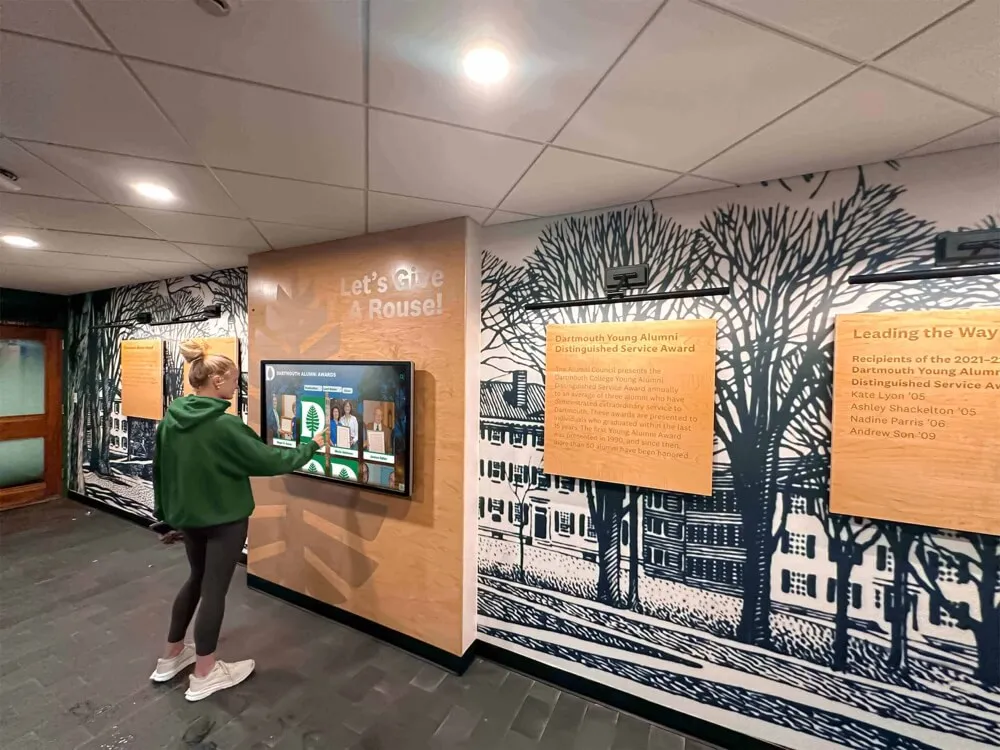
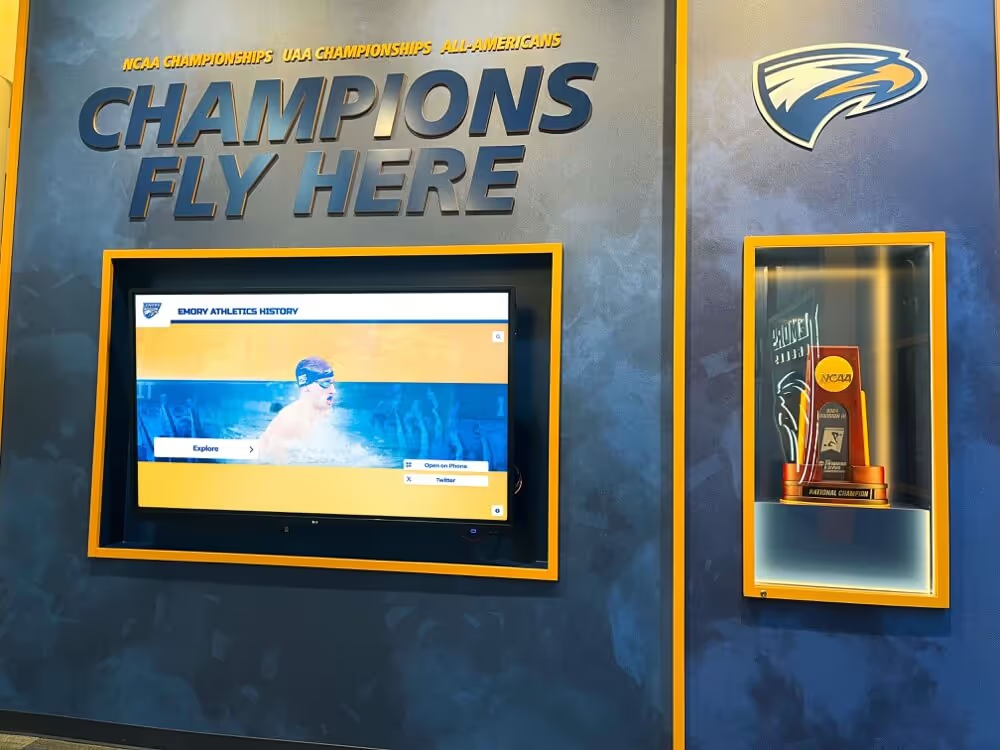
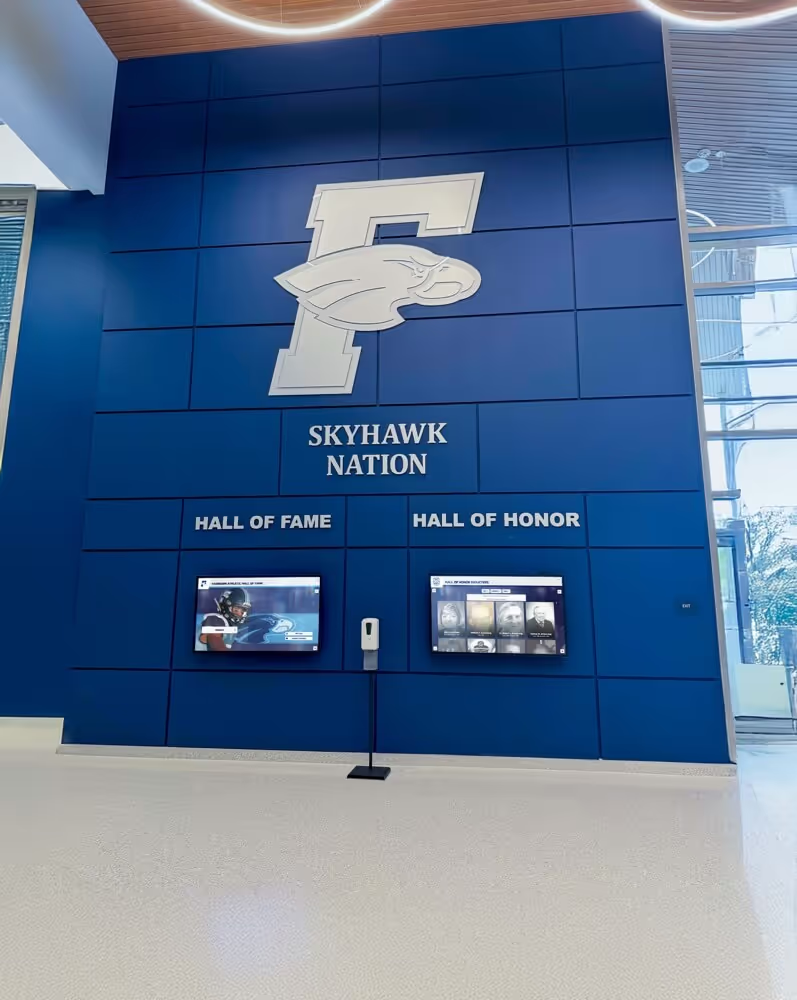
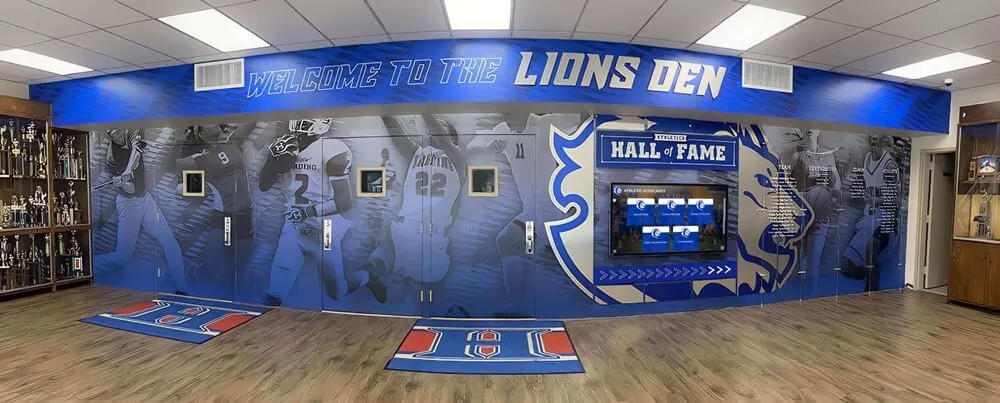
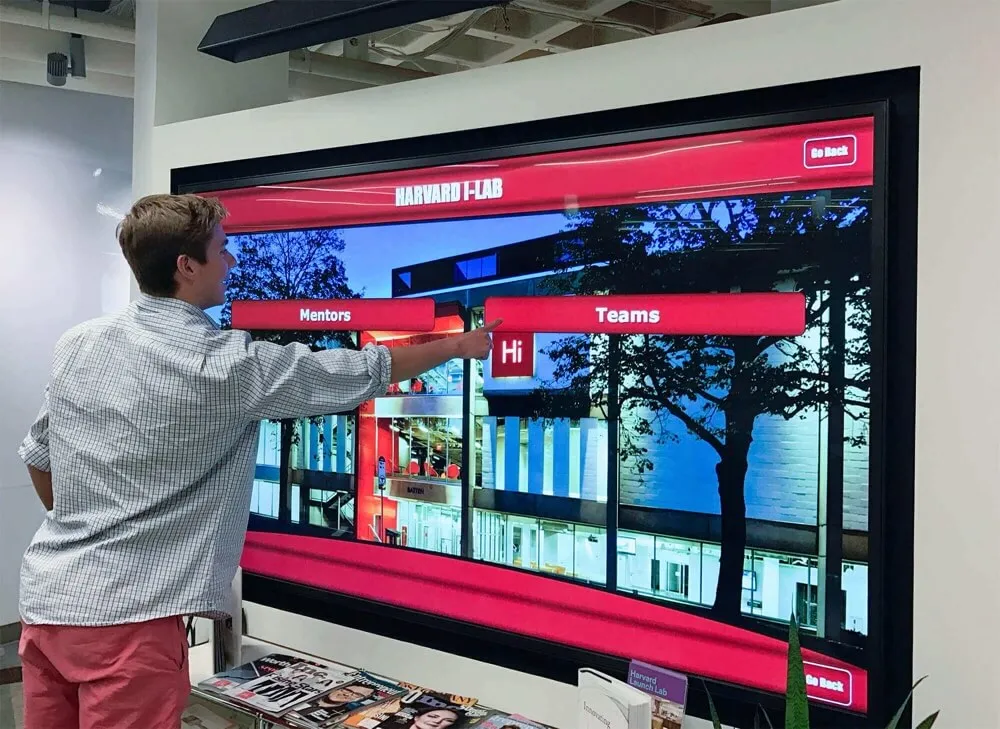
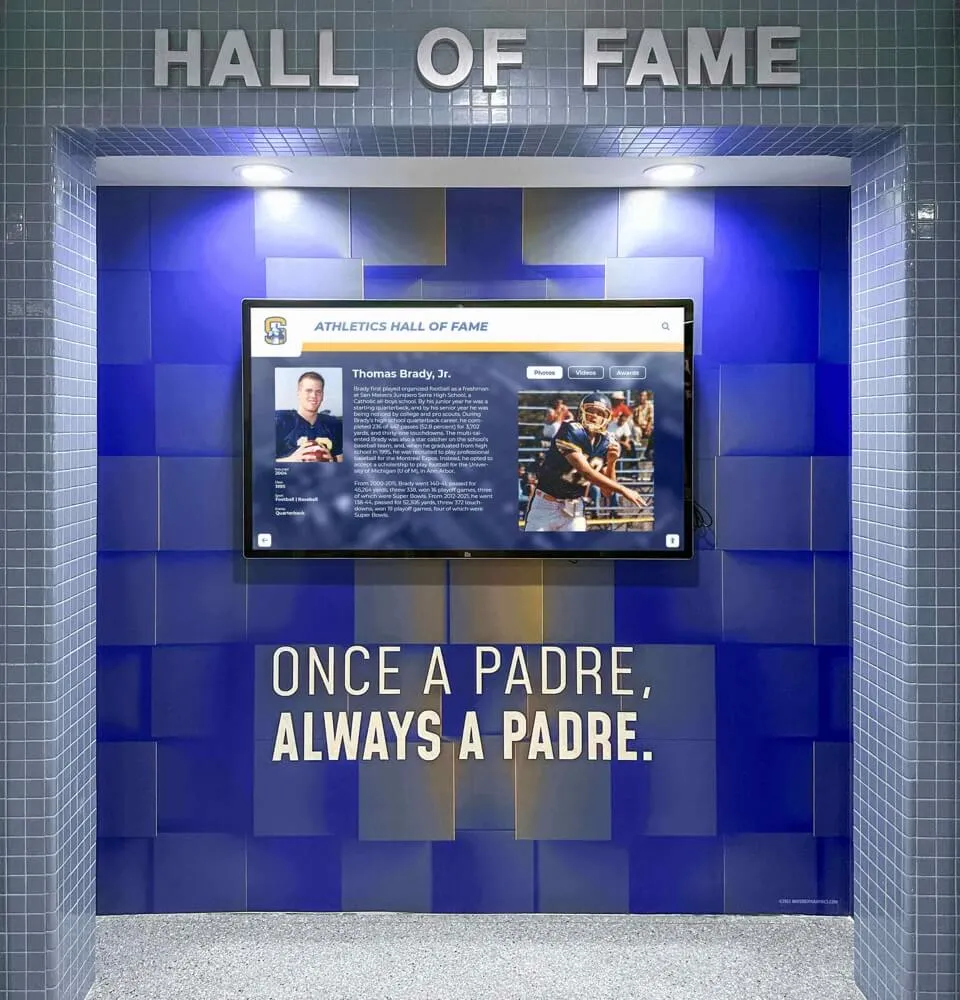
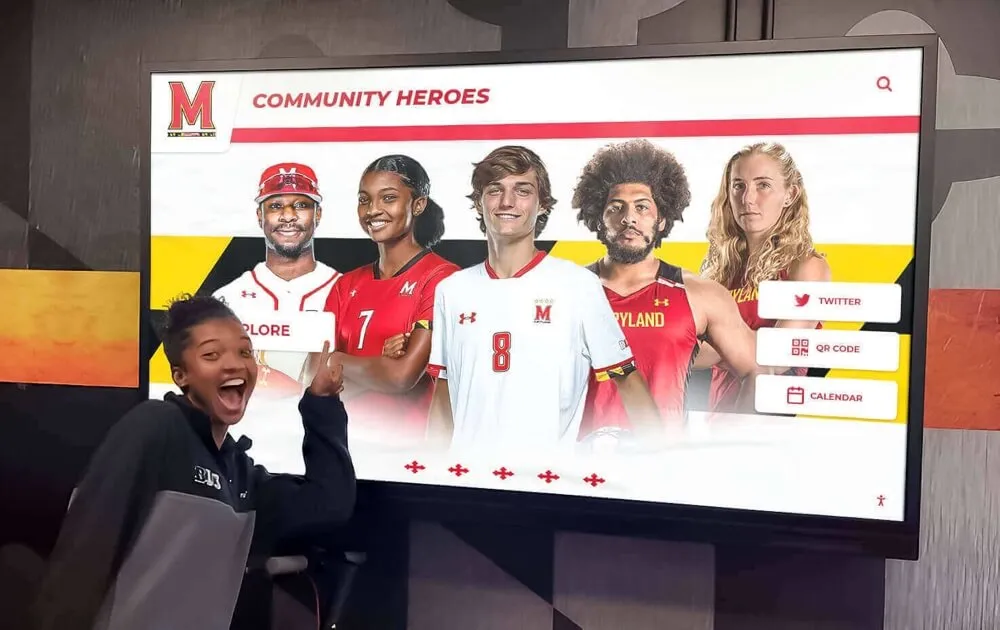
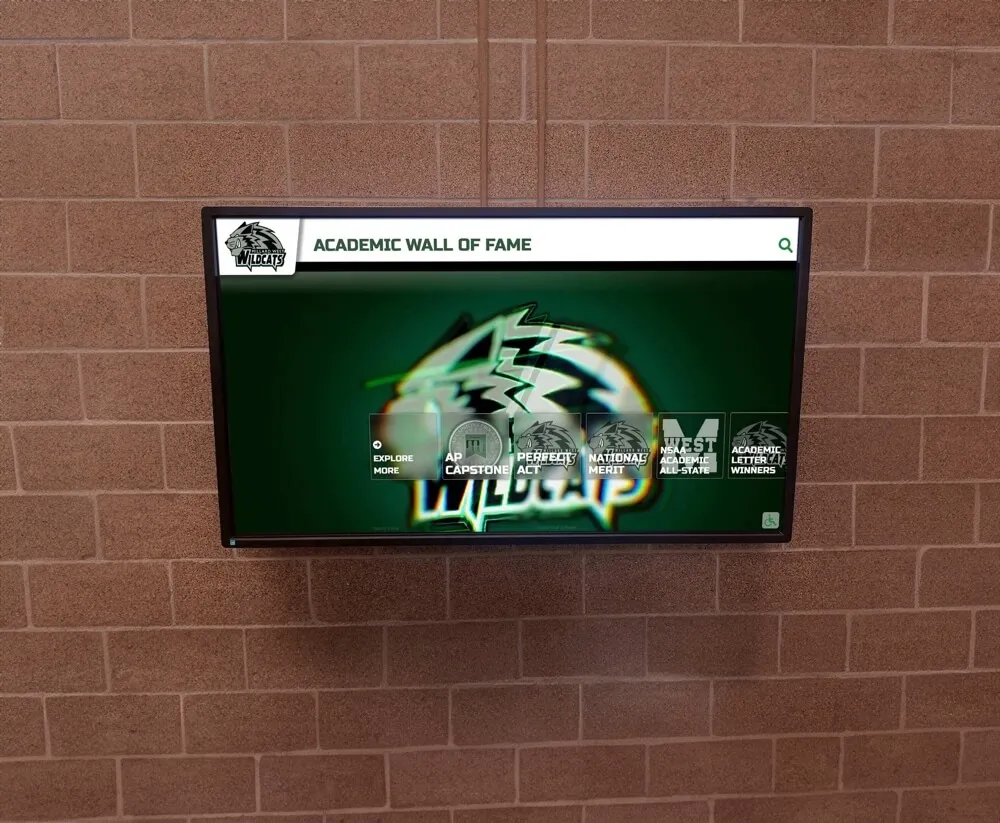
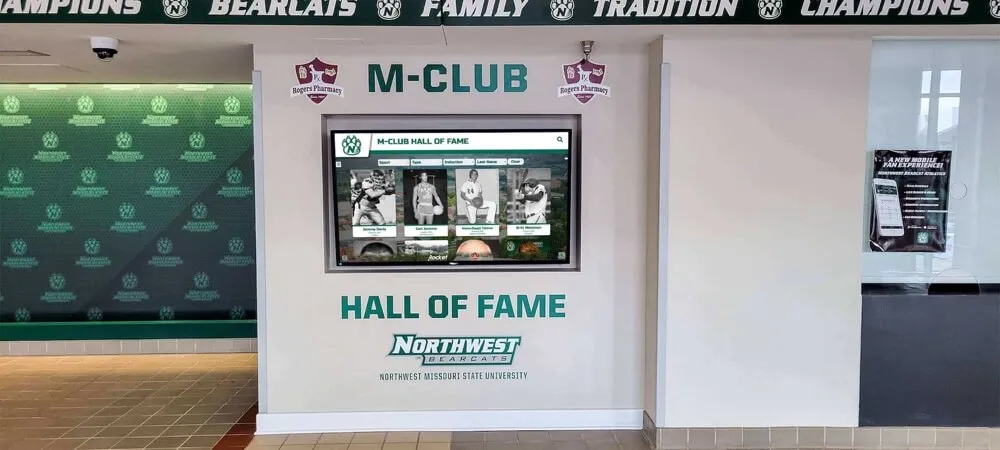
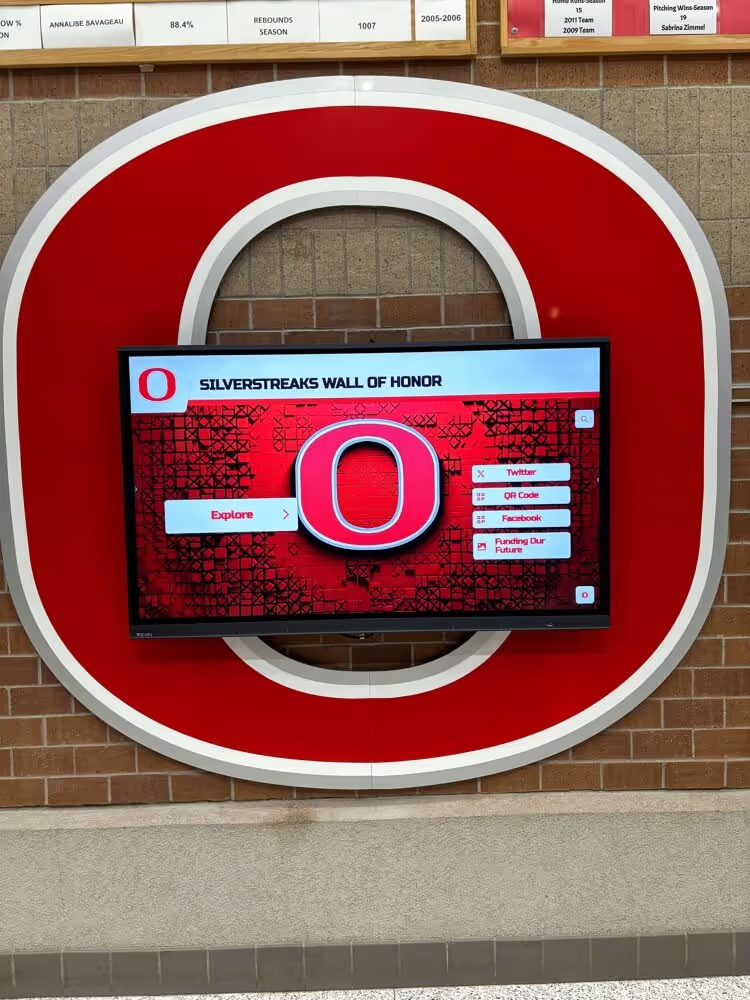
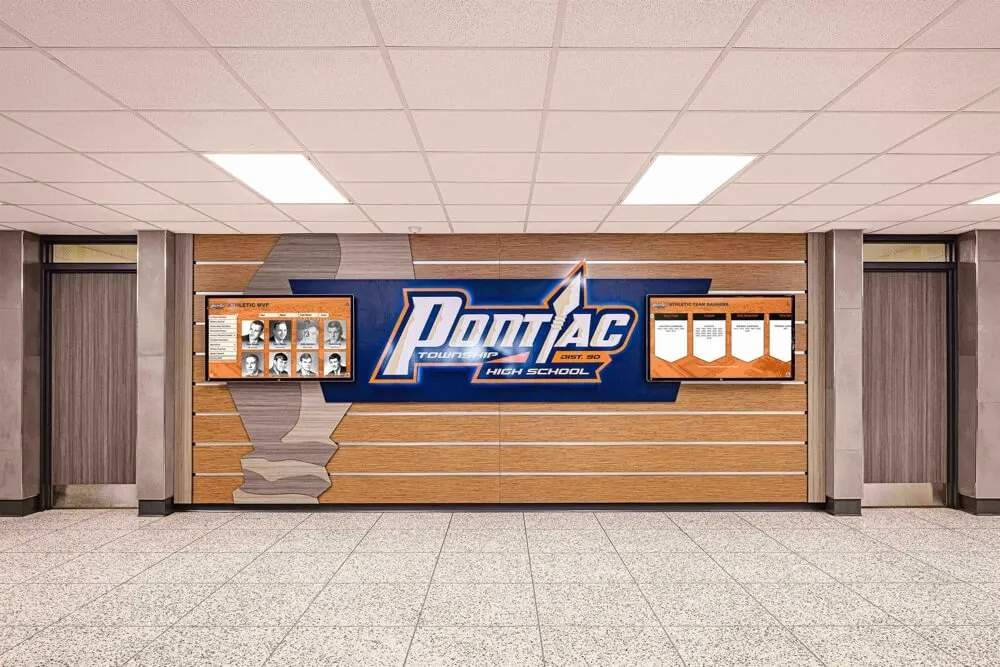
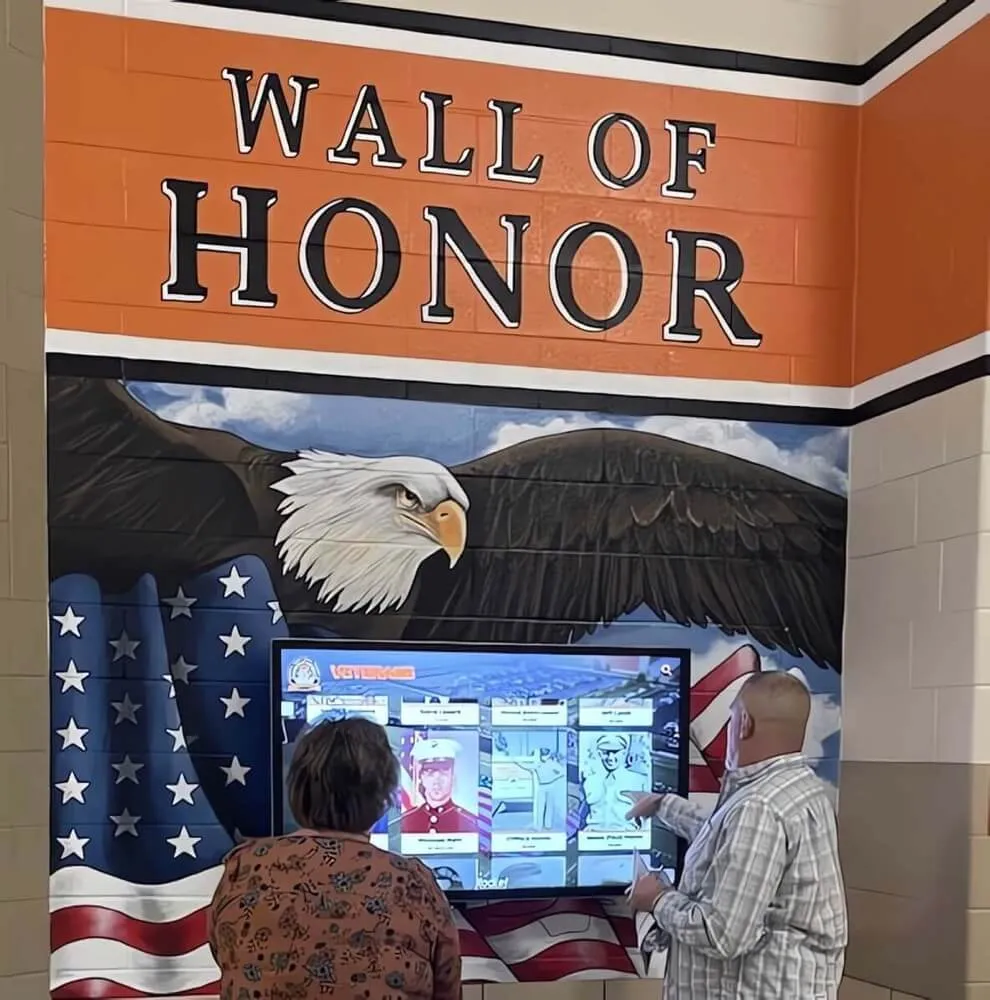
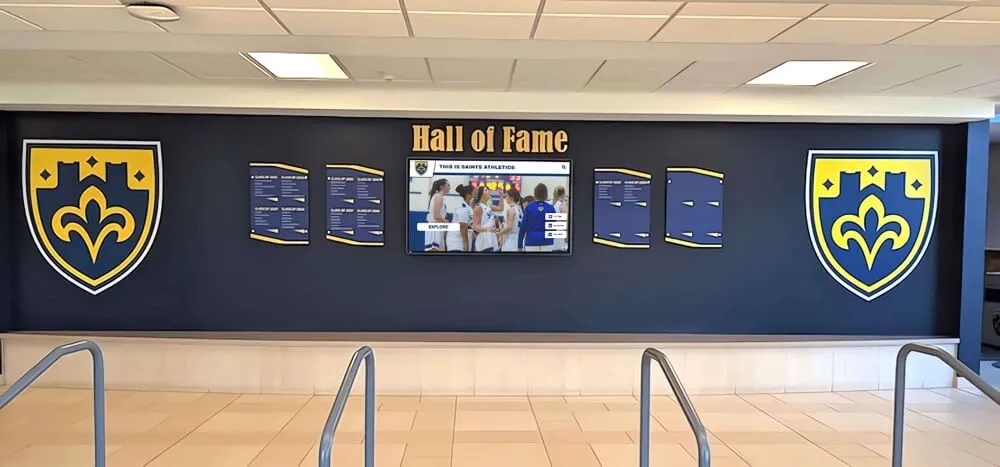
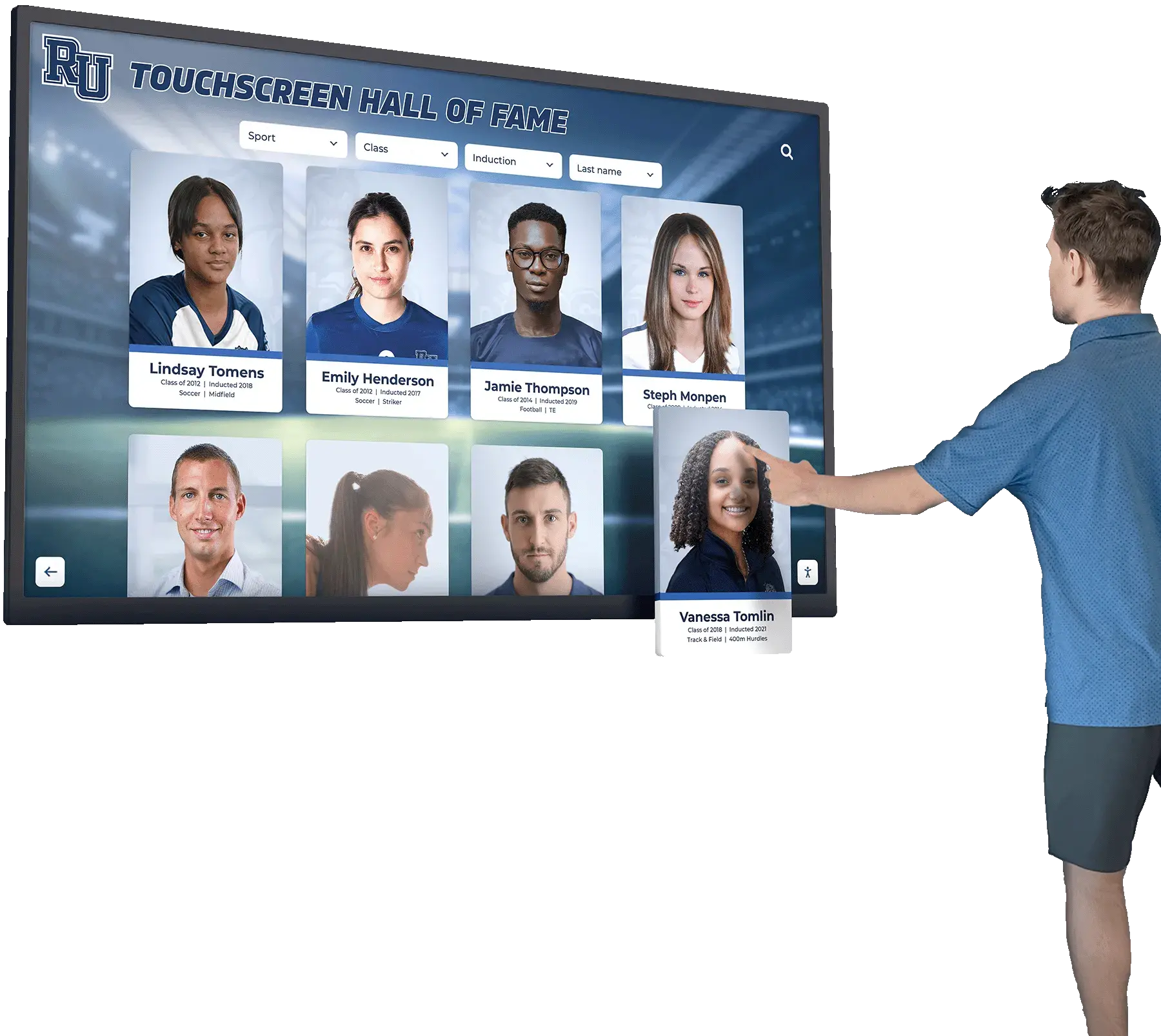
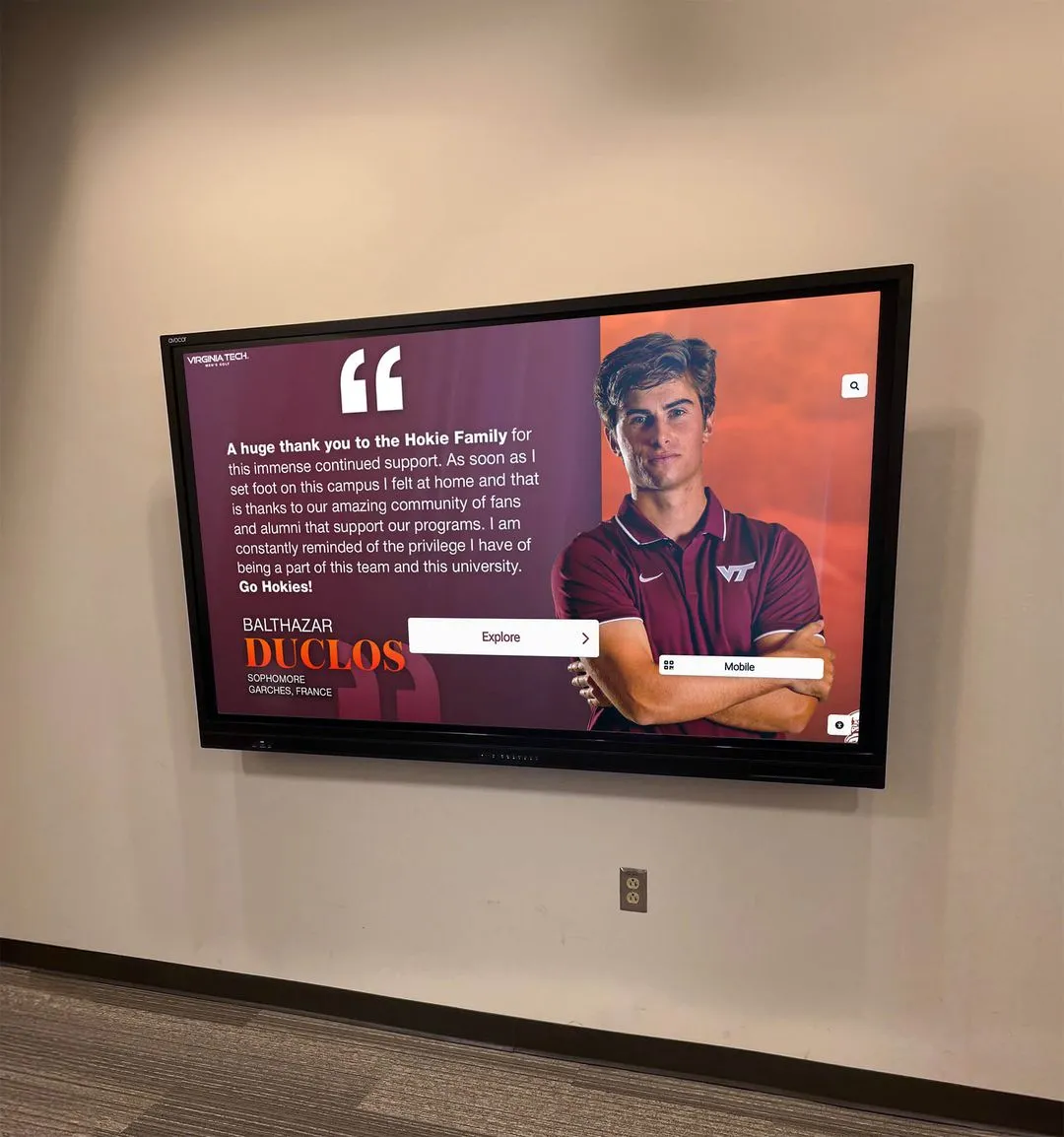
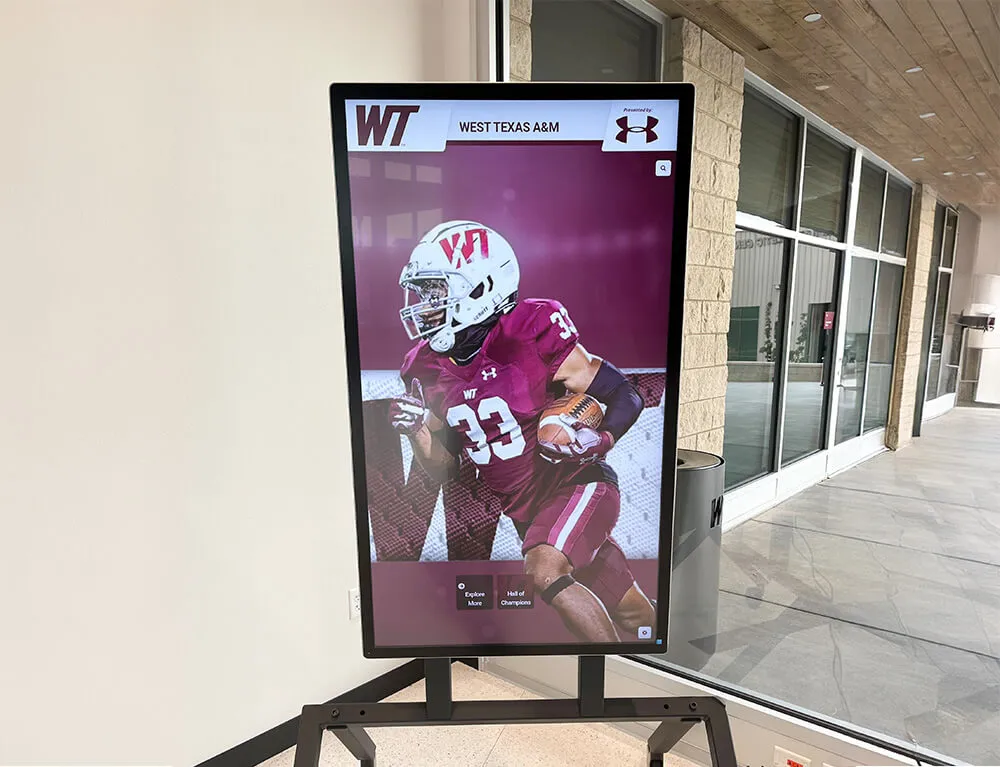
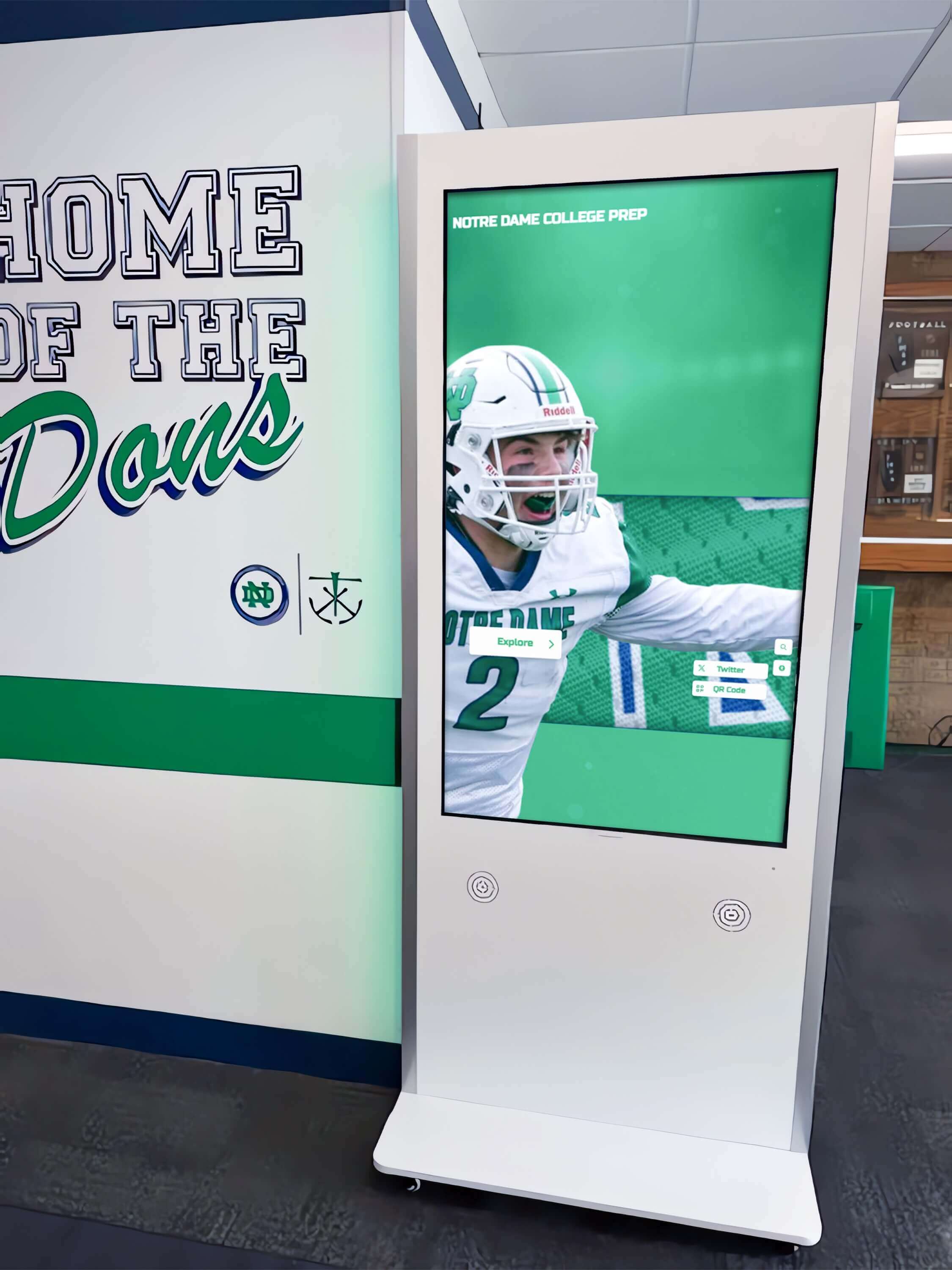
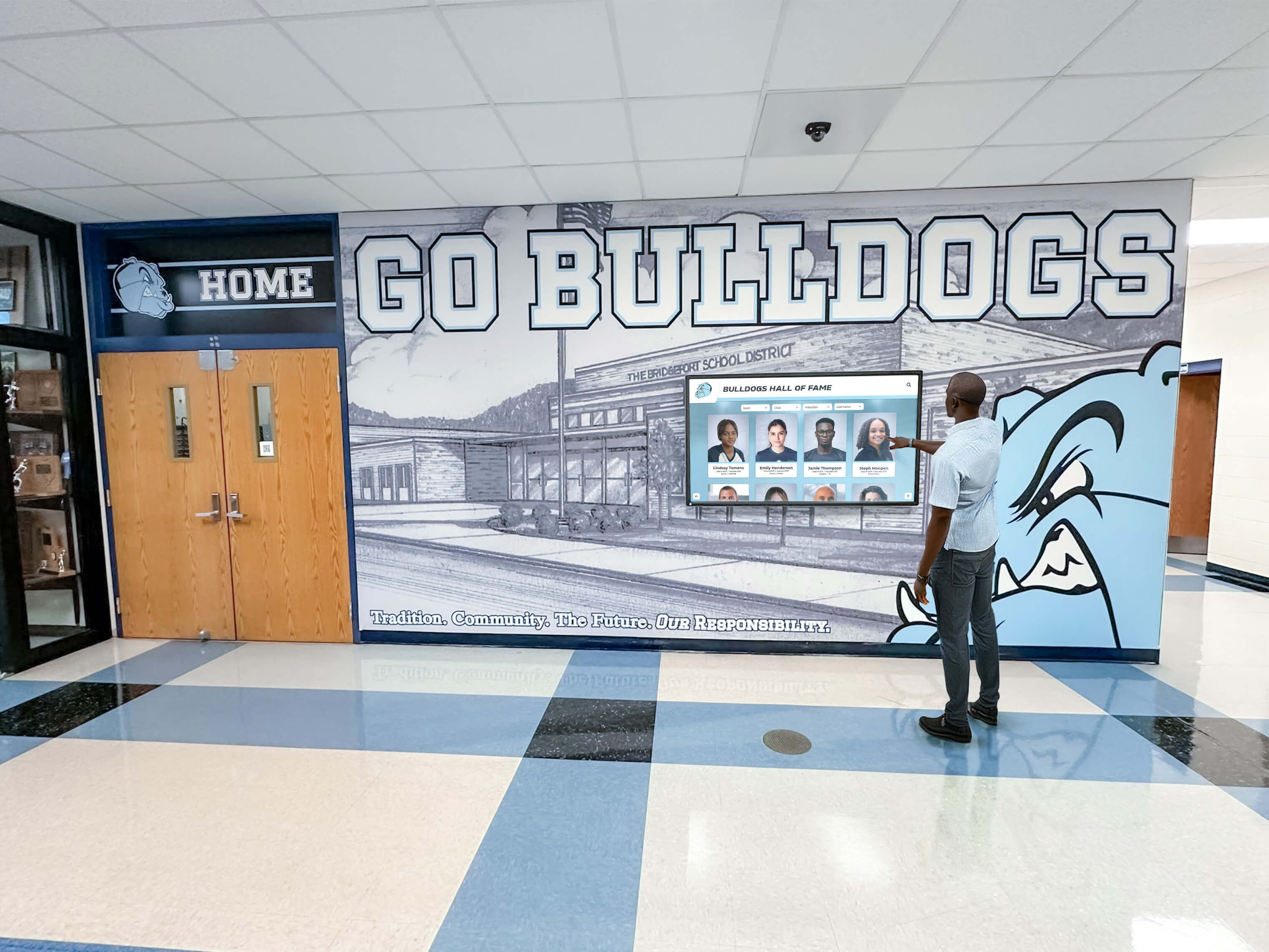
Touchscreen hall of fame displays deliver a fundamentally different experience. A visitor approaches a wall-mounted screen, navigates by sport, era, or inductee name, and arrives at a full biographical profile with photographs, career statistics, video clips, and player testimonials—all in the same physical footprint as a single framed photo.
Digital systems accommodate unlimited inductees without physical expansion. They update instantly when new inductees are added or existing profiles need revision. They can present rich multimedia content—video tributes recorded at induction ceremonies, archival footage from championship seasons, recorded interviews with coaches reflecting on their careers—that no physical plaque can approach.
For programs that have already launched athlete halls of fame and are adding a coaches recognition component, digital platforms make integration seamless. The same display that surfaces athlete profiles by class year can surface coach profiles by sport and era, creating a unified program history rather than separate silos of recognition.
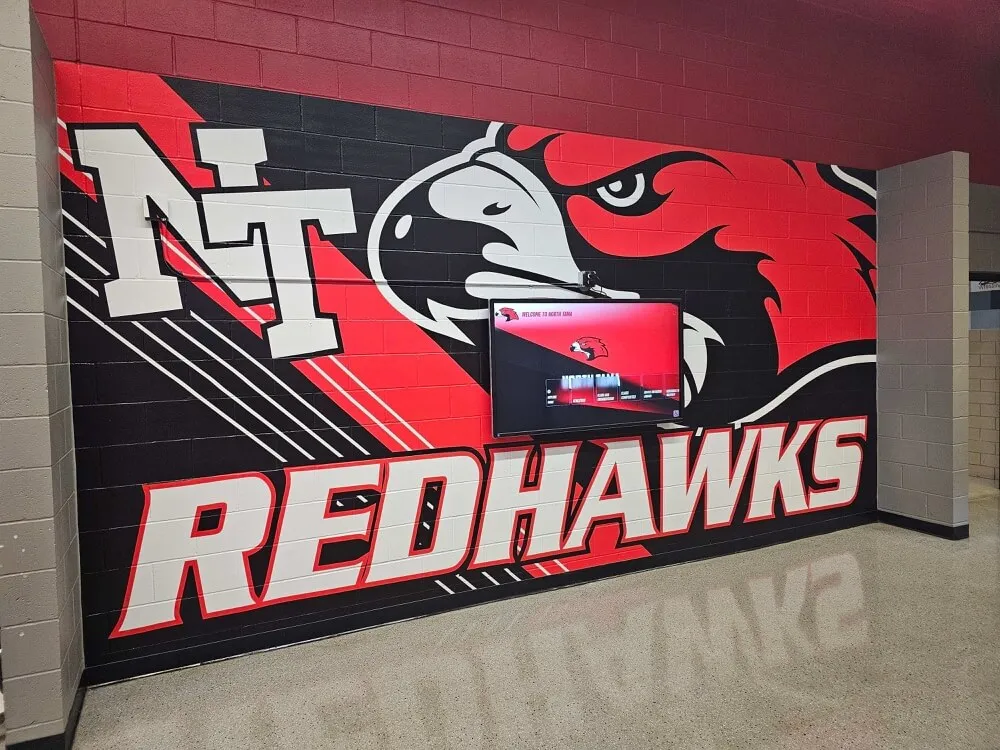
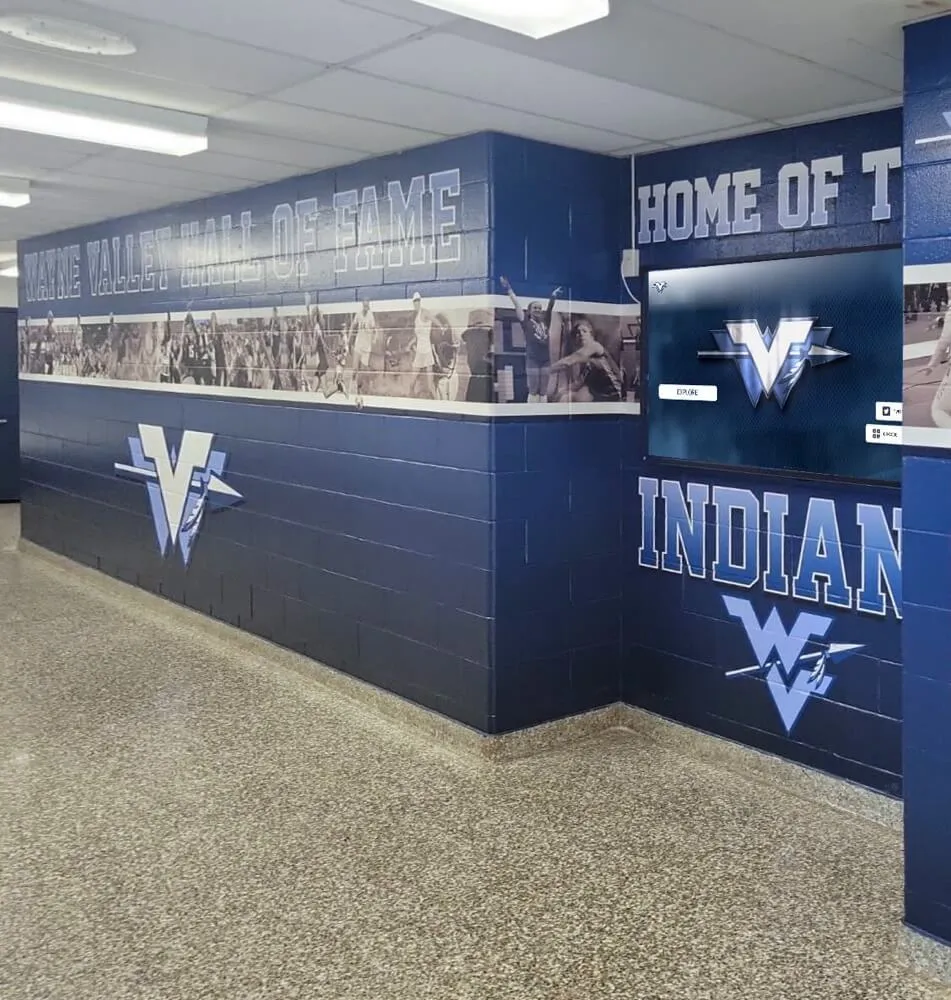
Digital signage solutions for schools walk through the full spectrum of display formats available, from lobby touchscreens and hallway kiosks to multi-screen installations that transform entire athletic corridors into living recognition environments.
Hybrid Approaches
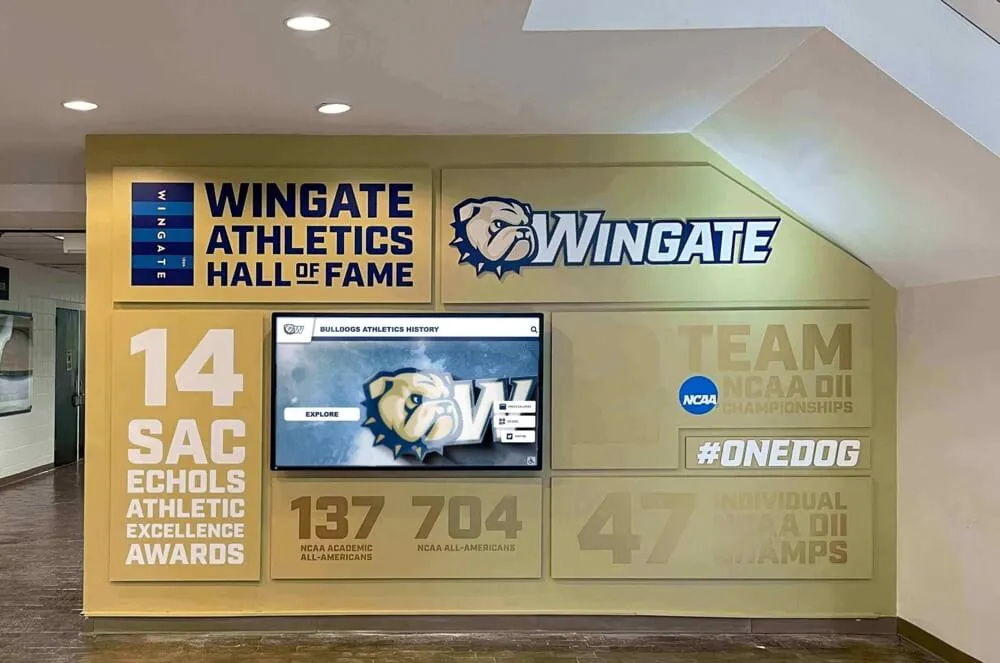
Many schools successfully combine physical and digital elements. Engraved plaques or framed portraits serve as the permanent, visible anchor—the element that commands attention from across a hallway and communicates institutional seriousness without requiring any technology interaction. A QR code embedded in the display links visitors to a comprehensive digital profile, delivering full biographical depth to anyone who wants it while maintaining the visual gravitas of traditional recognition.
This approach works particularly well for programs where community expectations lean traditional but administrative teams recognize the limitations of purely physical systems as programs grow.
What to Include in a Coach Hall of Fame Display
Core Profile Elements
Every coach hall of fame display entry, regardless of format, should include these fundamentals:
Professional photograph: A formal portrait works for most displays, but action photographs—a coach on the sideline during a championship game, at the whiteboard during a timeout, celebrating with athletes—often tell richer stories. If historical photographs exist from early career years, including them alongside more recent images documents the full arc of the coach’s tenure.
Career record: Win-loss record, conference championships won, state tournament appearances, and any national recognition provide the statistical foundation for the recognition. These numbers should be accurate and verifiable—errors in a public hall of fame display damage institutional credibility and can cause lasting harm to the honoree.
Years of service: The full tenure at your institution, including any prior stops at feeder programs or assistant coaching roles, provides context for the career’s scope and the relationship between the coach and the school.
Career biography: A narrative summary of 300–600 words—longer for particularly significant coaches—covering the coach’s background, program-building achievements, signature seasons, coaching philosophy, and lasting contributions to athletes and the sport. The best biographies are written for readers who may not remember the coach personally, supplying context alongside celebration.
Notable achievements and awards: Conference, state, and national coaching awards; milestone win celebrations; inductions into other halls of fame; career statistical benchmarks. These achievements situate the coach’s career within the broader landscape of their sport.
Enhanced Content for Digital Displays
Digital platforms unlock content categories unavailable to physical displays:
Video tributes: Recorded tributes from former players, athletic directors, and community members. Brief compilation videos of championship moments, milestone victories, and career highlights. Recorded interviews where the coach reflects on career defining moments, coaching philosophy, and the athletes who shaped their approach.
Photo galleries: Decade-by-decade collections documenting program evolution, team championship photographs, sideline action, and community events. Historical photographs sourced from yearbooks, school archives, and alumni collections can fill significant gaps in early-career documentation.
Player testimonials: Written or video quotes from former athletes describing specific ways the coach influenced their development. These testimonials humanize statistical achievements and provide the emotional texture that transforms recognition from a name on a wall into a genuine tribute.
Related recognition links: Connections to championship team profiles, athlete hall of fame members who played under the coach, and related program milestones help visitors understand the coach’s role within the broader program narrative.
The most effective digital coach hall of fame displays are built on the same principles that guide teacher and educator award showcase programs—detailed recognition that honors the full scope of a person’s influence rather than reducing their career to a headline statistic.
Location and Design Considerations
Placement Strategy
A coach hall of fame display placed where no one walks past it achieves little. High-traffic locations—main school entrances, athletic hallways connecting gymnasium and fieldhouse spaces, corridors outside coaching offices, lobby areas adjacent to varsity locker rooms—maximize daily exposure and create the ambient recognition that keeps coaching history present in institutional culture.
Programs with multiple sports benefit from displaying coach recognition near sport-specific venues: football coach profiles near the stadium entrance, swimming coach recognition in the aquatics center lobby, basketball coach honors in the gymnasium hallway. Sport-specific placement creates natural discovery moments when coaches, athletes, and families visit facilities for games and practices.
Design Consistency with Athlete Recognition
A coach hall of fame display that uses radically different visual design from the existing athlete recognition system creates a fragmented experience. Consistent color palette, typography, photograph treatment, and framing language communicate that coaches and athletes are part of the same institutional story rather than two separate recognition programs awkwardly coexisting.
If athlete profiles use school colors, mascot imagery, and sport-specific iconography, coach profiles should follow the same visual framework. If athlete entries are organized chronologically by graduation year, coach entries might organize by sport and tenure period—different criteria, but consistent visual treatment.
Accessibility and Interaction Design
ADA compliance matters regardless of display format. Physical displays should include appropriate mounting heights and lighting. Digital touchscreens require proper mounting height for visitors using wheelchairs, sufficient contrast ratios for visual accessibility, and navigation structures that work without requiring precise touch precision.
For interactive displays, designing touchscreen experiences that maximize visitor engagement requires thinking about the full range of visitors—from students using the display daily to alumni returning for the first time in decades who need intuitive navigation without a learning curve.
Selection Criteria for Coach Hall of Fame Honorees
The credibility of any hall of fame depends on the rigor of its selection process. Ambiguous criteria, inconsistent application, and selection decisions that appear driven by personal relationships rather than merit undermine confidence in the entire recognition program.
Core Evaluation Categories
Competitive achievement: Win-loss record and winning percentage; conference, regional, and state championships; tournament appearances and deep playoff runs; season records and program milestones. These quantitative measures provide the objective foundation for evaluation.
Program building: The condition of the program when the coach arrived versus when they departed tells a story that raw win totals sometimes obscure. A coach who inherited a program with no facilities, no culture, and no recruiting base—and built it into a consistent playoff contender over twenty years—may deserve recognition that a coach who inherited a dynasty and maintained it does not, even if the second coach’s win total is higher.
Player development: College scholarship placement rates; athletes who went on to coaching or athletic administration careers; former players’ testimonials about the coach’s role in their personal and professional development. The best coaches produce outcomes that extend far beyond the scoreboard.
Character and institutional representation: How the coach represented the school in difficult moments, sportsmanship under pressure, relationships with officials and opposing programs, and behavior during seasons that didn’t go according to plan. Character criteria should be documented and applied consistently rather than selectively invoked to exclude otherwise qualified candidates.
Longevity and loyalty: Length of service at the institution, including difficult periods when departing for a larger program would have been easy. Coaches who build careers in one place—who turn down offers to stay and continue building—demonstrate a form of institutional commitment worth honoring explicitly.
Following recognition program best practices ensures criteria are documented, communicated publicly, and applied consistently across inductee classes—the foundation of long-term program credibility.
Eligibility Requirements
Most credible coach halls of fame require candidates to have completed their active coaching career (or, for larger programs, their tenure at the specific institution) before becoming eligible. Waiting periods of three to five years allow recency bias to settle and give selection committees the perspective to evaluate careers fully rather than reacting to the momentum of a recent championship.
Character standards should address both historical conduct and post-departure behavior. Many programs include provisions allowing the committee to delay induction for coaches with pending investigations or active conduct concerns.
Waiting period: 3–5 years after departure or retirement.
Service minimum: Most programs require a minimum of 5–10 years of service at the institution, preventing recognition of coaches who passed through briefly even if they achieved immediate success.
Nomination requirements: Nominations should be open to any member of the community—athletes, alumni, current staff, parents, and community members—and should require documented justification rather than simply a name and sport.
Running the Nomination and Induction Process
Annual Nomination Cycles
Consistent annual cycles—nomination windows in the fall, selection committee deliberations in winter, public announcements in spring, and formal induction ceremonies in fall of the following year—create predictable rhythms that the community learns to anticipate. Programs that run nominations irregularly or skip years create perception problems suggesting the program is dormant or poorly administered.
Nomination forms should capture complete information: full coaching record, years of service, championships achieved, nominations’ specific justification narratives, and contact information for references who can speak to non-statistical contributions. Standardized forms ensure the committee evaluates all candidates using the same information framework.
Selection Committee Composition
A credible selection committee draws from multiple stakeholder groups: the athletic director (or their designee), sport-specific coaches who can evaluate technical contributions, alumni representatives with historical perspective, community members who can assess broader impact, and ideally one or two former athletes who can speak to the player development dimension. Committees of seven to eleven members provide sufficient diverse perspective without becoming unwieldy.
Committee deliberations should be documented without being public. The rationale for each inductee—and for each non-inducted nominee—creates institutional memory that guides future committee decisions and provides consistent answers if community members ask why specific coaches were or were not inducted.
Induction Ceremony Planning
Induction ceremonies carry the weight that makes recognition feel earned rather than administrative. Ceremonies timed to high-visibility moments—homecoming weekend, the annual athletic banquet, a major rivalry game—maximize attendance and community awareness.
The ceremony itself should honor inductees through specific, personal tributes rather than generic resume recitations. Inviting a former player to deliver remarks about a coach’s specific influence—a moment of guidance during a difficult season, a coaching decision that shaped the player’s approach to competition decades later—transforms the ceremony from acknowledgment into genuine tribute.
Sports memorabilia and achievement display strategies offer additional ideas for incorporating physical artifacts—championship game balls, milestone trophies, signed equipment—into the induction ceremony and display in ways that anchor the recognition in tangible history.
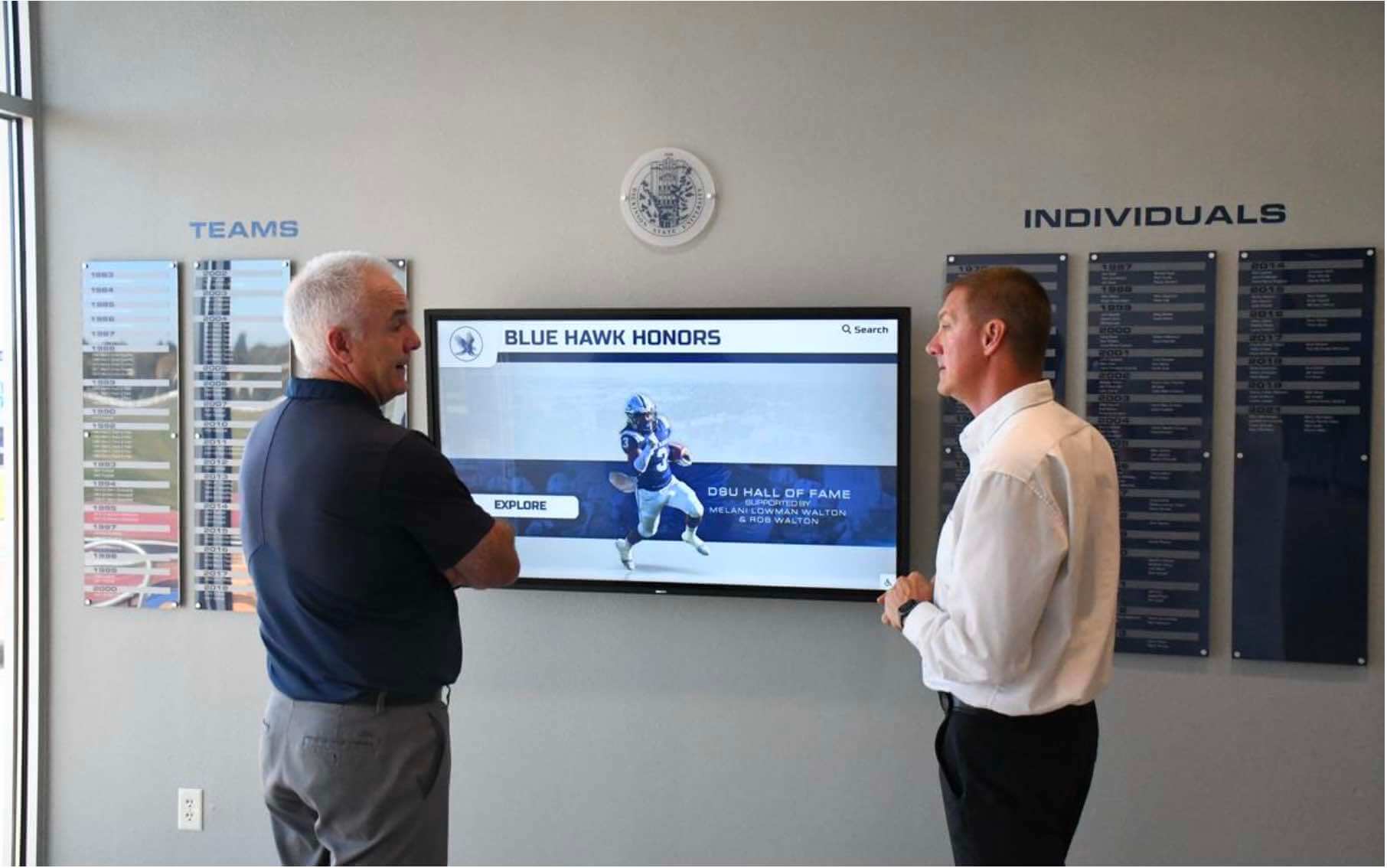
Building a Digital Coach Hall of Fame Display
Why Digital Works Better for Growing Programs
The argument for digital coach hall of fame displays becomes more compelling as programs grow. A school launching its coaches recognition program with five inaugural inductees can manage beautifully with framed photographs and engraved plaques. A school that has been running the program for twenty years with forty inductees—and adds two to four more annually—faces a fundamentally different problem.
Physical displays run out of wall space. Schools face choices between removing old plaques to make room for new ones, expanding into adjacent spaces not originally intended for recognition, or adding secondary displays that fragment the visual experience. None of these options is attractive, and all of them create maintenance and planning headaches that distract from the recognition program’s actual purpose.
Digital systems scale effortlessly. Whether recognizing 50 coaches or 500, the physical footprint of a digital display remains constant. Navigation structures accommodate expanding content through filtering and search rather than physical rearrangement. Profiles for coaches inducted in the program’s first year remain as accessible and prominent as profiles added last month.
Basketball alumni recognition displays illustrate how digital platforms handle the growing scope of athletic program history within a single display environment—an approach that translates directly to comprehensive coach recognition programs.
Content Management and Updates
Purpose-built digital hall of fame platforms provide content management systems allowing non-technical staff to add inductees, update profiles, and manage media without IT involvement. When a newly inducted coach wins a post-retirement coaching award, their profile updates the same day rather than waiting for a new plaque order. When archival photographs surface from a championship season twenty years ago, they integrate into the existing display immediately.
Cloud-based platforms extend this capability to remote access: athletic directors can update profiles from home, staff can upload content from phones during induction ceremonies, and alumni can see updated recognition from anywhere in the world through web-accessible versions of the same display content.
The process of digitizing historical records for hall of fame displays—converting yearbook photographs, press clippings, and archival coaching records into digital assets—is a one-time investment that pays dividends as programs grow and historical depth becomes one of the display’s primary draws.
Integrating Coach and Athlete Recognition
The most powerful hall of fame displays tell the complete story of a program rather than isolated individual achievements. A digital platform that connects coach profiles to the athlete profiles of inductees who played under that coach creates rich contextual links: visitors exploring the coach who won three state championships can navigate directly to the athletes who anchored those teams, then to the championship season summaries, then back to subsequent coaches who inherited the culture those championships built.
This network of connected recognition transforms the display from a list of honorees into a navigable program history—an experience that engages visitors for minutes rather than seconds and creates genuine emotional connection between current students and the institutional past.
Reviewing the best touchscreen hall of fame systems available helps programs identify platforms that handle integrated coach-athlete-team recognition as a native feature rather than an afterthought, ensuring the display grows into a genuine program archive rather than a static name list.

Practical Implementation Guide
Phase 1: Define Scope and Criteria (Months 1–2)
Begin by documenting answers to three foundational questions: Which sports will be included in the inaugural coach recognition program? What eligibility criteria will govern nominations? Who will sit on the selection committee and how will they be chosen?
These decisions should involve the athletic director, head coaches across major sports, and ideally a representative alumni voice. Decisions made without community input often face credibility challenges during the first induction cycle. Documenting criteria publicly—in program communications, on the school’s athletics website, and in nomination materials—establishes accountability and manages expectations before the selection process begins.
Phase 2: Launch Nominations and Select Inaugural Class (Months 3–5)
The inaugural inductee class sets the standard for the entire program. Too small a class, and the program launches with an underwhelming ceremony; too large, and the selection criteria appear to have no meaningful threshold. Most programs aim for three to eight inaugural inductees representing diverse sports, eras, and achievement types—enough to establish the program’s scope without diluting its significance.
For athletic directors managing this process alongside full athletic department responsibilities, creating clear nomination timelines, standardized forms, and documented committee procedures reduces the administrative burden significantly and makes subsequent annual cycles substantially easier to run.
Phase 3: Gather Content and Build Profiles (Months 5–8)
Content development is typically the most time-intensive phase of launching a coach hall of fame display. Each inductee profile requires accurate career statistics (often requiring archival research), biographical narrative (often developed through direct interviews with the coach and former players), and visual assets (requiring photography coordination and archival image sourcing).
Direct outreach to inductees, former players, and institutional archives yields the most compelling content. Coaches who are still living can participate in the process, reviewing biographical drafts, providing additional context, and contributing personal photographs that would otherwise be unavailable. Former players contacted through alumni networks often provide the most emotionally resonant testimonials and frequently share personal photographs from their playing days.
Phase 4: Install Display and Launch Program (Months 8–10)
Whether physical or digital, display installation should be completed with sufficient lead time for testing before the induction ceremony. For digital displays, this means loading all initial content, testing navigation flows, verifying multimedia playback, and training staff on content management systems. Technical issues discovered during the ceremony itself—screens that won’t load, navigation that doesn’t respond—create lasting negative impressions of a program designed to create lasting positive ones.
The induction ceremony launch should be treated as a significant institutional event with appropriate communication, invitations to inductees’ families, media outreach, and documentation through photography and video. First-year ceremonies set expectations for all subsequent cycles and establish the ceremonial culture that gives the honor its meaning.
Conclusion
A dedicated coach hall of fame display is more than a wall of photographs. It is a permanent institutional statement about what kind of achievement gets remembered and what kind of service gets rewarded. Programs that invest in meaningful coach recognition discover that it pays dividends across multiple dimensions: it attracts and retains quality coaches who know their work will be honored; it deepens current athletes’ connection to program traditions they are now responsible for continuing; and it engages alumni who remember the coaches being honored and reconnect with the institution through that recognition.
The format matters less than the commitment to doing it well. Whether traditional plaques, digital touchscreens, or a carefully designed hybrid, the coach hall of fame display that succeeds is the one built on credible selection criteria, comprehensive profile content, and genuine institutional pride in the people who built the program from the inside.
Ready to build a coach hall of fame display that will honor your program’s legendary coaches for generations? Explore how Rocket Alumni Solutions creates interactive touchscreen displays and digital recognition systems purpose-built for schools and athletic programs—combining coach, athlete, and team recognition into a single unified platform that scales with your program’s history.